


 134 / 210

[
] 132
C
onfronting
F
amily
P
overty
ing space in the fisheries production system is a matter of
concern with implications on household decision-making,
food security and the social perception of women. This
needs to be adequately addressed in policy measures.
Irrespective of the state of technology, fisher families are
considered as vulnerable groups due to the multiple risks
associated with their occupation (seasonality, market risks,
occupational hazards); location (high exposure to natural
hazard); asset specificity (lack of education, other employ-
able skills, land) and lack of social safety (poverty, absence of
steady income, congestion in fishery space). Therefore, ensur-
ing the sustainability of fisher families has remained a difficult
but not insurmountable challenge.
Recent initiatives in the region are trying to address this
challenge by adopting multi-pronged strategies such as
extension of social safety nets to fishers (India, Bangladesh),
women’s empowerment and marketing support (India, Sri
Lanka), access to alternative sources of finance such as micro-
finance, hedging against market risks (Bangladesh, India, Sri
Lanka) and the introduction of new technologies for better
income (Maldives and in and around the bay).
Livelihood issues
The increasing fisher population and resultant increasing
competition for fish remains the major issue for the sustain-
ability of fisheries livelihoods and the future of fisher families
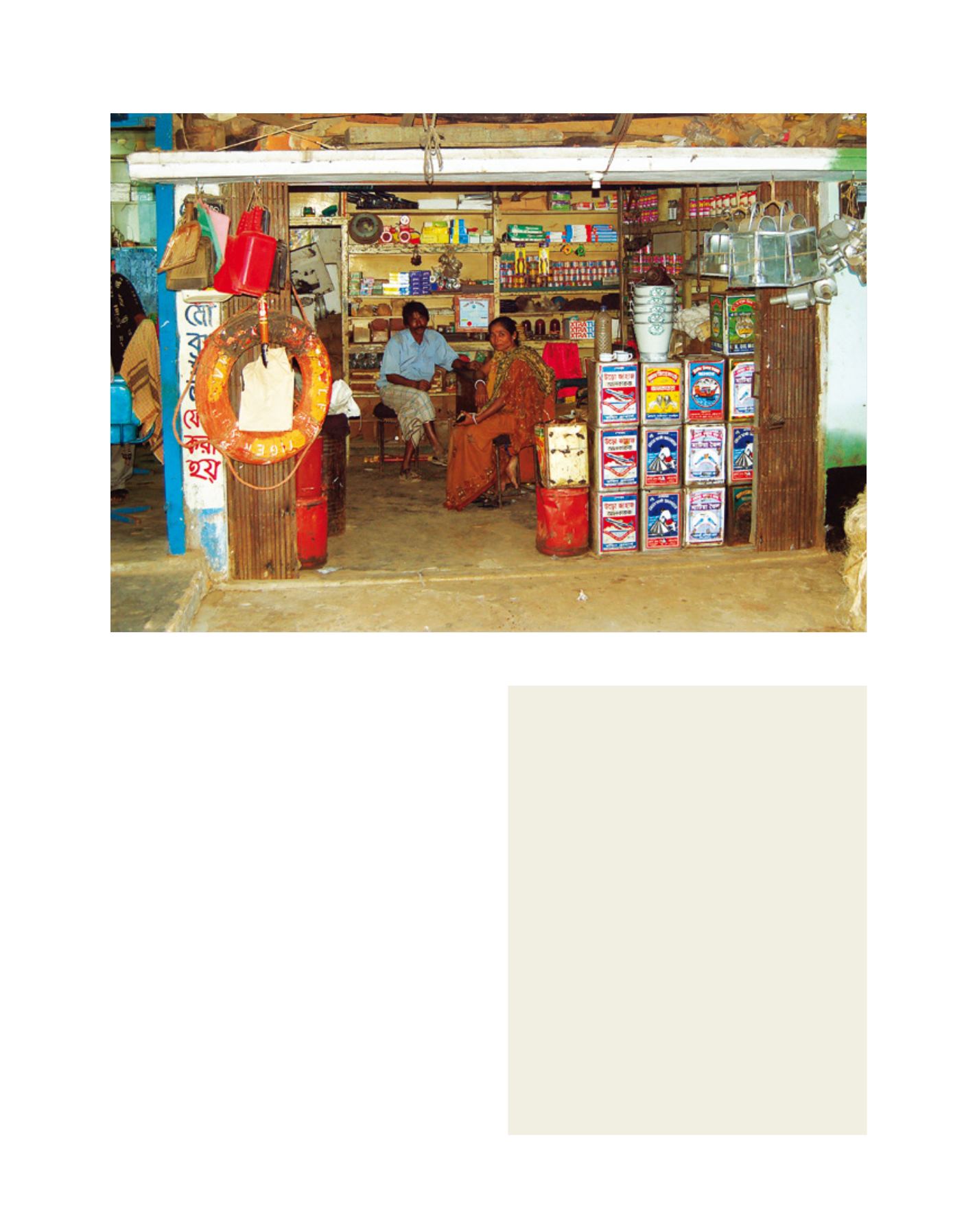
A fisher couple in their small shop selling fishing implements, Cox’s Bazaar, Bangladesh
Image: S. Jayaraj
The multi-day fishers of Chakaria
Chakaria is a major fishing locality in the Cox’s Bazaar district
of Bangladesh. Fishers here usually work as crew in multi-day
mechanized fishing vessels, which camp for about six months in and
around the Sundarbans deltaic area. The fishers usually receive a
lump sum as advance payment for their engagement from the vessel
owner. The amount depends on their role in the fishing operation,
relation with the vessel owner, expected profits and revenues from
past operations. They hand this money to their families to cover the
cost of food and basic needs while they are away. The fisher’s food
and other needs are taken care of by the vessel owner.
Families back home, mostly women, children and elderly
members, often find this advance insufficient to meet the cost
of food, health and other expenses. In many cases, unforeseen
expenditure leads the families to borrow from local moneylenders
at exorbitant interest rates (30-60 per cent). They also maintain
credit accounts in local stores.
In a good year, fishers return with sufficient compensation to pay off
their debts and keep good standing within the community. However,
this security is extremely fragile. During a bad year, the families are
unable to repay their debts unless they have had a series of good years.
Therefore, they live in perpetual poverty with a high debt burden.
Families often face destitution if the earning member has an
accident or dies. In such cases, the family loses its creditworthiness
and is often driven out of the house by creditors. Since very few
earning opportunities are available for women, they are forced to
live on the mercy of the community and relatives and do odd jobs
such as fish vending, fish drying or farm work. Often, they end up
begging while their children leave school and work as labourers.