


 137 / 210

[
] 135
C
onfronting
F
amily
P
overty
no figures are available, most major fishing centres in
the region have three to four women’s SHGs involved in
various activities from fish vending, processing, seaweed
farming or making pickles to alternative options such as
animal husbandry, sewing and petty commercial activi-
ties. However, further hand-holding is required to make
the fisherwomen SHGs more market-savvy and improve the
market penetration of their products.
Like many other parts of the world, families in the WBOB
region also play a crucial role in shaping harvesting deci-
sions and effort level, as well as building the human capital
necessary for developing alternative skills to move outside the
fisheries sector. For example, the awareness levels of women
on safety at sea influence the preparedness of the men when
going fishing, as well as during emergencies.
An important step towards ensuring family sustainability
is to recognize the role of fisherwomen in the family. Apart
from the technological barriers mentioned above, fisher fami-
lies share a host of sociocultural barriers with rest of society in
the region. Therefore, the task is quite challenging. However,
designing institutions and workplaces in a women-friendly
way could be the first step towards empowerment. The role
of women in decision-making can also be boosted through a
better safety-at-sea regime in which women participate in trip
planning and preparation.
In fisheries management, there is a steady movement
towards inclusive decision-making processes with greater
community participation. Although, in practice, fisheries in
the region are still managed through a top-down approach,
with increasing community participation and feedback, more
enabling policies are now being formed.
The story of Badal Das
Badal Das, aged 31, from Jelepara Village in South Dhurang, Cox’s
Bazaar district, Bangladesh has been fishing for 15 years. During
the last four to five years he has fished in the Sundarbans area, on
the extreme west coast of Bangladesh. About 25-30 fishermen from
his village and neighbouring areas go fishing during September-
October, staying in the Sundarbans and adjacent areas for five to
six months before returning home.
“While we carry some medicines, getting proper medical attention
in case of emergency is extremely difficult and on most occasions a
fisherman who meets with an accident or falls ill (mainly diarrhoea) is
left to die,” says Das. “Engine trouble is another major problem at sea.
Boats that develop engine trouble often drift and land in neighbouring
countries, where the fishermen land in jail and are released after
protracted interventions by the Government. Our boats do not have
lifesaving appliances or proper communication equipment to talk to
the boat owner or to our families. Some crew members carry radios,
which become our source of information. On most occasions, we
get the cyclone warnings through the radio sets, but at times these
warnings are received too late to move to sheltered areas.
“The boat owners are not willing to discuss our problems. If we
argue, we lose the job. There is no compensation if a fisherman meets
with an accident or dies. Our families go through hardships and do
odd jobs to make ends meet when we are out at sea. If we take a loan
from a moneylender, the interest rates are exorbitant. We do not get
loans from the bank since we cannot meet their conditions.
“I have three children. I will ensure that they get a good education and
settle well in life. I will neither allow my daughters to marry fishermen
nor allow my son to take up the fishing profession,” says Das.
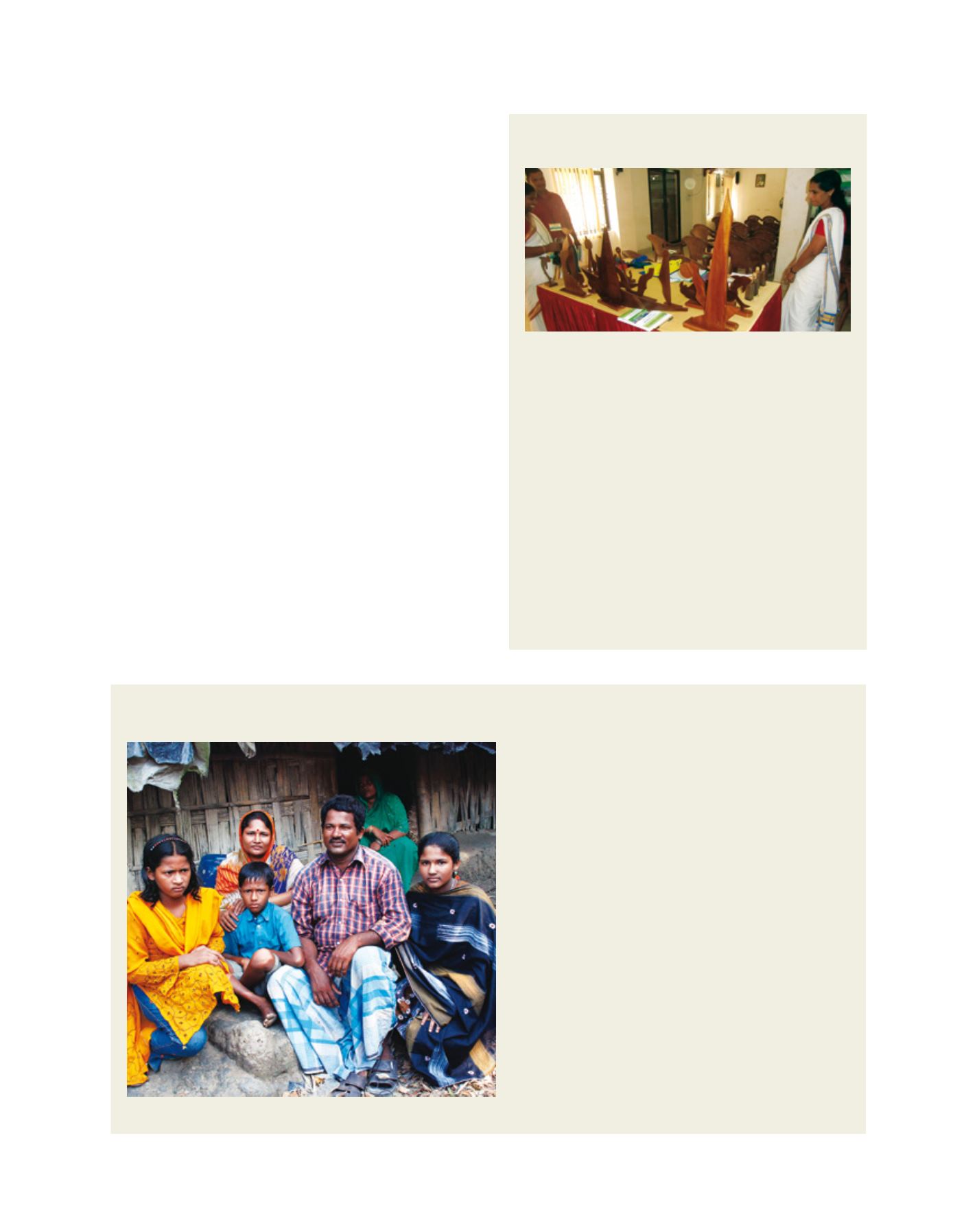
Badal Das and his family
Image: S. Jayaraj
Empowering the fisherwomen of Toothoor
The Association of Deep Sea-going Artisanal Fishermen, based in
Toothoor, Kanyakumari district, Tamil Nadu, India has 3,168 male
and 2,816 female members, categorized in three types:
• boat owners
• fishing crew
• fisherwomen, either from the family of the boat owner or the crew.
The fishermen fish in offshore waters and are out at sea for
months together, while the fisherwomen look after the family and
do petty business to make ends meet. Some 22-25 per cent of
the fisherwomen do fish vending and 5-6 per cent engage in petty
businesses like running tea shops or making fish products. The rest
are homemakers and engage in various social and religious activities.
For the past couple of years, the association has provided
training in skills such as making cloth bags, umbrellas, school bags,
assembling solar lanterns, making liquid fertilizer from fish waste
and handicraft items from sea shells. The objective is to empower
the fisherwomen with skills that can add to the family income when
their husbands are out at sea.
Handicrafts made by Toothoor fisherwomen, Kanyakumari, India
Image: Vincent Jain