


 129 / 210

[
] 127
Family structure and well-being
across Israel’s diverse population
Liora Bowers, Director of Policy, Taub Center for Social Policy Studies in Israel
C
onfronting
F
amily
P
overty
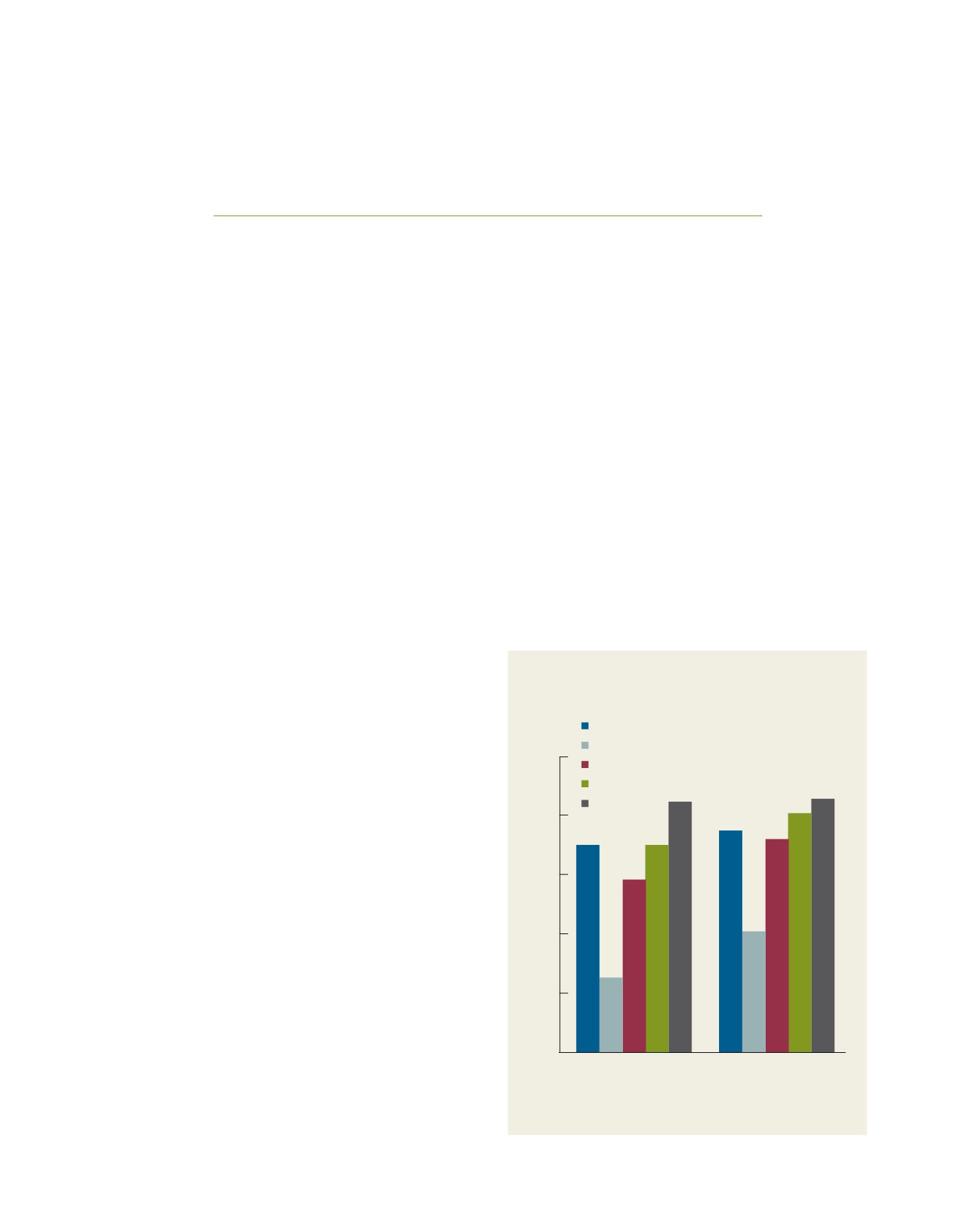
Female labour participation rates by presence of
children in the home and education
Source: Haya Stier and Efrat Herzberg, Taub Center (2013)
I
srael represents a unique blending of a very family-
oriented society with a developed, modern economy.
The country’s dedication to the nuclear family
concept is evident across a host of measures. According
to the Organisation for Economic Co-operation and
Development (OECD), Israel has among the highest
marriage rates in the developed world, at 6.3 marriages
per 1,000 inhabitants relative to the OECD average of
5.0 in 2009.
1
Divorce rates are also relatively low
2
and
Israeli Central Bureau of Statistics data from recent
years shows that only 4 per cent of couples live together
out of wedlock, as compared to 10 per cent in the United
States and 27 per cent in Sweden.
3
The importance of children in Israeli life is reflected in the
country’s birth rates, which are the highest in the developed
world (3.0 children per woman of childbearing age rela-
tive to the OECD average of 1.7 in 2010).
4
While Central
Bureau of Statistics data shows that the ultra-Orthodox
(Haredim) and Arab-Israelis have particularly high birth
rates, secular Jewish women also tend to have more chil-
dren than women in other developed countries.
5
Israel’s
high marriage and low divorce rates mean that relatively
few children are raised in single-parent homes, although
this figure has been rising in recent times.
6
A confluence of possible factors can help explain these
family dynamics.
7
First, the religious values prevalent in
Israeli society promote fertility. A 2010 Central Bureau of
Statistics survey indicates that over half of the Jewish popu-
lation considers itself ‘traditional’ or even more religious,
8
and a majority of Arab-Israelis, which comprise about one-
fifth of the country’s population, are Muslim and fairly
traditional. Furthermore, many of the immigrants to Israel
in the early decades following its independence came from
North African and Middle Eastern societies characterized
by large families and strong family ties. Finally, sociologists
have also suggested that Israel’s continuous conflict with
Arab neighbours strengthens family ties, while mandatory
military service not only means that children depend on
their parents until a later age, but also that some parents
have more children than they otherwise would because
of the inherent dangers. Various factors such as relatively
young average marriage ages, older age for beginning
higher education studies and high housing costs often lead
young Israeli adults to continue relying on their parents
for assistance.
Alongside supportive cultural and sociological factors,
specific government policies also promote high birth rates.
Israel is the only country in the world to provide essen-
tially free, unlimited coverage of in vitro fertilization (IVF)
procedures for women up to age 45, for up to two chil-
dren. As of 10 years ago, Israel’s rate of IVF procedures was
almost double that of Iceland, the country with the second-
highest rate.
9
Although reduced substantially from their
very high relative levels in the 1990s,
10
child allowances
are received by every Israeli family with children under the
age of 17.
11
A 2010 OECD analysis shows that while child
benefits are common across developed countries, they are
limited based on income in many other countries.
12
Even as the nuclear family concept dominates in Israel, the
country is quite progressive in terms of labour force partici-
pation by mothers with young children. Employment rates
Secondary
Non-academic post-secondary
Academic
Less than secondary
All women
0
With children
No children
2011
20
40
60
80
100
Children under four years old in the home, women aged 25-44
72
26
60
72
87
77
42
74
83
88
Per cent