


 125 / 210

[
] 123
Ethical Family Income: ongoing support
for the most vulnerable families
Ms Luz Granier Bulnes, Vice Minister of Social Services, Ministry of Social Development, Chile
C
onfronting
F
amily
P
overty
O
f all the social phenomena affecting the quality of
life and the well-being of the population, poverty
is one of the most important. It is a complex
phenomenon which means that all families living in
poverty face many shortages and find it extremely diffi-
cult to meet basic needs for items such as food, clothing,
housing, education and health care. In addition, being
poor is associated with the existence of other negative
phenomena also affecting quality of life, such as inequal-
ity and lack of opportunity.
One of the main goals of the Government of President
Sebastián Piñera is to combat poverty, eliminate extreme
poverty and create more social mobility in Chile. For this,
it is essential to create a society in which everyone can enjoy
minimum conditions for meeting basic needs and have an
opportunity to overcome social and economic dependency.
The creation two years ago of the Ministry of Social
Development, together with its main programme, the Ethical
Family Income, plays a leading role in this work, focusing on
the family as the central nucleus for poverty eradication and,
in particular, recognizing the crucial role played by women
in this regard. This social policy is built on the bedrock of
people’s freedom and accountability. It is the people, and not
the state, who must reach their own decisions and choose how
to move forward; people are the leading players confronting
this great challenge.
The Ethical Family Income is therefore a partnership
between families and the state to enable vulnerable people and
families, by their own efforts and commitment, to overcome
their situation of extreme poverty. It is an innovative policy
designed to empower families to take control of their lives and
to enhance the role of women and employment.
This programme promotes access to better living condi-
tions. Through a system of comprehensive and ongoing
support and personalized work with the most vulnerable fami-
lies and people, the Ethical Family Income tries to promote
family development, self-sufficiency and insertion in the
world of work. This support includes the provision of bonuses
to reward achievements and performance of duties associ-
ated with family goals, in the areas of health, education and
employment. As a result, families can emerge from their situ-
ation of poverty in a dignified and sustainable manner. Today,
over 30,000 families are participating in this programme.
The Ethical Family Income is a combination of monetary
payments, skills building and mentoring. This dual approach
relieves the most immediate effects of poverty, not only by
providing monetary payments but also by addressing the
underlying causes in a more structured manner. In doing so,
it enables members of the household to join the labour market
and thus increase the family income.
Plan of intervention
The intervention model has three levels:
• the Key Programme, which follows families while they are
participating in the programme
• the Social Support Programme
• the Labour Support Programme.
The Key Programme consists of an individual plan for
each family, based on the diagnosis of its initial situation
and defining the work strategy, support and linkage with
networks and programmes that can help in the present
situation. This survey is conducted by an official from the
Ministry of Social Development, who identifies the families’
resources and capacities and draws up an intervention strat-
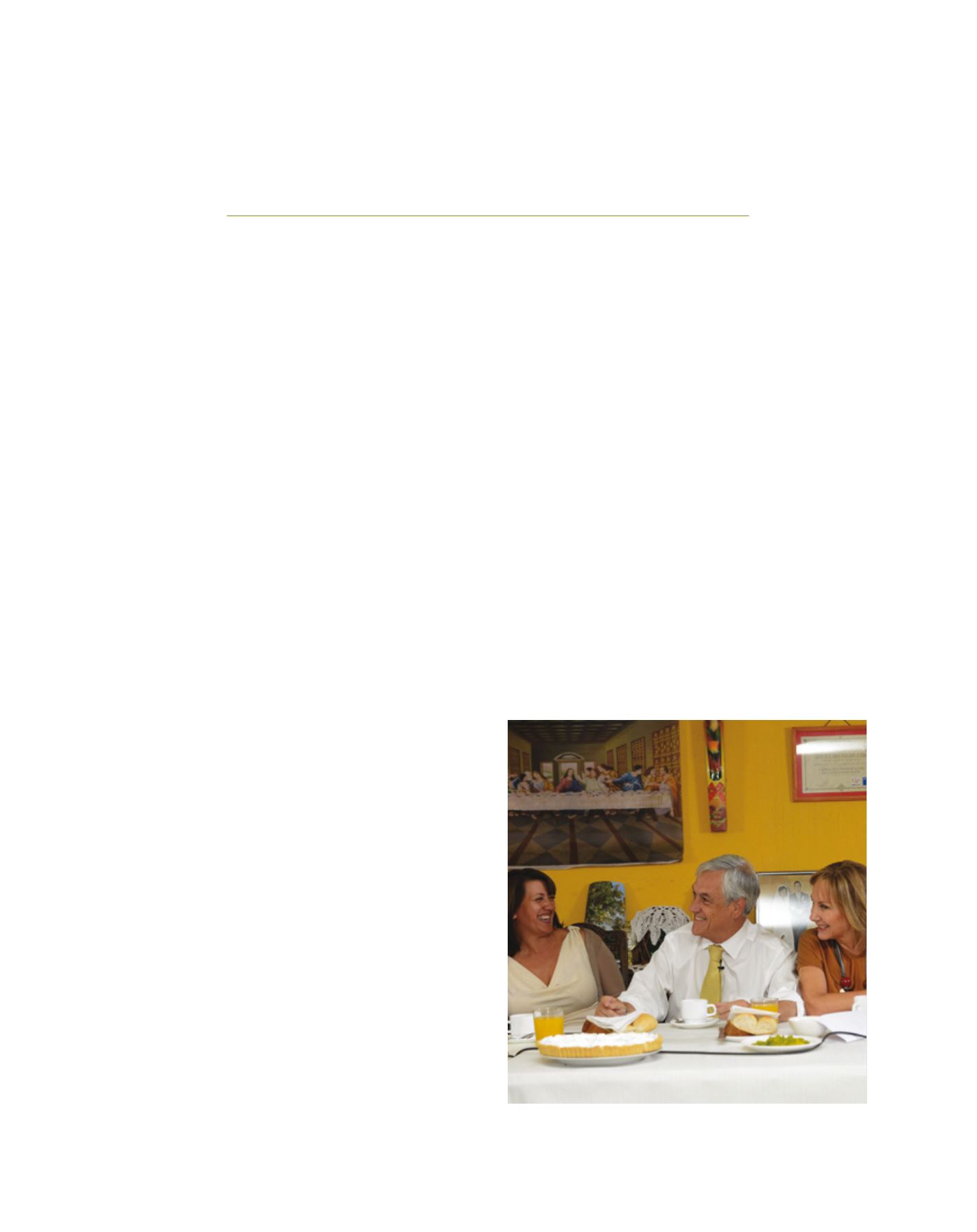
President Sebastián Piñera celebrates with family number 3,500
participating in the Ethical Family Income programme
Image: Ministry of Social Development