


 121 / 210

[
] 119
Family-focused social protection in Indonesia:
a journey to address children’s vulnerability
Santi Kusumaningrum, Co-Director, Center on Child Protection, University of Indonesia
C
onfronting
F
amily
P
overty
2009
2010
2011
2012
Poverty rate overall population
Poverty rate children urban area
Poverty rate all children
Poverty rate children rural area
20.7
13.4
17.4
14.2
20
12.5
16.5
13.3
18.6
11.4
15.1
12.5
17.8
11
14.5
12
Poverty rates based on the national poverty level
in Indonesia (per cent)
Source: SMERU-UNICEF, 2013
I
ndonesia is the fourth largest country in the world
by population, with vast cultural diversity, and the
sixteenth largest by landmass. It is also the home of
approximately 250 million people, a third of whom are
children. According to the 2010 census, that amounts
to more than 82.5 million individuals. Administratively,
Indonesia is an archipelago structured in 34 provinces,
close to 500 districts and municipalities, and around
70,000 villages. Needless to say, the country faces signifi-
cant geographical challenges.
After reaching its independence in 1945, Indonesia transi-
tioned into democracy in 1998 and has been institutionalizing
stronger and more open government ever since, including
implementing decentralization. Identified as one of the emerg-
ing Asian giants, Indonesia had been successful in maintaining
its stable economic growth rate at an average of 6 per cent
per year, and has been categorized as a lower-middle income
country. It has survived some global and regional financial
crises as well as having to manage frequent medium to large-
scale natural disasters. Indonesia is also leading some of the
most notable global agenda and human rights platforms.
The most recent one is co-chairing the high-level panel that
is shaping the post-Millennium Development Goal global
agenda. In less than 20 years, for those who believe in the
prediction, Indonesia will also enjoy what demographers call
a ‘demographic window’. This is a 30-40 year period in which
the dependency ratio is at its lowest, th e fertility rate declines,
and the productive-age population dominates. Such a window
can reportedly give countries the benefit of increased savings
and human capital investment.
Despite all those important accomplishments and leads,
poverty is lurking as one of Indonesia’s most critical challenges.
The impact of poverty might steer the whole country away from
achieving the desired development goals. It also potentially
prevents Indonesia from reaping the fruit of the said demo-
graphic bonus. Around 12 per cent of the population still live
on or below the national poverty rate, while nearly half the
population live on less than US$2 a day – a group considered
by the World Bank to be at high risk of falling into poverty. The
2011 Social Protection Program Data identifies more than 96
million individuals, almost 25 million of whom are children,
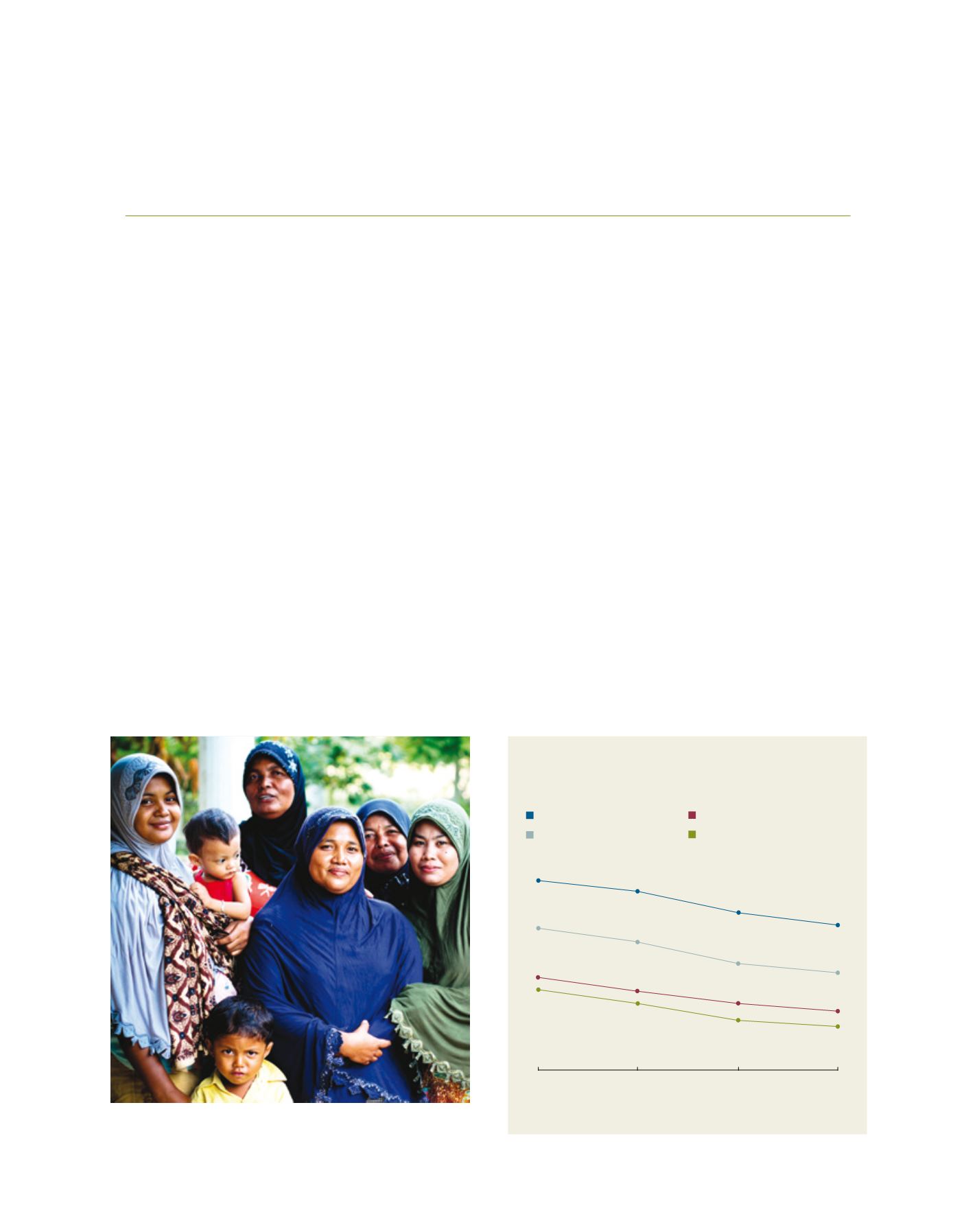
Indonesia’s social assistance programmes target families and individuals,
and are often conditional on child well-being
Image: Lindsay Stark