


 127 / 210

[
] 125
C
onfronting
F
amily
P
overty
This programme targets all those Key Programme participants
who are not working or studying, although they are eligi-
ble to do so by virtue of their age. Like the Social Support
Programme, it has a maximum duration of 24 months.
Monetary payments
The Ethical Family Income also includes monetary payments
or bonuses linked to three basic pillars: dignity, duties and
achievements.
The dignity pillar helps the most vulnerable families to have
a minimum income and fills the need for immediate support.
It thus provides ‘respite’ or ‘relief’ for all families living in
a situation of extreme poverty. Three types of payment are
involved: a family bonus, a personal bonus and other mone-
tary subsidies provided by the state such as the Clean Water
Subsidy and the Subsidy for Remaining in School. Families
participating in the programme are entitled to these payments
by virtue of their extreme vulnerability.
Whereas the family bonus is the same for all families partici-
pating in the programme, the amount of the personal bonus
varies. Together with the monetary payments received for
duties, it provides 85 per cent of the income needed by the
family to overcome its situation of extreme poverty. Thus the
amount of the personal bonus depends on the composition of
the household and whether the family receives other subsidies
from the state.
Both the family bonus and the personal bonus decrease over
time and are discontinued when families leave the programme
and stop receiving benefits.
The payments for duties are conditional on fulfilment of
certain specific commitments, particularly in the areas of health
and education, so as to encourage actions to overcome poverty
situations in a structured and permanent manner. In other
words, this type of conditional payment rewards family commit-
ment and accountability and requires health check-ups in the
case of children under six years of age (Well Child Check-up)
and a school attendance record of 85 per cent or higher in the
case of children 6-18 years of age (School Attendance Bonus).
Lastly, payments for achievements are monetary payments
to the most vulnerable people for important achievements in
various areas. They reward effort and attainment of targets for
permanently overcoming poverty in fundamental areas such
as education and employment. They include the Bonus for
School Achievement, awarded for children under 18 years of
age in the fourth and fifth grades of secondary school who are
in the top-performing 30 per cent in their class. In addition, the
Female Employment Bonus recognizes and rewards the efforts
of women and female heads of household of the most vulner-
able families in Chile who enter the formal labour market.
As stated above, the Ethical Family Income is a programme
for families living in extreme poverty in Chile, who represent
about 2.8 per cent of the population. However, the payments
for achievements are being extended to reach the most vulner-
able 30 per cent of the population, so that those who are
covered are eligible for the Female Employment Bonus and
the Bonus for School Achievement.
The extended coverage of these two benefits will include
a borderline group of people at serious risk of falling into
poverty, who are penalized for their social and economic
advances by no longer receiving benefits because they are
not considered to be poor. These bonuses give recognition
to these families and motivate them to continue their efforts.
They also reward their success, since good performance at
school requires effort from the entire family and the incor-
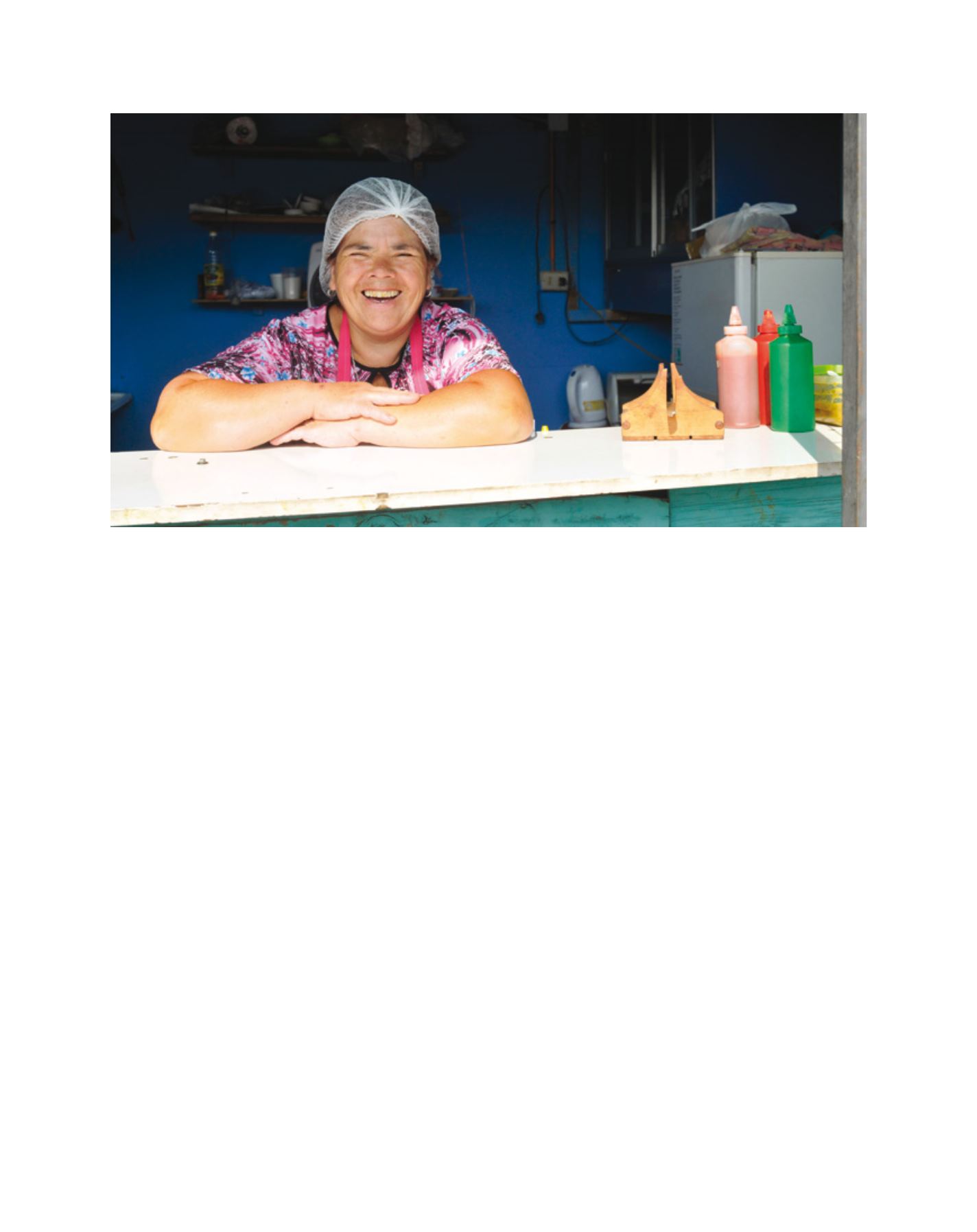
A recipient of the Female Employment Bonus, which rewards the efforts of women from the most vulnerable families who enter the labour market
Image: Ministry of Social Development