


 128 / 210

[
] 126
C
onfronting
F
amily
P
overty
poration of a female head of household in the world of work
also requires support and coordination from all members of
the family group.
One of the pillars of the Ethical Family Income aims to
enhance and recognize the role of women in combating
poverty within the family. For this reason, one of its essential
components is the Female Employment Bonus, awarded to
vulnerable female heads of household entering the world of
work. In addition, their employers receive a subsidy, creating
an incentive to recruit women in a situation of poverty.
In Chile, many single-parent households are families with
few resources, in which women face the challenge of provid-
ing for their families. Accordingly, in addition to encouraging
paid work outside the home, the Government has adopted a
series of public policies to support women’s work, includ-
ing extended hours and extended coverage for crèches and
kindergartens. The goal is to support the most vulnerable
families and allow them to work without neglecting their chil-
dren. Similarly, the Government is awaiting approval of draft
legislation on the provision of monetary support to families
with three or more children, which will boost the birth rate
and provide a network of social benefits enabling these fami-
lies to maintain a good quality of life.
As mentioned earlier, the Ethical Family Income also
highlights the value of education and work as basic tools for
overcoming poverty, always taking into account the compo-
sition and particular needs of each family. However, if we
want all families to have the same opportunities, it is crucial
to take into account their differences and specific require-
ments. In this regard, the programme is designed to improve
the quality of life of families, on the understanding that they
are the foundation of society and that, if they have access to
better opportunities and more benefits, they will be able to
improve themselves and thus build a better country.
As a Government, we are convinced that families can
achieve sustainable development over time only if they have
the knowledge and skills to increase their income, together
with state support and a range of opportunities helping them
to overcome poverty. We know that poverty is a challenge
facing not only the state, but also civil society. Above all, it is a
challenge for the families themselves who are in this situation,
since they are the ones who write their own story.
For this reason, our Government is also strongly commit-
ted to entrepreneurship, which is a powerful weapon against
poverty, allowing people to acquire skills and supplies to
develop a reliable source of income. In conjunction with the
Fund for Solidarity and Social Investment, we have encour-
aged programmes that give people the capital to purchase the
supplies needed to start up or expand a business, as well as
advice and guidance on the development of business plans.
Consequently, the Government has concentrated on achieving
a permanent form of poverty relief through a comprehensive
and high-quality programme that expands the definition of
vulnerability to include people who really need support from
the Government, through the Ethical Family Income.
With this programme and, importantly, with the participa-
tion and support of a sympathetic state, we hope to empower
families to know their capacities and skills and to make them
their best tools for permanently overcoming their situation of
poverty. This is the best legacy that we can leave as a govern-
ment, since the Ethical Family Income is not merely a welfare
policy. Its effect will be felt over time and will enable families
truly to surpass themselves, to improve their quality of life
and to leave poverty behind.
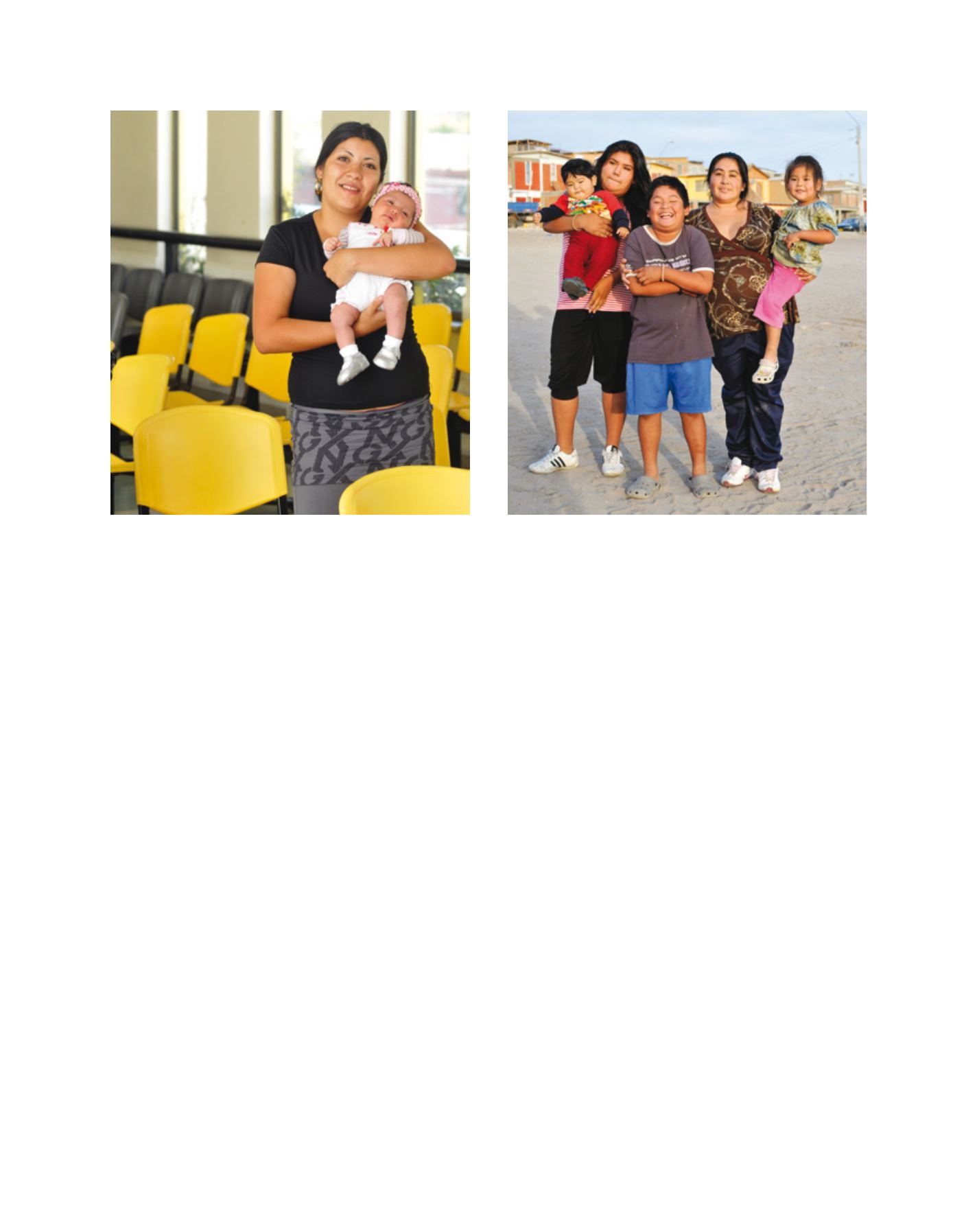
Recipients of the Well Child Check-up Bonus, one of the payments that
rewards commitment and accountability in Chile’s most vulnerable families
The Ethical Family Income programme empowers families like this one to
build their capacities and skills to permanently overcome poverty
Image: Ministry of Social Development
Image: Ministry of Social Development