


 109 / 210

[
] 107
C
onfronting
F
amily
P
overty
of Trainers Business Skills Programme for Rural Women and
the Wanjohi Farm for Internally Displaced Persons.
These projects support families by ensuring that financial
challenges are dealt with as much as possible. For instance,
Gatina and Maramba nursery schools were established in
the tea plantations in 1995 to provide early childhood
education for over 140 of the tea and coffee plantation
workers’ children in the Tigoni area. Tewa Training Centre
has targeted over 60 women and girls from financially chal-
lenged backgrounds in Kilifi County. Kimlea Girls Training
Centre was established in 1992 and offers technical skills
to around 50 girls annually from poor backgrounds and
mostly living in the Tigoni plantations. Kimlea Medical
Clinic was established in 2006, targeting many tea and
coffee plantation workers in Tigoni who had little or no
access to health care due to high levels of poverty. Over
10,000 people are annually treated in the clinic. CHEP was
initiated in 2009 to cater for the health needs of children
in the Limuru area, because lack of access to medical care
for many of the children in primary schools near Kimlea
Training Centre was leading to high levels of morbid-
ity. Currently 3,502 children have medical cover under
this programme. The Wanjohi farm was acquired by the
Kianda Foundation in 2008 to resettle internally displaced
persons (IDPs) who had been camping at Limuru following
Kenya’s post-election violence in 2007/8.The IDPs in turn
are repaying the cost of the land and on completion each is
issued with a title deed. For 230 families, a housing scheme
was begun in order to provide proper shelter for the IDPs as
well as a scholarship programme for primary and secondary
school children. In addition, water pipes and water tanks
were installed to provide clean water for the population.
The Educational Initiatives Trust promotes the Informal Sector
Business Institute (ISBI) and the Eastland Centre in Nairobi.
ISBI’s flagship course is the Youth Empowerment Project and a
Business Training Course for small-scale traders and entrepre-
neurs in the jua kali (informal sector). Since its inception 10
years ago, over 5,000 people have been trained in various skills.
Eastlands also doubles up as a cultural centre with after-
school programmes that cater for primary and secondary
school boys. They are mentored and helped with their
schoolwork and given study facilities. Often, the boys may
not have the time, space and facilities such as books, light-
ing, desk and chair to study as they come from poor homes.
Parents are also engaged in the education of their children
and come for meetings and special sessions organized at the
centre. Some receive bursaries from beneficiaries abroad
and manage to educate their children through high school,
tertiary colleges and even university.
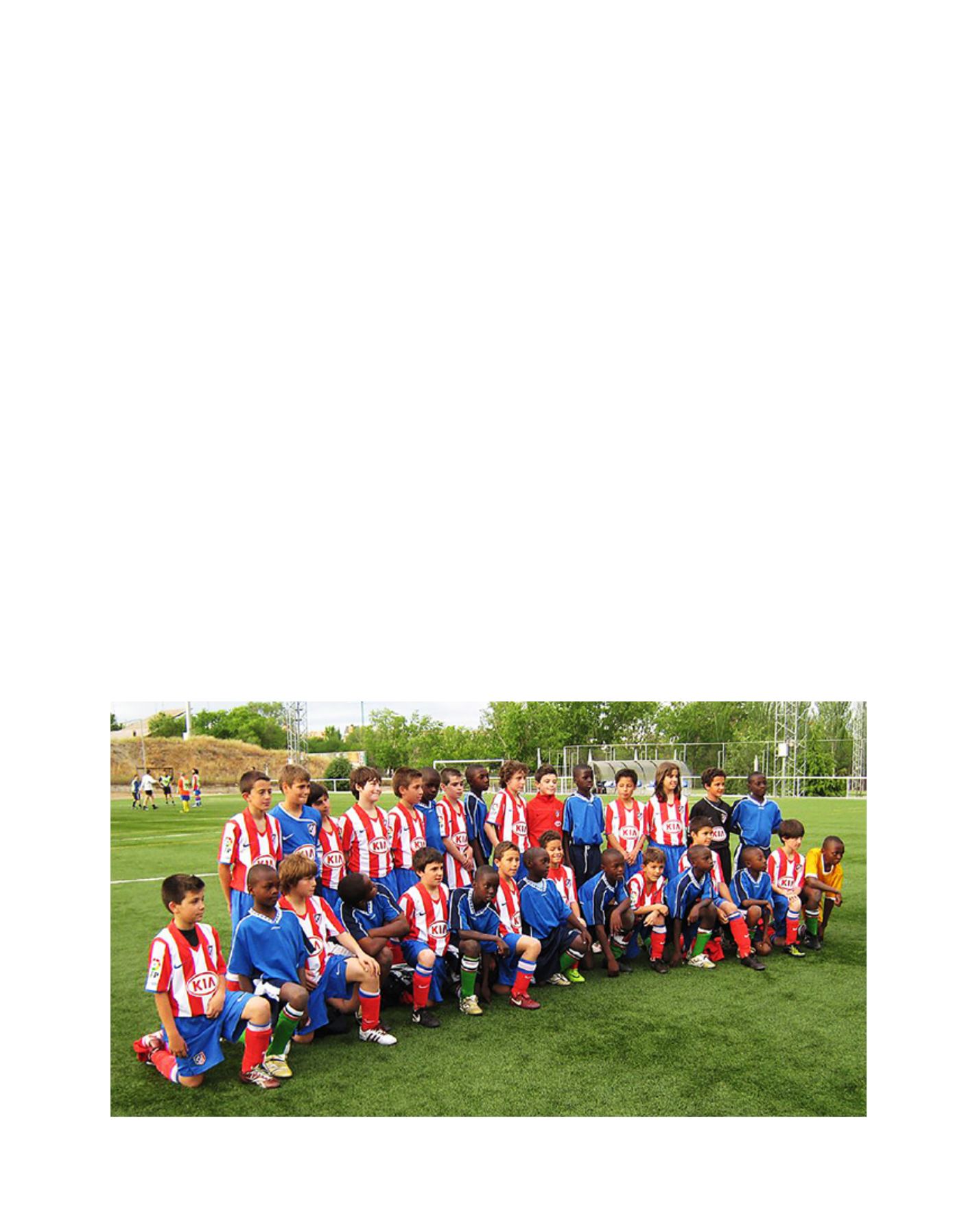
Eastlands Centre also started a soccer academy that will
hopefully grow to nurture talent and provide all-round
development. In 2009, some boys from the academy were
sponsored take part in a soccer trip in Madrid courtesy of
Deporte y Desarollo, an NGO in Spain.
The nine years of work was boosted significantly when VOFA,
in conjunction with the Strathmore Law School, hosted a prepar-
atory meeting for the United Nations International Year of the
Family in January 2014 in Nairobi. Many of those undertak-
ing initiatives on the family shared progress in the conference.
Aristotle observed that society and, by extension, politics are
natural institutions – and that both are an extension of one
fundamental natural institution: the family. It remains for VOFA,
Africa and the world to see how to duplicate these projects; then
we will truly be able to strengthen the family in Africa.
Boys from the ISBI soccer academy at the Eastlands Centre on their visit to Madrid in 2009
Image: VOFA