


 103 / 210

[
] 101
C
onfronting
F
amily
P
overty
0
1
2
3
4
5
6
1990
2010
Total
4.2
3.5
5.5
4.5
4.8
4.0
4.4
3.6
4.0
3.1
3.4
2.7
Quintile I
Quintile II
Quintile III
Quintile IV
Quintile V
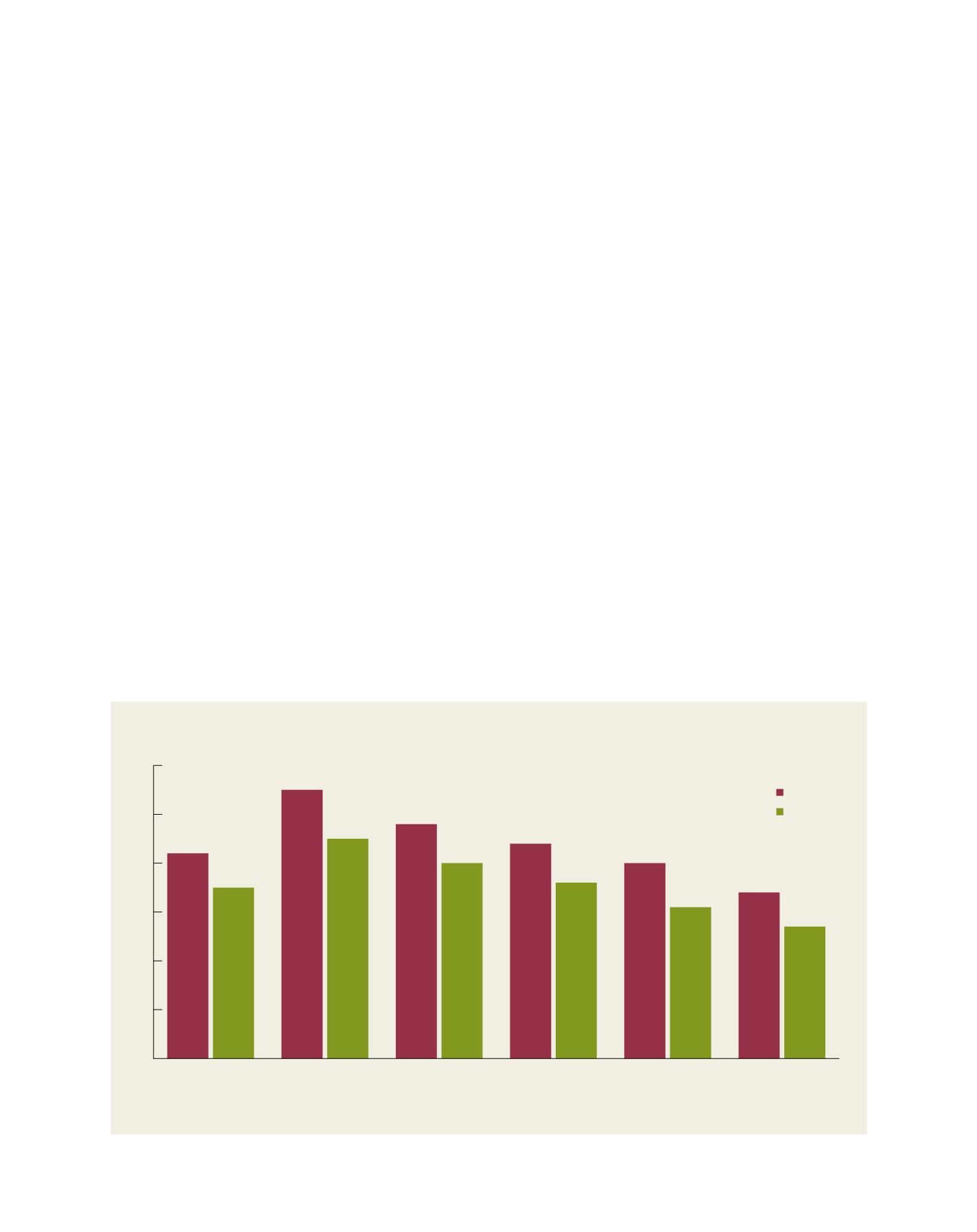
Latin America (18 countries): average household size, total and by income quintiles, 1990 and 2010
Source: ECLAC, on the basis of tabulations of household surveys in the region
on behavioural problems, language development and long-
term impacts on nutritional status as measured in height.
Despite these encouraging results, debates have emerged
regarding the limits of CCT programmes. One aspect relates
to the obstacles that some programmes have experienced in
trying to achieve their goals, both in terms of incorporating
the potential beneficiary target population and in compli-
ance with the commitments. In some countries, the physical
terrain and distances restrict the access of beneficiaries to
health and education services. In many other cases, weak
infrastructure has limited access to services and hampered
compliance with the commitments. A second point of
contention concerns the potential of CCT programmes to
generate sustainable long-term changes in the situation
of families, particularly to achieve gains in job placement
and employment. A related issue pertains to defining the
programme exit criteria.
A final area of concern is the gender biases that may be built
into the programmes by requiring that mothers be responsible
for ensuring compliance with the commitments, for attending
programme activities and for the administrative procedures
involved in receiving the monetary transfer. While earlier
studies indicated that CCT programmes empowered women
by giving them more economic autonomy and decision-
making power within the household, more recent evidence
suggests that the way in which programmes are structured
reinforces existing inequalities between men and women
around the distribution of paid and unpaid work within the
home. The heavy time demands imposed on mothers by the
programmes may also infringe on the time that they can
devote to other activities, namely paid work in the labour
market. This is problematic since the process of incorporating
women into the labour market in Latin America is imperative
for long-term poverty reduction, particularly among children
and adolescents. Female employment represents an important
contribution to total household income, contributions that in
many cases prevent the household from falling into poverty.
Although female labour force participation has increased
markedly in recent years in Latin America, women are
still almost exclusively responsible for domestic tasks,
including childcare and care of other dependents. This
overload creates a series of tensions that fall most acutely
on women of low-income households. Time use surveys
allow a comparison of the distribution of unpaid domes-
tic work carried out by men and women. These surveys
reveal similar patterns across the region. Indepedent of
household economic status, men dedicate considerably less
time to unpaid domestic work than women and this trend
varies little across income quintiles for men. In contrast,
poorer women spend more time on unpaid domestic work
compared to wealthier women, who in turn spend more
time on paid work. In terms of care provision specifi-
cally, both poor men and women spend more time on care
responsiblities than their wealthier counterparts, although
poor women do so at levels that are far superior to those
of poor men. Due to these realities, two levels of inequity
converge in the provision of childcare in Latin America:
gender and socioeconomic.
In many Latin American countries there are regulations
for the provision of childcare that apply mainly to women
employed in the formal sector, often based on the number
of employees in the company. As such, these regulations
often exclude women working in small and medium enter-
prises, and by definition women working in the informal