


 97 / 210

[
] 95
C
onfronting
F
amily
P
overty
The transnational family
The transnational family is a new family model. It can be characterized
by the geographical dispersion of a family because of the migration
of one or more of its members who, nevertheless, continue to keep
tight relationships across borders. Bryceson and Vuorela say that
transnational families are “families [where family members] live some
or most of the time separated from each other, yet hold together and
create something that can be seen as a feeling of collective welfare
and unity, namely ‘familyhood’, even across national borders.”
into a position where they can no longer decide over their situ-
ation. Once in the host country, the migrant has to establish a
new life, find a place to live, a job – and even when this is done,
things do not automatically get easier.
Two key points are worth mentioning. First, there is the
power of the economic dependency between the two sides
of the same family. For many families with a relative abroad,
remittances are the main source of income. Unfortunately,
with a growing trend of economic migration, some countries
are themselves becoming dependent on remittances, with
consequences for their economic stability, sustainability and
development. Dependency on a family member abroad can
trigger a vicious circle that can affect transnational family
life and its duration. During long separations, the family
inevitably changes shape. Some members may get married,
new babies are born, children grow into adults or adults
become too old to work. This entails changes in the needs of
the family and has implications for both the emotional and
economic relationship between members of a transnational
family. How do they establish when the needs of the family
back home have been met?
Second, it is not rare for migrant workers with poor
living and working conditions to feel ashamed and hide
their condition from the rest of the family back home. A
sense of guilt and/or an inability to provide may interfere
with communication, which can also be very difficult due
to material conditions between the two sides of the family.
Concerning communication between the two (or multi-
ple) locations where a transnational family has members,
we cannot ignore the important role played by mobile
phones and the Internet. Being able to contact a family
member in another country at any time has definitely
changed the way transnational families communicate. It
gives the possibility for more frequent contact and engage-
ment in bilateral and more private conversations, with a
huge impact on long-distance parenthood and care, and
its perception. However, this does not work for everyone.
Those who live in areas where there isn’t a proper commu-
nication infrastructure, or who have not been empowered
by learning how to use such devices, are unable to exploit
this potential. Therefore, those families, which are often
the most vulnerable, will have to use more traditional
communication tools, which are by far more expensive.
Low literacy, little information about their rights or simply
poor knowledge of the local language in the host country are
also common barriers in accessing services that are necessary
for transnational families, such as money transfer or ship-
ping services. The situation becomes even more complicated
when the family member is undocumented.
For transnational families, access to employment is funda-
mental because it is the key for a regular residence permit.
However, finding a job can often be difficult for a migrant,
especially when it comes to the recognition of foreign degrees
and diplomas and ability to work in the host country’s local
language. Therefore, migrants are often forced into low-skilled
jobs and into the black market. Moreover, work contracts for
migrants are mainly temporary. Labour market policies and
regulations often limit the possibilities for amelioration of
employment conditions of migrants, including difficulties in
accessing stable jobs. In the European Union (EU), for example,
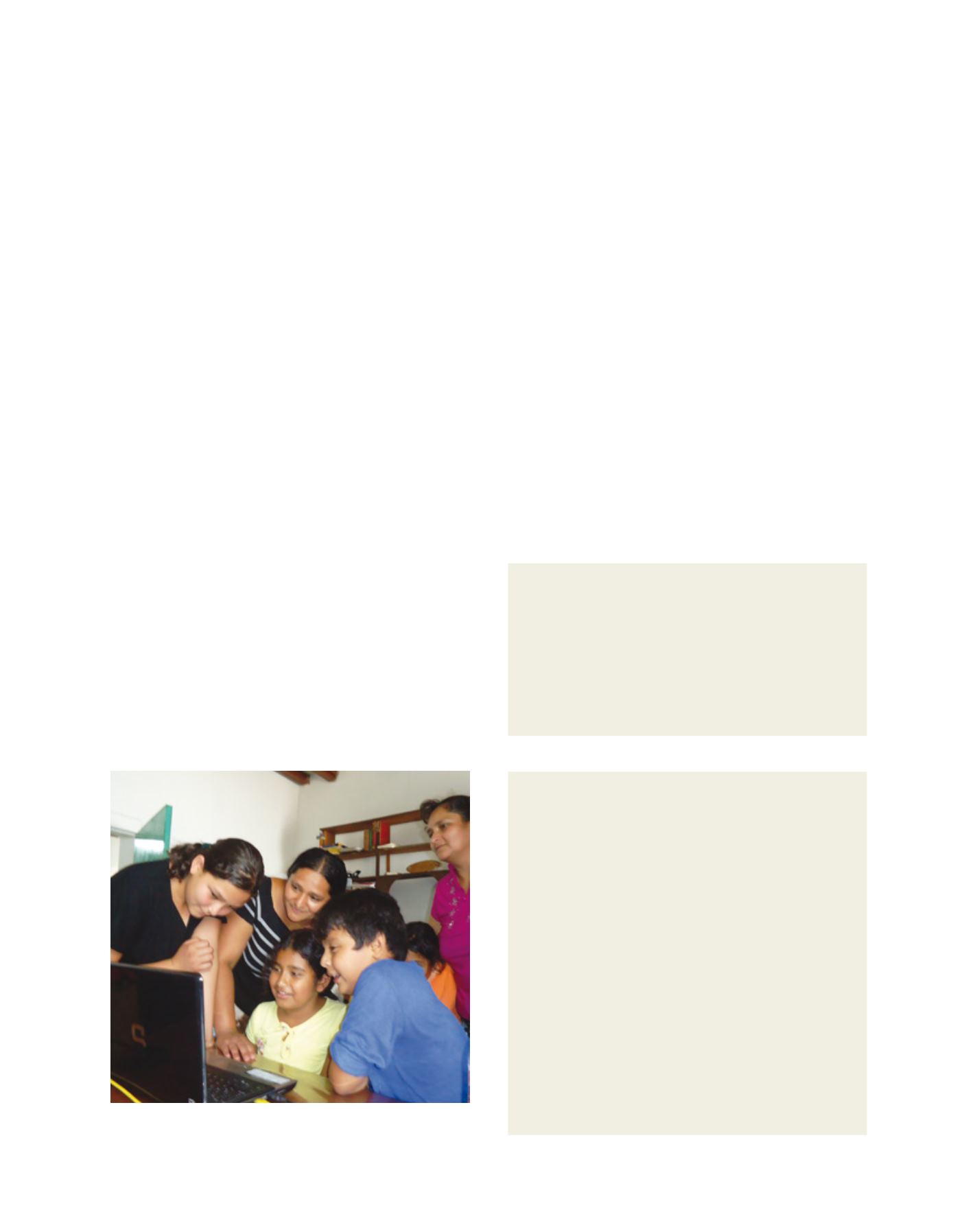
Being able to contact a family member in another country at any time has
changed the way transnational families communicate
Image: Soleterre NGO/www.soleterre.org
Elia’s story
Elia moved from El Salvador to Italy in 2008, when she was 35
years old. She left her son Brayan, four years old at the time, with
her sister. After two years she found a stable job and started thinking
about applying for family reunification, to have Brayan come to Italy.
She succeeded and they have lived together in Italy since 2012.
Since 2008, Elia has had to face several difficulties to keep
her family life with her son and her sister, who was the principal
caregiver back home. Her role in the family as provider, through the
remittances she kept sending, changed the relationship between
her and her family, who were in charge of daily care for Brayan. Her
sister tried to resist the family reunification that brought Brayan to
Italy, both because of the strong attachment that grew with the child
and because of fear of losing the money Elia was sending, which
became an important economic asset.
Elia is now living in Italy with Brayan and both have a good
relationship with the rest of the family in El Salvador. This has
been possible thanks to the ongoing psychological, social and legal
support that Elia, Brayan and her family in El Salvador received from
Soleterre, an Italian non-governmental organization that works to
support transnational families through an international network of
twin centres in Italy and sending countries.
www.soleterre.org