


 86 / 210

Most of the ETAFs are managed by a civil society organiza-
tion (CSO) and supervised by the Management Unit, each
serving 40 families included in a department or location.
Teams are comprised of four or five specialists (a total of 120
hours per week) in social work, psychology, social education
and other social and human disciplines.
Households to be approached by ETAF to participate
in Cercanías are selected from an index that includes the
extreme poverty and socio-familiar situation of vulner-
ability. Extreme poverty is measured from the Gaps Index
Reviews, helped by National Assessment and Monitoring
teams (DINEM-MIDES). Socio-familial vulnerability is
assessed from a technical social report completed by
operators of various public services or social networks. By
crossing the two sources, a list of indices and situations
is generated for the Centralized Management Unit, which
coordinates with DINEM to georeference the situations in
the ETAF area. Before visiting the family, corresponding
coordinates are checked with the institutions involved so
as not to overlap or affect the operation and, if applicable,
to refer to another service. Regional committees support
this process, ensuring equity of access, giving priority to
the most critical situations and facilitating access to the
benefits, services and rights that apply.
In the process it is essential to consider the confidentiality
of the information used in these technical fields. Currently,
1,503 families are being met across the country, with a target
of 2,300. All of them have accepted the escort team .
The challenges are articulated by Cercanías to consol-
idate the national social protection system, in which
families are progressively the subjects of social policies and
programmes, and to contribute to the comprehensiveness
and effectiveness of that system.
diverse and uneven paths as subjects to whom the produc-
tion of public goods should be directed, and the required
cross-agency management this requires. This proposal also
underlines the necessity for the integrity and promotion of
rights to be made from public policy, with its inter-logic
and recognition of actions and potentials both in families
and in communities from different public actors operating
privately in the territories.
Cercanías has formed a management team to ensure level
design and implementation, technical supervision and
attendance, and to develop the above conceptualization. It
also integrates a permanent inter-institutional dialogue
with the National Monitoring and Evaluation Direction
(DINEM) to monitor the results, and to form a team that
integrates theoretical and methodological approaches that
account for the complexity of a historical-critical perspec-
tive and the qualification of equipment, with the necessary
care and ethical components (for the teams themselves
and with families) required by this intervention, proximity
and privileged communication between families, outreach
teams and the state.
The guiding principles of the this programme are:
• consolidating inter-institutionality at the territorial
and central level with the national level, through the
creation and/or strengthening of local protection systems,
involving civil society and the state
• working with families as subjects of rights and social
services programmes to provide comprehensive care,
considering the plurality of existing arrangements and the
dimensions of gender, generation and ethnicity
• developing a proximity methodology to strengthen the
capacities of family autonomy, encouraging process
participants and ensuring access to public programmes
that help improve their living conditions
• coordinating the work of interdisciplinary outreach
teams with local service networks, based within
a unified inter-agency management structure that
ensures quality work
• establishing a system of benefits and priority transfers
to participating families, which allows for simultaneous
and complementary work on the sociocultural aspects
and dynamics of households and unmet basic needs,
understanding them as a bridge to access social rights
and universal policies
• establishing a monitoring system, training and continuous
monitoring of actions to ensure a qualified work, based on
a rights perspective and generating relevant information
for setting the strategy and social policies in general.
Direct work with families is developed from the Territorial
Family Attention Teams (ETAF). They are innovative
components, working on a weekly basis with selected
families as an integral device and proximity. The strategy
began in 2012 with 27 ETAFs and grew in 2013 to comprise
55 ETAFs nationwide. The programme’s objectives are to
strengthen families for the fulfilment of duties of care,
socialization and upbringing of dependent members, and
to contribute to household access to social benefits, rights
and other community resources.
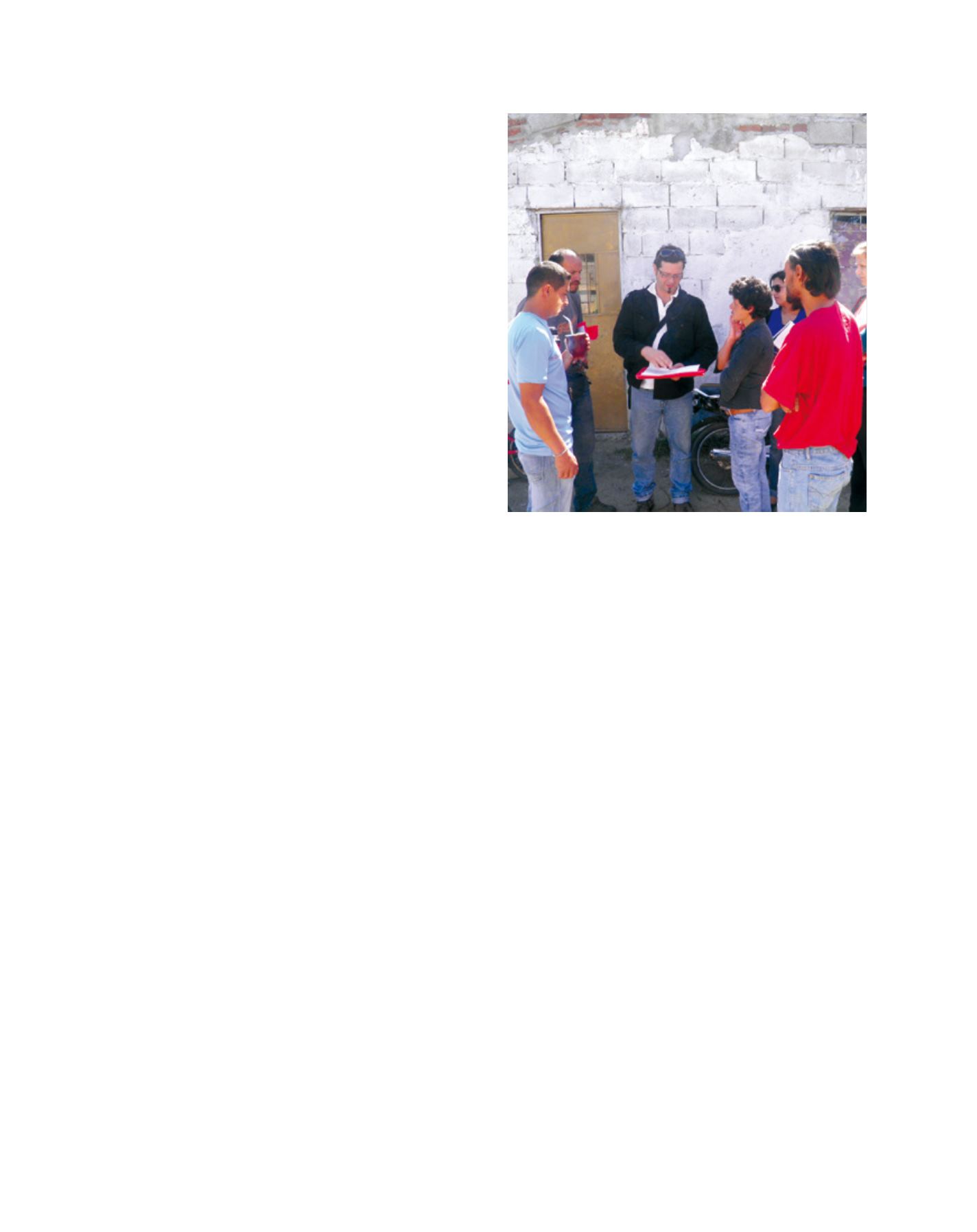
ETAFs work directly with selected families on a weekly basis
Image: Cercanías Coordination Program
A
dvancing
S
ocial
I
ntegration
and
I
ntergenerational
S
olidarity
[
] 84