


 79 / 210

[
] 77
A
dvancing
S
ocial
I
ntegration
and
I
ntergenerational
S
olidarity
studies have shown that families with violence were
usually socially isolated. Spouse abuse was often treated
as a family secret in Chinese society and was covered up.
The abusers, victims and their children were hesitant to
seek help. Hence, it is important to offer intervention once
the problem is identified and before it gets worse. A total
of 101 community agencies/units, including the medical
profession, police, lawyers, district organizations, schools,
housing estates and churches, as well as 35 media expo-
sures helped to publicize BIP, contributing to the 49 per
cent agency-referrals of BIP participants.
The effectiveness of the BIP groups was evaluated
by a number of outcome measures including abusive
behaviours, abusive beliefs, battering knowledge and moti-
vational level. Comparisons between the pre-treatment and
post-treatment measurements suggested that there were
significant reductions in both physical and psychological
forms of aggression, with improvements in negotiation
skills. Changes also occurred in terms of abusive beliefs
and knowledge about battering. Positive change towards
less abusive attitudes was shown and the effect was found
to be impressive. Gains in knowledge about battering also
significantly increased. Although most of the participants
started with low levels of motivation to change, progression
in stages of change was shown after treatment, suggesting
that they were more motivated to correct their behaviours.
Building on BIP experience, we continued to render family
peace-related projects including Harmony@Home, a project
which served 150 participants aiming at relationship enhance-
ment and anger control. Demonstrated improvements in
harmony and happiness were found in its pilot study in 2009 and
Experiences of a BIP participant
Mr Ng was a 45-year-old taxi driver who had been married
for more than 14 years, living with his wife and two teenage
sons in a public housing unit. Before Mr Ng joined the BIP,
he had fights with his wife and was on the verge of getting a
divorce. He thought that his violent behaviour was triggered
by unemployment and his poor mood. He admitted that
he was responsible for the fights as he had used physical
violence, but he considered that violence helped to control
his wife’s emotions.
After joining the group, he realized that his temper control
had improved. He owned his responsibility for violence and
admitted that he had not treated his wife well in the past. He
perceived that the group had helped him to reduce his bad
temper by half, if it could be measured. He quoted his wife as
saying that he was less irritable than before. As a result, his
wife also reacted less fiercely to him. As an overall remark, he
used the word “nice” to describe his state after joining BIP.
this project will further expand. The Women Helping Women
Against Violence Project started in 2012, aims to strengthen the
coping capability of women at risk in facing critical situations
and raise public awareness to cultivate ‘zero tolerance’.
Collaborative efforts in the community with differ-
ent sectors, including the legal profession, police, social
welfare, education and mass media, are crucial in referring
potential service users, getting funding support, sustaining
service impact and building a positive social culture.
From our experience in helping these disintegrating fami-
lies, we are fully aware that ‘prevention is better than cure’.
We advocate the provision of more family life education and
family activities to build up family solidarity for the preven-
tion of tragedies. According to Luther T. Jansen,
3
family
solidarity is defined as the closeness of family members to
each other and is observable in eight types of interaction:
cooperation, agreement, concern, interest, enjoyment, admi-
ration, affection and trust. More couples are from nuclear or
single-child families who need time to learn close cooperation
with family members in their roles and responsibilities, and
understand their family members’ underlying needs, difficul-
ties and perspectives to reach common agreements. In such
a competitive city, parents need to refocus their priorities
on their concern for their family’s needs rather than always
being preoccupied with their work and children’s studies.
In the information and communication technology era, it is
becoming more difficult to have quality family time to develop
common interests, enjoyment and admiration for each other.
Even when family members are physically together, they are
often doing their work or enjoying leisure time individually
through digital devices. People need to resist temptation from
digital devices and have in-depth human encounters to fulfil
their need for affection, and resist extra-marital affairs that
undermined the trust between couples. Last but not the least;
we can enhance mutual support among families at different
stages of similar struggles, and help to build generational soli-
darity to pass family values to the next generation.
For further information about the Hong Kong FamilyWelfare Society
and its programmes and services, please visit
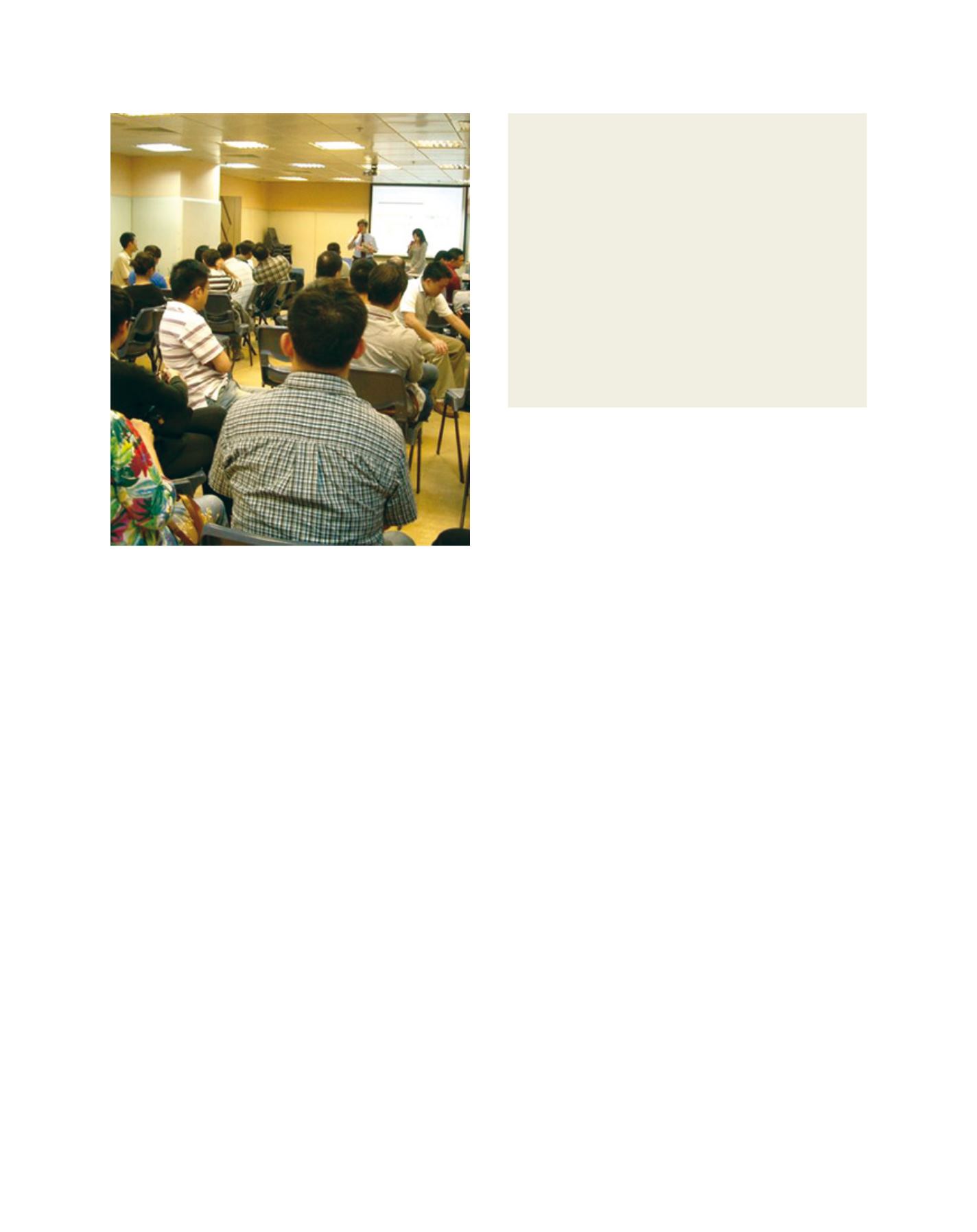
www.hkfws.org.hkPolice receive training on understanding domestic violence
Image: HKFWS