


 76 / 210

[
] 74
From disintegrating families to family solidarity
Eunis Vu Kit Teng, Shirley Ng Wai Ngan and Lai Wong Suet Wing, Hong Kong Family Welfare Society
A
dvancing
S
ocial
I
ntegration
and
I
ntergenerational
S
olidarity
A
mong all species, human beings need the longest
period of protection and rearing before they can
live independently. Family is the basic building
block in a community that cares for the dependent and
passes important values – including love, respect and
responsibility – from one generation to another. Yet,
some families lack these functions, particularly when
the marriage has been broken up.
The 2011 census revealed that the divorce rate in Hong Kong
had increased by 46 per cent, contributing to a 30 per cent
increase in single-parent families (81,750 families over 10
years). The higher divorce rate also leads to increases in second
marriages or partnerships, which negatively affect parenting
due to confusion and uncertainty. Even in those families that
stayed intact, there are signs of disintegration. The number of
reported spouse abuse cases in Hong Kong was 2,734 in 2012.
Among them, 87.7 per cent were classified as physical abuse.
These disintegrating families have difficulties in passing on
important family values to the next generation. Good parent-
ing carries love and support to children. Inconsistency between
parents weakens the effect of parenting, and trauma and family
violence will cause long-term damage to the psychological
health of children. According to recent research by Dr Daniel
Shek
1
in Hong Kong there is clear evidence that, on average,
children with separated parents have poorer emotional well-
being than those in intact families. At the same time, children
of parents with a hostile inter-parental relationship, regardless
of family type, tend to have poorer emotional well-being too.
The Hong Kong Family Welfare Society (HKFWS) has
witnessed these changes while serving Hong Kong families
for 65 years, and has developed a series of services to meet
the needs of disintegrating families, especially those suffering
from divorce and violence. HKFWS began providing special-
ized services to separated and divorced families in 1988. These
packages of innovative services, designed to meet the changing
needs of families, have been delivered through service centres
established in different locations and at different times, namely
the Family Resource Centre (FRC), the Mediation Centre (MC)
and the Women and Family Enhancement Centre (WFEC).
With the current review on ‘parental responsibility’ by the
Labour and Welfare Bureau and the adoption of the Practice
Direction of 15.10 and 15.13 in the Judiciary, emphasis on
the Family Mediation Practice and the Children’s Dispute
Resolution Pilot Scheme manifests a shift of societal values
and judges’ views on the need for change. For the children’s
sake, co-parents have continued to interact with each other in
child-rearing matters, especially in terms of collaboration and
a focus on the children. Hong Kong is an international city
and bound by the international treaties – the United Nations
Convention on the Rights of the Child 1989 (UNCRC) stresses
children’s rights to protection and to maintain personal rela-
tions and direct contact with both parents on a regular basis
if they are separated from one or both parents.
2
Article 18(1)
of the UNCRC also emphasizes the responsibilities of parents.
In line with HKFWS’s mission and vision, we believe that the
parent-child relationship should not end despite the termi-
nation of the marriage. Divorce does not dissolve the family;
rather, the family is reorganized from a one-home structure
to a two-home structure. How parents navigate the separation
colours the impact of divorce on children. A new project, A
Beam of Hope – Pilot Project on ‘Child-focused’ Parenting
Coordination and Co-parenting Services for Divorced Families,
Transforming from service user to befriender
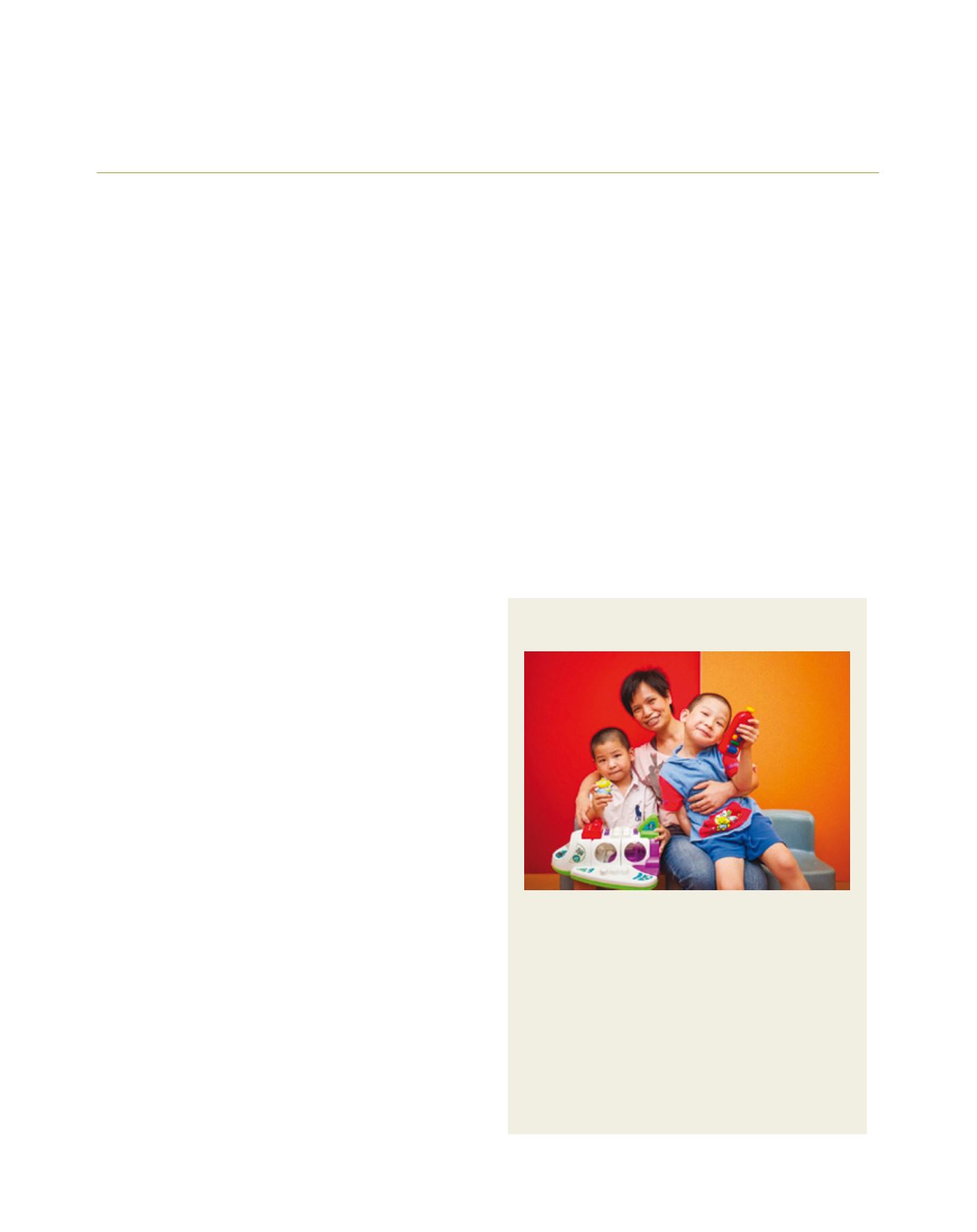
Fong was a single mother who had brought up her two sons,
aged six and four, since early 2012. Reasonable access by the
children’s father was granted by court order. However, the visits
seemed unsatisfactory and Fong found that this was due to a lack
of communication and cooperation between co-parents. In view of
this, Fong joined the new project: A Beam of Hope.
Fong said: “I experienced a change in attitude from the couple
role to the co-parents role. It is of immense importance for us as
co-parents to let go and transform; and to keep up communication
on children’s matters for the best benefit of our sons.”
Fong was significantly stepping forward to cooperate with the father
of her sons, and this resulted in an improvement in communications
and the relationship between co-parents. In fact, Fong also
volunteered as a befriender to help other divorced parents.
“Love is action...not words.” Fong with her two sons
Image: HKFWS