


 72 / 210

[
] 70
Building on traditional cooperation among
women for sustainable rural development
P. Ceci, P. Wolter, L. Monforte, F. M. Pierri and B. Rice, United Nations Food and Agriculture Organization, Italy; and
F.B.S. Diallo, University Assistant, Centre for Environmental Research, Gamal Abdel Nasser University of Conakry, Guinea
A
dvancing
S
ocial
I
ntegration
and
I
ntergenerational
S
olidarity
T
he 2014 International Year of Family Farming
(IYFF) aims to raise the profile of family farming
by focusing world attention on its significant role
in eradicating hunger and poverty, providing food secu-
rity and nutrition, improving livelihoods and managing
natural resources in a sustainable way. In order for this
potential to be fully realized, there must be the develop-
ment of agricultural, environmental and social policies;
increased knowledge, communication and public aware-
ness on the importance of family farming; and improved
understanding and action in terms of family farmers’
needs at a technical level.
The goals of the IYFF make it a subject of direct importance
in terms of the twentieth anniversary of the International Year
of Family. Family farming has the power to eradicate poverty,
starting at the level of the family unit and eventually impacting
entire economies. Women and youth are central in this process
but many challenges persist. The rural exodus of young people
to the cities has huge implications not just for future agricultural
productivity, but also for social cohesion and intergenerational
solidarity in the context of families. Women farmers face a gender
gap, which negatively impacts families and the viability of family
farming. The key role played by women in family farming is not
recognized in terms of income earned and asset ownership.
The IYFF is a chance to highlight and impact the millions
of farmers across the world who contribute to food security
through family farming, along with the projects and policies
that enable this process. One such example is the work being
done regarding the utilization of women’s interest groups for
sustainable rural development in the Fouta Djallon Highlands
(FDH). The project shows how the marginalization of
women in terms of decision-making and access to productive
resources and markets can be overcome. In this project, social
cohesion is reinforced through traditional modes of coopera-
tion and collaboration, in order to strengthen family farming
as a viable, income-producing endeavour.
The FDH is a series of high plateaus ranging from 900 to
1,500 metres above sea level, concentrated in the central part
of Guinea and extending into Guinea-Bissau, Mali, Senegal
and Sierra Leone. The highlands are the point of origin of a
number of regionally important rivers including the Gambia,
Niger, Senegal and Konkouré Rivers and, together with the
surrounding foothills, harbour a rich variety of savannah and
humid forest ecosystems.
The FDH area is predominantly inhabited by the Fula ethnic
group and extensive subsistence agriculture is still the princi-
pal source of livelihood for most households. This case study is
based on the results of a survey of 95 households and seven inter-
est groups conducted in June 2012 in the Guetoya watershed,
Sub-prefecture of Bantignel, Prefecture of Pita in Central Guinea.
Women and young people are the most vulnerable in the rural
society of the FDH. Women play a crucial role in the household
economy, from agriculture to livestock breeding, from nutrition
to health care, and including all domestic jobs – preparation of
meals, water and fuel wood collection, house cleaning and laundry
– activities in which they are usually assisted by daughters or
granddaughters. They increasingly take on various responsibilities
in agricultural production, processing and small-scale commerce,
including traditional male duties, as men and young people leave
Image: P. Ceci
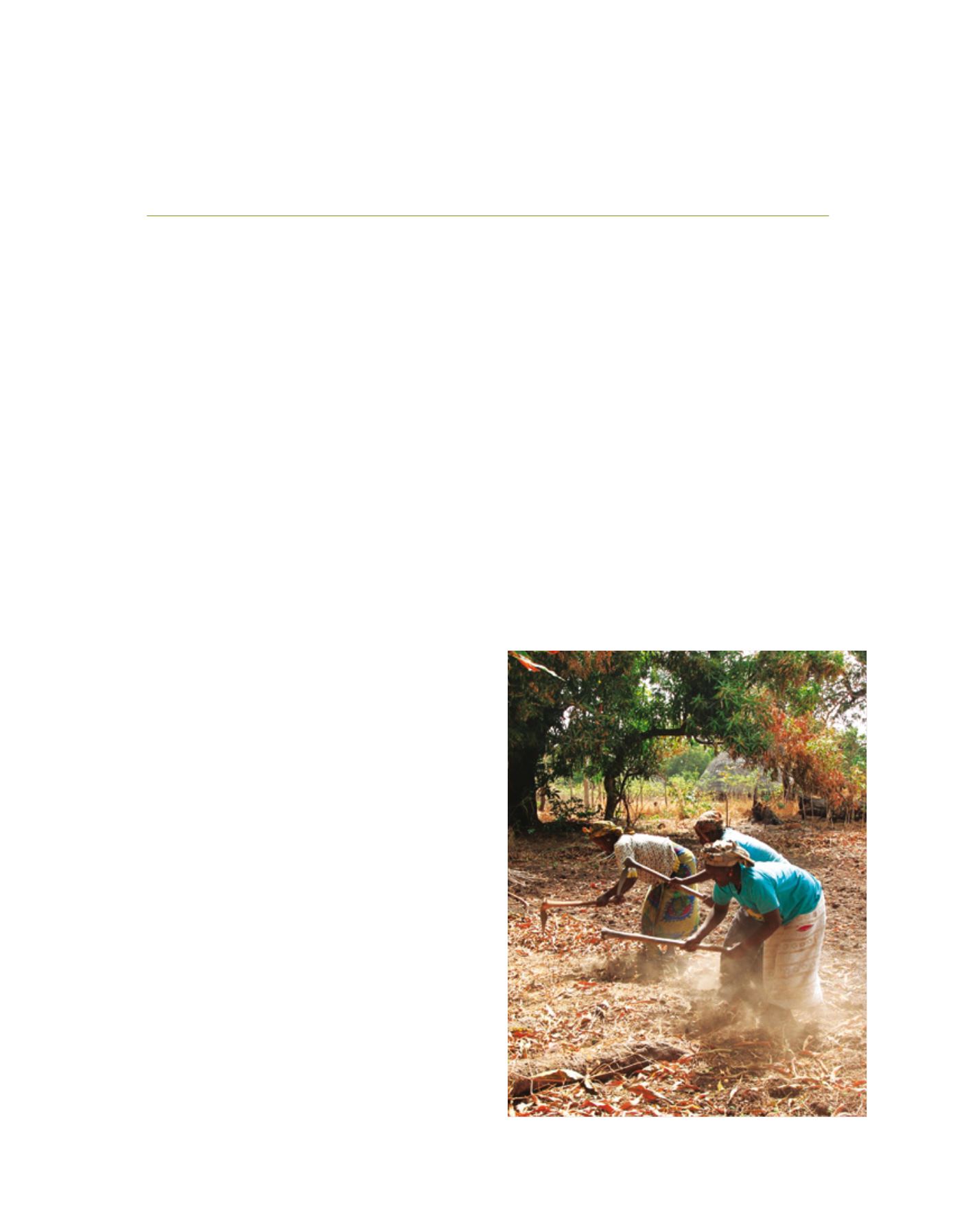
Women tilling a kitchen garden for sowing in Heïrè, Bantignel