


 70 / 210

[
] 68
A
dvancing
S
ocial
I
ntegration
and
I
ntergenerational
S
olidarity
not well aligned with social consequences have brought in
their wake massive unemployment and under-employment.
Parents are no longer able to cater well for their children.
Children are not attending schools and do not have access
to quality affordable health care. There is domestic tension.
As a result of the economic downturn and what often seem
to be irreconcilable differences among parents, spouses are
now living far apart from their children and therefore rely
very much on telephones and the Internet to parent their
children. This form of ‘teleparenting’ does not adequately
enhance family and social cohesion and development. What
the children, parents and family need is the personal rela-
tionships that come from the inner souls of each member
of the family to each other. Teleparenting must rather build
on direct interpersonal family relations, particularly during
brief periods of separation.
On 22 November 2013, a CNN news item under the heading
‘When God isn’t on the guest list’ highlighted the increase in
marriages that are contracted without any reference to God,
Christianity (or any religion) and the active involvement
of family members.
1
The true sanctity of marriage, which
forms the bedrock of the family, is fast being thrown away by
‘modernists’. Many modernists are also eloping to get married
later, with many regrets coming soon after. When society
sows to the wind, it must be prepared to reap the whirlwind.
The causes and effects of divorce inmarriage are too many and
varied to be enumerated in this short article. It must be stated,
however, that the consummation of marriage and the establish-
ment of the family unit by many a person – particularly the
young aged 15-19 and 25-29 – and based on infatuation and
lust is very alarming and must be the concern of all.
On 28 January 2007, the
Public Agenda
newspaper
published the banner-headline ‘Alarming Divorces in 2006’,
stating that divorce cases had reached a record high in Accra,
the nation’s capital.
2
In 2006, a total 1,714 marriages were
registered and 633 were dissolved. In 2005, 2,199 were regis-
tered while divorce cases stood at 484. These are just the
reported cases. The consequences are very dire for children,
parents and society. In its 12 January 2012 edition, the
Public
Agenda
published a research finding which indicated that “if
marriages last more than 10 years they are likely to survive.”
3
The report said that the common time to separate was “soon
after seven years”. According to some social watchers, the
tragedy is that the number of divorces and disintegration of
families after four years is probably rising.
A further addition to the challenges and near breakdown of
the family is what is seen by the population to be the sudden
influx of foreign cultural practices that are inimical to local
values, virtues and family cohesion; irresponsible social
behaviours; and the breakdown of law and order. New distor-
tions of the existing knowledge of marriage and family are a
big worry to the majority of Ghanaians.
To cite some examples, on 20 November 2013 a Ghanaian
media site,
radioxyonline.com, reported a statement by the
Ghana Health Service that 750,000 teenagers between the ages
of 15 and 19 had got pregnant within the past 12 months. Most
of these teenage mothers come from disintegrated families –
families with virtually no economic or social capital and as a
result no social support systems from the local communities.
4
Recently, a St Aquinas Senior High School graduate
committed suicide by hanging himself after attaining an
aggregate that was too low for him to gain admission to a
medical school. Investigations revealed that this student had
little or no family support.
Since 1993, the Africa Development Programme (ADP)
has been working with partners to promote good family
existence and relations through church worship, seminars,
social and economic empowerment of women and youth
development programmes.
In 2010/11, ADP collaborated with the SNV Netherlands
Development Organisation and other civil society organi-
zations to monitor and evaluate the Ghana School Feeding
Programme (GSFP). The GSFP aimed to provide one nutri-
tious hot lunch each school day for pupils in deprived
communities, in order to increase the enrolment and retention
of pupils. As a cross-positive impact it helped families to iden-
tify with the educational and social needs of their children.
In 2002/3, ADP was the regional coordinator/lead non-
governmental organization for the implementation of the
Food Marketing Programme for Small Scale Marketers in
the Eastern Region of Ghana for the Ministry of Finance,
Economic Planning and Regional Integration. This programme
provided funds for women to purchase food at the farm gates
so they could earn income to support their children and fami-
ly’s welfare.
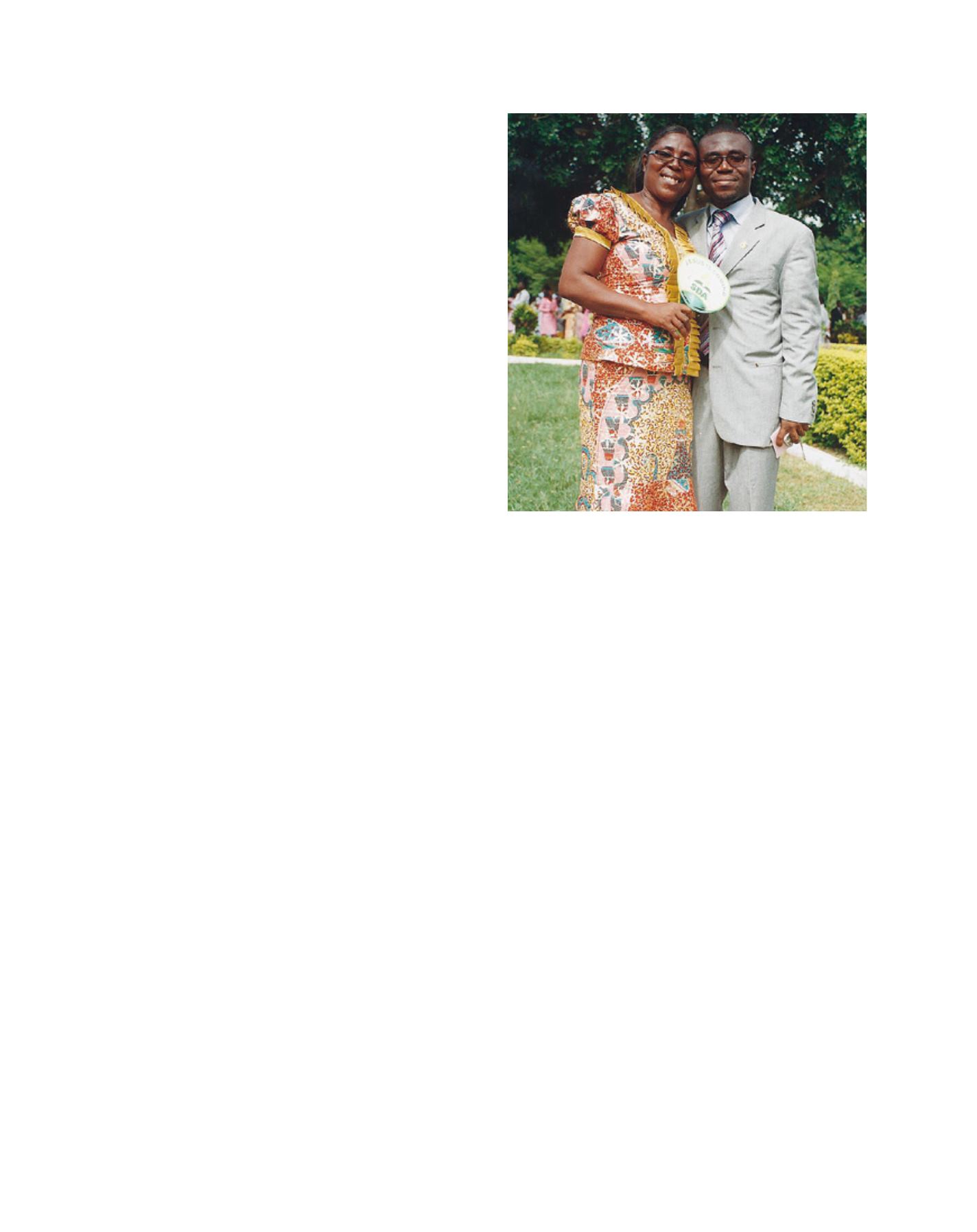
Of particular importance is ADP’s collaboration with the
Accra West District of the Seventh-Day Adventist Church
to promote the sanctity of marriage and the family. More
recently, through its executive director, ADP co-facilitated
the development of a 10-year strategic plan of action for the
church district. The plan incorporates the establishment of
a multi-complex facility that will offer support for couples
ADP is working with organizations to promote the sanctity of marriage
Image: ADP