


 66 / 210

[
] 64
Changing family structure and development
transformation in Africa
Hassan M. Yousif, Senior Researcher on Population and Development, United Nations Economic
Commission for Africa, Population and Youth Section, Social Development Policy Division
A
dvancing
S
ocial
I
ntegration
and
I
ntergenerational
S
olidarity
D
evelopment transformation and social change are
usually intertwined processes. Economic devel-
opment leads to improvement in human welfare,
such as increasing income levels and improving people’s
standard of living and quality of life. In turn, these
improvements are usually accompanied by moderniza-
tion and social and cultural changes, including profound
changes in intergenerational relationships, family struc-
tures and living arrangements. In addition, considerable
changes occur in lifestyles and residence, social institu-
tions such as marriage and households, social relations,
norms and value systems.
Social and economic developments often lead to the gradual
replacement of many of the traditional functions and roles of
the family with private and public social institutions to meet
the needs of people. When development activities succeed
or fail, the social and economic consequences will impact
directly on the survival and stability of the family.
In Africa, as elsewhere, the family structure is changing as
a result of development transformation. Traditionally, the
family in Africa played a key role in defining the production
and reproduction functions of its members, and in deter-
mining their social relations and responsibilities in society.
The extended family system placed high value on marriage,
polygamy and childbearing as important institutions for
procreation and social relations, and for providing social secu-
rity and protection to family members. It also played a major
role in communal ownership and allocation of resources such
as fertile rain-fed land, forests and cattle.
These dimensions of the traditional social system have
changed as a result of development activities in the conti-
nent. The changes in family structure and composition can
be traced back to the colonial development policies which
included, among other things, the establishment of large-
scale agriculture and mining projects. These projects created
a labour shortage that was covered through inducing migra-
tion and increasing birth rates. The development policies in
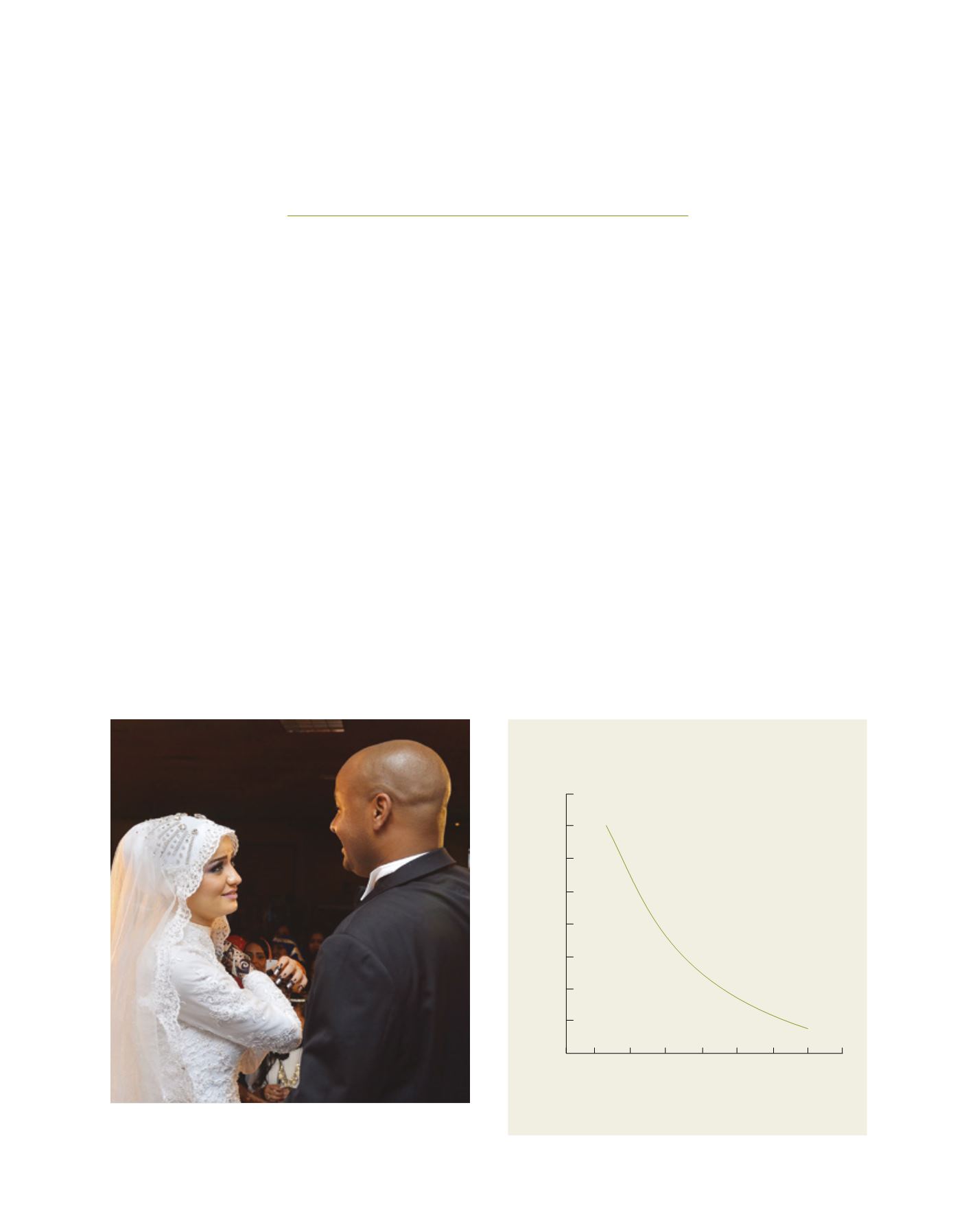
Modernization and cultural transformation are reflected in the outfits of the
bride and groom at an urban wedding
Image: Hassan M. Yousif
Per capita consumption
Nuclear family
Extended family
Average family size
0
2 0
4 6
8 10 12 14 16
20
40
60
80
100
120
140
160
Relationship of family size to per capita consumption
of food, energy etc.
Source: Hassan M. Yousif