


 63 / 210

[
] 61
Bonding of the generations: promoting family
values and intergenerational solidarity in Singapore
Leng Leng Thang and Ern Ser Tan, Associate Professors, National University of Singapore
A
dvancing
S
ocial
I
ntegration
and
I
ntergenerational
S
olidarity
I
t is generally agreed that family ties remain very
important to Singaporeans. Research has shown
a consistently high level of agreement among
Singaporeans that they have a close-knit family, and
a survey conducted by the National Family Council in
2010 showed that 91 per cent of Singaporeans regard
the family as most important in their life. These positive
responses ascertain the state policy’s emphasis on the
family as the basic building block of society, and the
first line of care and support for its members. Strong
family values and intergenerational relations are invari-
ably significant in contributing to individual and societal
resilience and well-being.
However, contemporary world trends in demographic and
social changes have impacted national family trends in
Singapore. The rapid pace of ageing; a persistently low birth
rate as a result of delayed marriages and a rise in single-
hood; and increases in divorces and distressed families
have combined to place strain on the capability of fami-
lies to provide intergenerational support. According to the
Survey on Social Attitudes of Singaporeans conducted by
the then Ministry of Community Development, Youth and
Sports (since renamed the Ministry of Social and Family
Development), the number of Singaporeans who agreed that
they have a close-knit family dropped by about 10 per cent,
from 97 per cent in 2001 to 89 per cent in 2009; and the
number who agreed that they would give money to family
members in financial need fell from 99 per cent to 90 per
cent. Despite the sustained strong emphasis on the family,
such current trends suggest that more efforts are necessary
to meet the challenges facing families in the future.
Policies to promote strong families and intergenera-
tional cohesion are especially emphasized in Singapore,
as reflected in the 1999 Report of the Inter-Ministerial
Committee Workgroup on cohesion and conflict in an
ageing society. The policy recommendations centre on
suggestions to promote extended family ties and reciproc-
ity including, among others, that “the teaching of family
values in school textbooks should also include illustrations
of grandparents as an integral part of the family structure,”
that family-oriented concessions based on the extended
family concept should be given at government-controlled
recreational facilities, and that additional incentives should
be granted to public housing applicants who choose to stay
in close proximity to their grandparents as well as their
parents. In the final point of the report, under ‘promot-
ing extended family ties’, the family’s role in the provision
of care for older members is further highlighted. Here,
the report reiterates that the measures will not “merely
enhance intergenerational interaction or lessen intergen-
erational conflict” but “will also help to reinforce the role
of the family in supporting senior citizens and expand the
resource base of the family to do so.” This “will help fami-
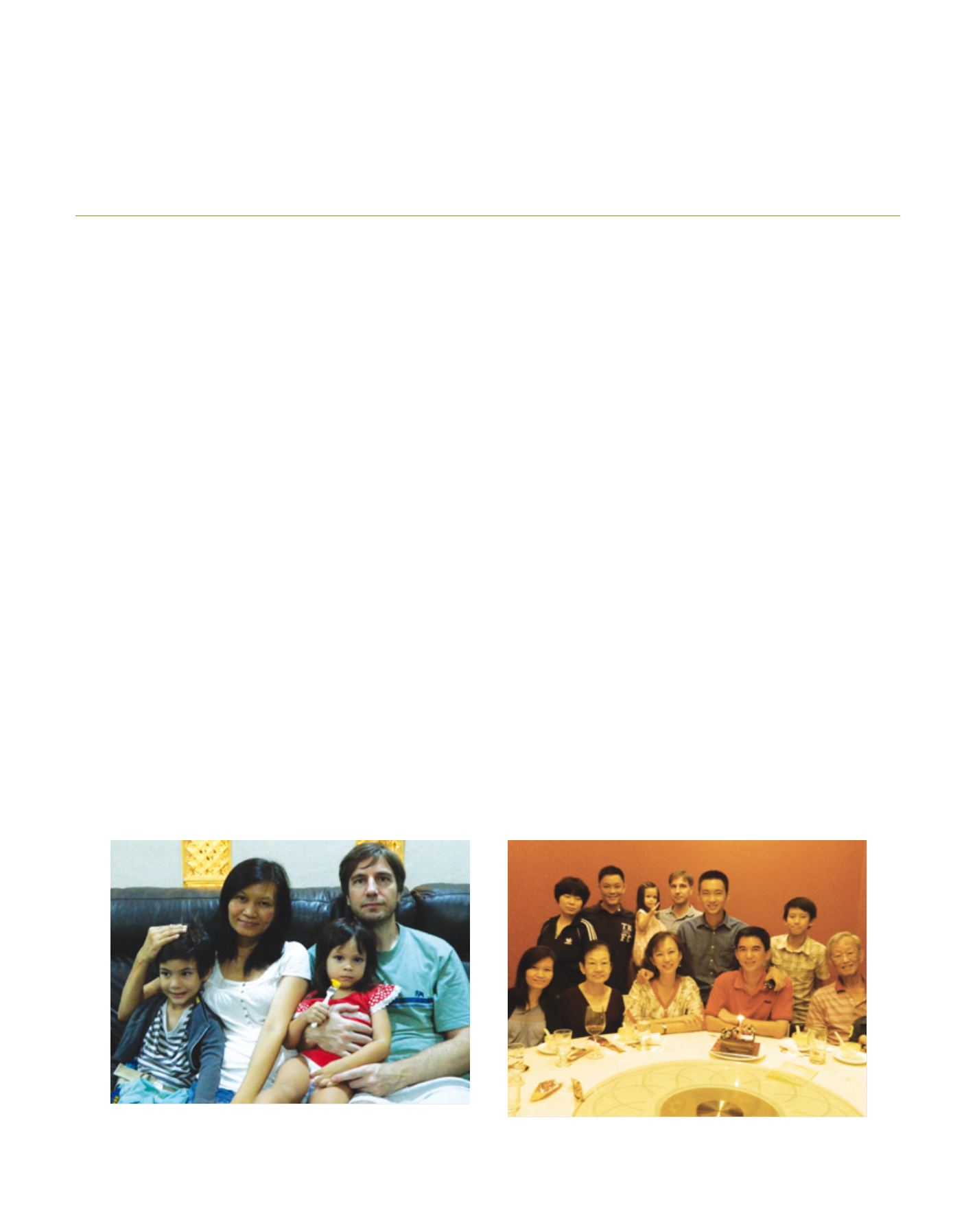
It is common for extended families to get together for birthday celebrations
Mr Diez from Spain with his wife Georgina (Singaporean Chinese) and
two children: cross-cultural families are on the rise in Singapore
Image: Pang Kit Ong
Image: Julio Diez Gomez