


 73 / 210

[
] 71
A
dvancing
S
ocial
I
ntegration
and
I
ntergenerational
S
olidarity
in search of work elsewhere.
1
Of the 95 households surveyed,
168 former members were found to have out-migrated, a trend
concerning 71 per cent of the sample and a warning for a critical
level of dependence of the local economy on external remittances.
Widespread polygamy often results in a multiplication of
split widow-led households where, in an already difficult envi-
ronment, women must fulfil all family needs. The massive
outmigration of work-age men is significantly increasing the
number of female-headed households.
Twenty-four per cent of the households surveyed are
female-headed, of which 70 per cent are due to widowhood
and 30 per cent due to the outmigration of the household
head. In 38 per cent of the households, women entirely or
partially contribute to children’s educational costs, and in 46
per cent they do so for health care expenses.
While legally recognized as equal to men, rural women are
still disadvantaged in many ways. Most of them suffer from
marginalization, social and cultural discrimination, and illiter-
acy. The low level of education among women directly affects
their ability to access information, agricultural extension
services and inputs, improved technologies and decision-
making. Where ownership or usage of land is concerned, men
habitually claim priority and hereditary rights.
2
Striving with often uncomfortable situations, women have
learned to come together and share burdens and difficulties.
Traditional forms of solidarity and collaboration among Fula
women in the FDH imply mutual assistance in case of need
in terms of both exchanges of food and resources and of
labour for agriculture.
Image: P. Ceci
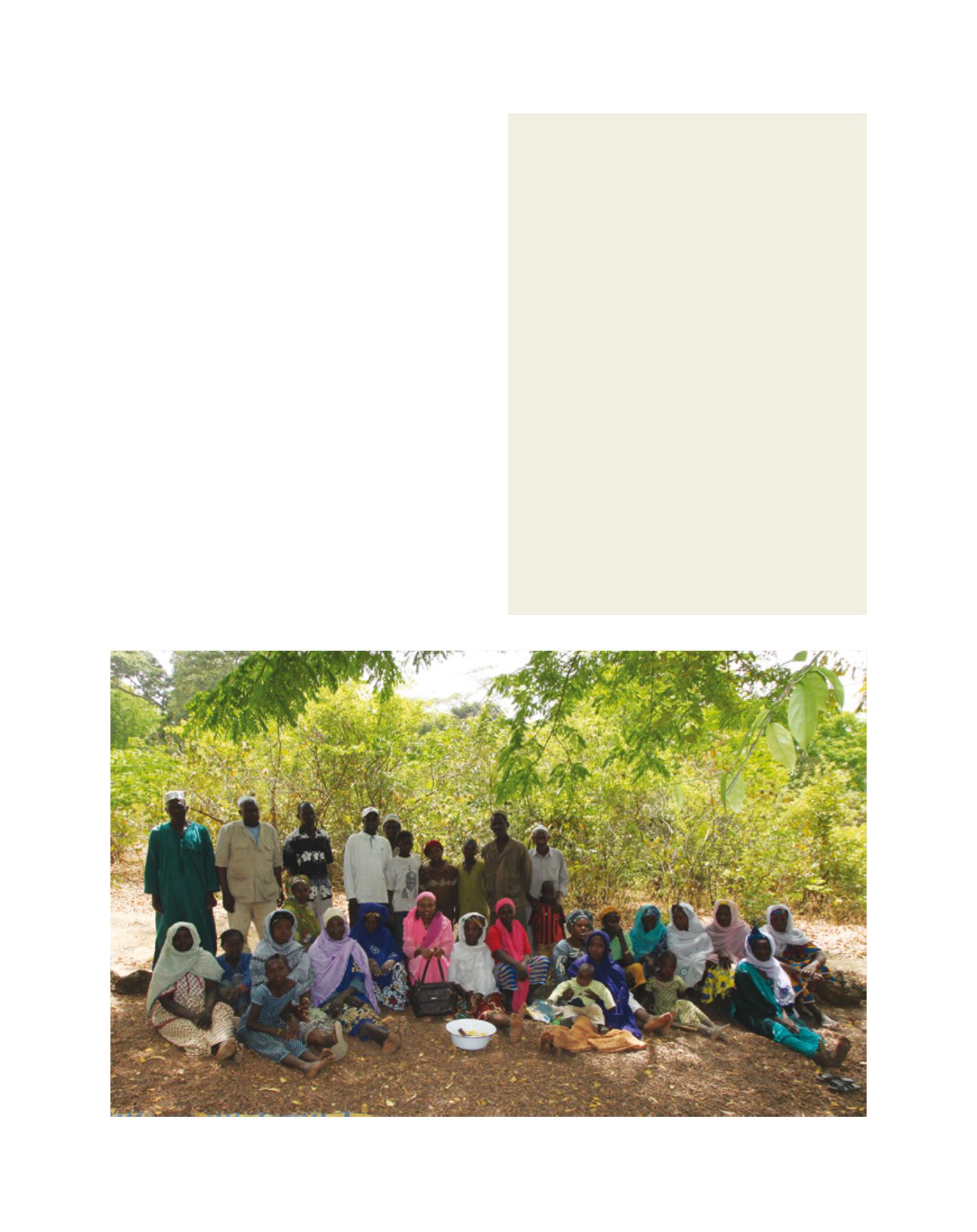
Women of a market garden group and villagers in Fello Férobhè, Bantignel
Family farming in the FDH
Seventy-five per cent of the households surveyed
acknowledged agriculture as the main source of livelihood
and 38 per cent of them practice both rainy- and dry-season
agriculture. Farming is often complemented by small-scale
livestock rearing. Due to the mountainous topography of
the area, several types of land are exploited for agricultural
production. They include kitchen gardens, delimited by fenced
perimeters surrounding the houses and cultivated exclusively
by women, as well as external fields in the valley bottoms, the
plains and on the slopes.
Typical crops of kitchen gardens are maize, cassava, taro,
sweet potatoes, groundnuts, beans and vegetables for daily
consumption, including tomatoes, eggplants, chilli peppers
and okra. On the slopes, mountain rice and fonio, but also
cassava, maize and groundnuts are cultivated with the slash-
and-burn system. In the plains, fonio is mostly cultivated. In
the fertile bottom valleys, where dry-season agriculture is more
easily practicable due to adjacent streams, the main crops are
tomatoes, cabbages, eggplants, onion, chilli peppers, potatoes,
sweet potatoes, beans, okra, lettuce, paddy rice and maize.
With the exception of lowland vegetable production, all agricultural
stock produced is destined for household self-consumption.
Land, if not personally owned, is allocated to villagers by the
most influential families – the descendants of those who came
first to the area during the Fula colonization of the highlands.
Normally, one tenth of the seasonal agricultural production is
due to land owners in exchange for land use rights.
Work division by gender assigns to men the heaviest tasks,
including preparation of wooden fences, clear-cutting, cleaning and
burning, ploughing, sowing, harvesting and threshing. Common
women’s tasks are weeding, sprinkling and winnowing, while
children deal with surveillance and the carrying of tools and crops.