



 74 / 210

[
] 72
A
dvancing
S
ocial
I
ntegration
and
I
ntergenerational
S
olidarity
Since the 1980s, building on these already existing social prac-
tices, development projects have worked to establish women’s
interest groups and facilitate their legal recognition. Their aim
has been to strengthen community solidarity, improve agricul-
ture production and increase and diversify household incomes.
Interest groups are effective instruments to reach women,
inform and train them, thus contributing to improved living
standards. Groups targeting men’s activities also exist, address-
ing livestock rearing and reforestation, but women’s groups
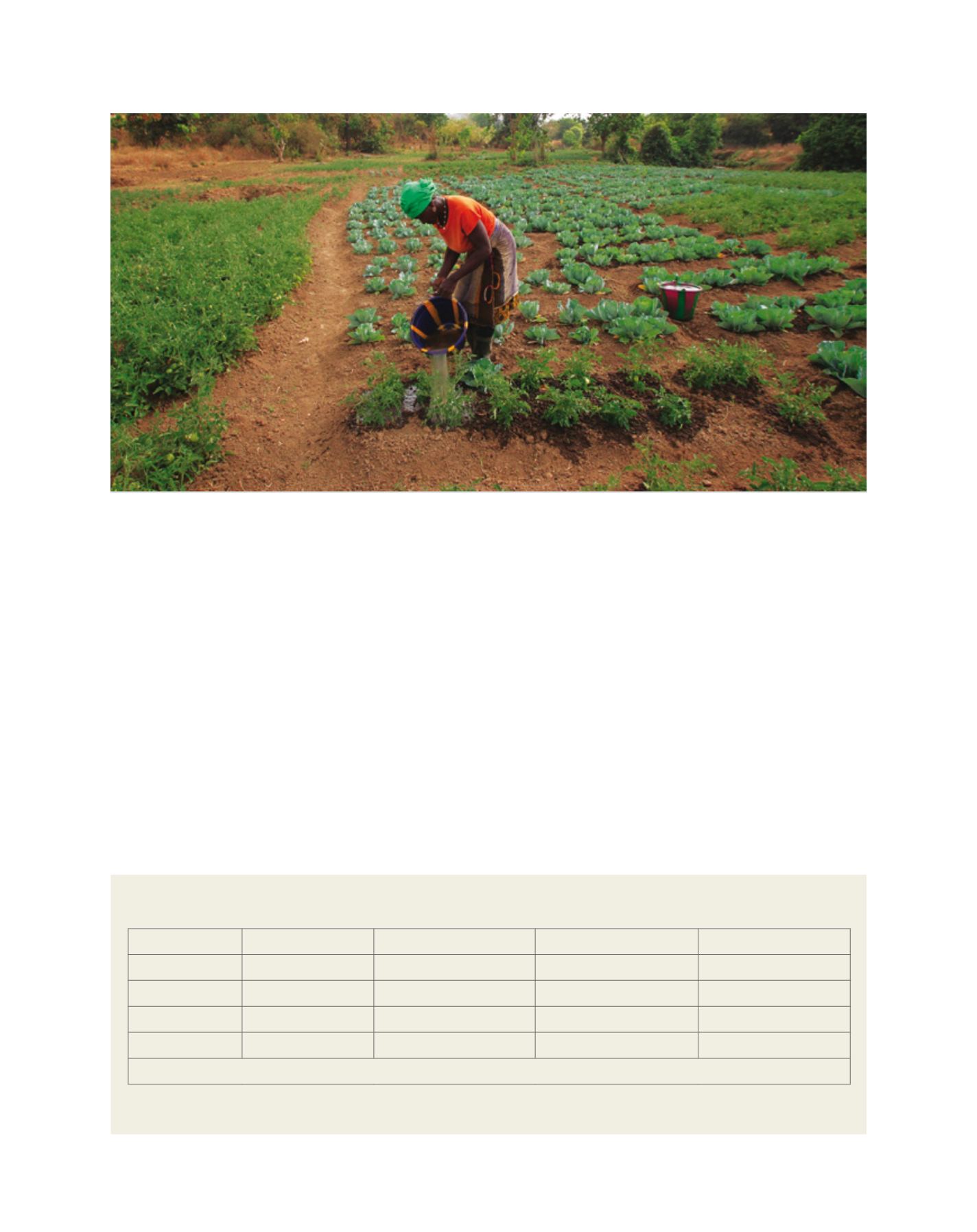
specializing in vegetable production in the fertile bottom
valleys and, to a smaller extent, in dyeing and soap-making,
prevail in the FDH. As a result of the establishment of these
groups, a considerable boost was witnessed in the production of
cabbages, tomatoes, aubergines, chilli peppers, lettuce, spinach
and so on. The increased yield from horticulture allowed
women to enrich the daily family diet, to become more finan-
cially independent and to contribute to school fees, resulting
in increased enrolment rates. Forty-seven out of the 95 families
interviewed participate in interest groups. Thirty-seven per cent
of the women living in the households surveyed are members
of groups, or 49 women compared to 18 men.
In this context, the FDH Integrated Natural Resources
Management Project, executed by the United Nations Food and
Agriculture Organization (FAO), is assisting farmer groups. In
2012 the project trained 19 interest groups in five pilot sites –
including Guetoya – in anaerobic compost preparation and the
manufacture of improved stoves, which can significantly reduce
cooking time and wood consumption. Some 449 people were
trained in improved stove production, out of which 360 were
women, while 244 out of the 306 people trained in compost
preparation were also women. In other sites, the project assisted
farmer groups to fence and secure agricultural fields against
livestock encroachment as well as to improve access to water
resources for dry-season agriculture.
Common price fluctuations of frequently marketed commodities and average seed costs
Source: FAO
Commodity
Local name
Minimum final market price Maximum final market price Average seed cost
Tomato
Tamati
600 Guinean Frank (GF)/kg
1.400 GF/kg
32.500 GF/hg
Aubergine
Giakatou; Kobö kobö
600 GF/kg
800 GF/kg
25.000 GF/hg
Lettuce
Saladi
300 GF/head
1.000 GF/head
60.000 GF/hg
Cabbage
Chou
1.000 GF/head
2.500 GF/head
66.000 GF/hg
* Exchange rate at the time of the survey:
€
1 = 8.890 GF
Image: P. Ceci
A woman watering tomatoes in the market garden of Gaggal, Bantignel