


 75 / 210

[
] 73
A
dvancing
S
ocial
I
ntegration
and
I
ntergenerational
S
olidarity
In its second phase (2014-2019), the project will pursue
a two-pronged approach to target both women’s groups and
innovative individual farmers for business development,
encouraging their adhesion to the Fouta Djallon Farmer
Federation. Activities will include diversification of agricultural
production by introducing innovative techniques and crops,
the promotion of pest-proof storage bins, and training in inte-
grated pest management and improved processing techniques.
In connection with the increased vegetable production
of women’s groups, it was observed that the simultane-
ous influx on local markets of unprecedented amounts of
perishable products and the lack of access to wider market
networks is likely to occasion severe seasonal price drops.
Gross-buyers from Conakry dictating daily market prices,
combined with the lack of negotiation power of sellers,
result in little income and can even make groups incur losses
after the hard work in the fields.
In order to reverse this undesired effect and to provide
farmers with more economically viable alternatives, the project
plans to test and promote sustainable conservation and trans-
formation techniques for surplus agricultural production,
and to develop capacities for an increased level of organiza-
tion of women’s groups and for business development. High
attention will be paid to the labelling of high-value processed
products from organic agriculture, grafted fruit trees and
native tree species (such as Shea butter and Néré), and to
developing market networks and inclusive value chains. The
linkages between nutrition and health will be demonstrated,
for instance by testing local production of groundnut oil to
replace the use of imported and less healthy palm oil.
Governance and land tenure issues will also be looked at. Men
tend to occupy managerial positions even in women’s groups
– including presidency, secretariat and bookkeeping – with a
resulting imbalance in decision-making and power distribution
that the project will have to address. Land is normally borrowed
by groups from the wealthiest families based on 10-year written
agreements. Given that the project is investing in this land also
in terms of irrigation infrastructure, agricultural facilities and
equipment, access issues will have to be carefully monitored
and eventually rectified in the coming years.
The strength of the interest-group approach presented here
lies in its potential to reach a higher number of people for
training purposes and to trigger a farmer-to-farmer process
of knowledge transfer. It plays for long-term sustainability, as
it builds on motivation, interest and commitment expressed
by local actors who join forces to pursue common objectives.
Notwithstanding, past experiences show that innovation and
entrepreneurial skills are equally important in order to iden-
tify market niches, diversify groups’ activities and develop
cost/profit positive ventures. This highlights the need for
leadership considerations and to empower women to take
on decision-making responsibilities as well as to increase
their negotiation capacity especially in market contexts. The
current project executed by FAO, as well as similar initiatives
active in the region, are expected to harvest more tangible
results if they embark on a strengthened collaboration with
women’s interest groups.
Family farmers around the world face a number of challenges,
from lack of access to services andmarkets to unfavourable policy
environments. Group formation and collective action as depicted
in this case study go a long way in overcoming these impedi-
ments. The gender gap in agriculture has enormous implications
for family cohesion, agricultural productivity and income levels.
The FDH Integrated Natural Resources Management project
executed by FAO seeks to overcome these challenges. From
compost preparation to improved techniques, storage, process-
ing and marketing – the project is enabling family farmers to
succeed, with women’s interest groups leading the way.
Traditional forms of women’s mutual assistance
Several forms of mutual assistance exist among Fula women. The
most widespread is the Kilé that can be called upon by one of the
household head’s wives at the beginning of the rainy season when
the most demanding tasks in the agricultural cycle are due.
The Kilé confers on women the right and privilege to spell out a collective
invitation to the entire village, normally to work on steep slopes. Farmers
go with their own tools to the field of the convener, who offers a copious
midday rice and meat lunch, accompanied by traditional cola nuts.
3
However, this particular arrangement is rather costly and, therefore,
restricted to the social class that has the means to organize it. A reduced
version of Kilé is called Kilé Futu and is convened by old women who
periodically gather their young nephews and nieces to help out.
Other forms of mutual assistance include the Ballal, which appeals
to family solidarity based on the principle of reciprocity, for instance
all the women living in the same concession work together. There is
also the Yirdè, associations of youth of the same age who provide
assistance in exchange for meals or small compensations. Under the
arrangement of the Tontine, women periodically take up a collection
of money that, in turn, is given to each of them according to needs.
Remunerated work, which replaces slave work, can also be a solution
for those who have the means to hire daily labourers.
4
More recently, household-leading women who are not able to rely on
sufficient economic resources started coping with the situation by joining
forces and reciprocally assisting each other in heavy agricultural tasks.
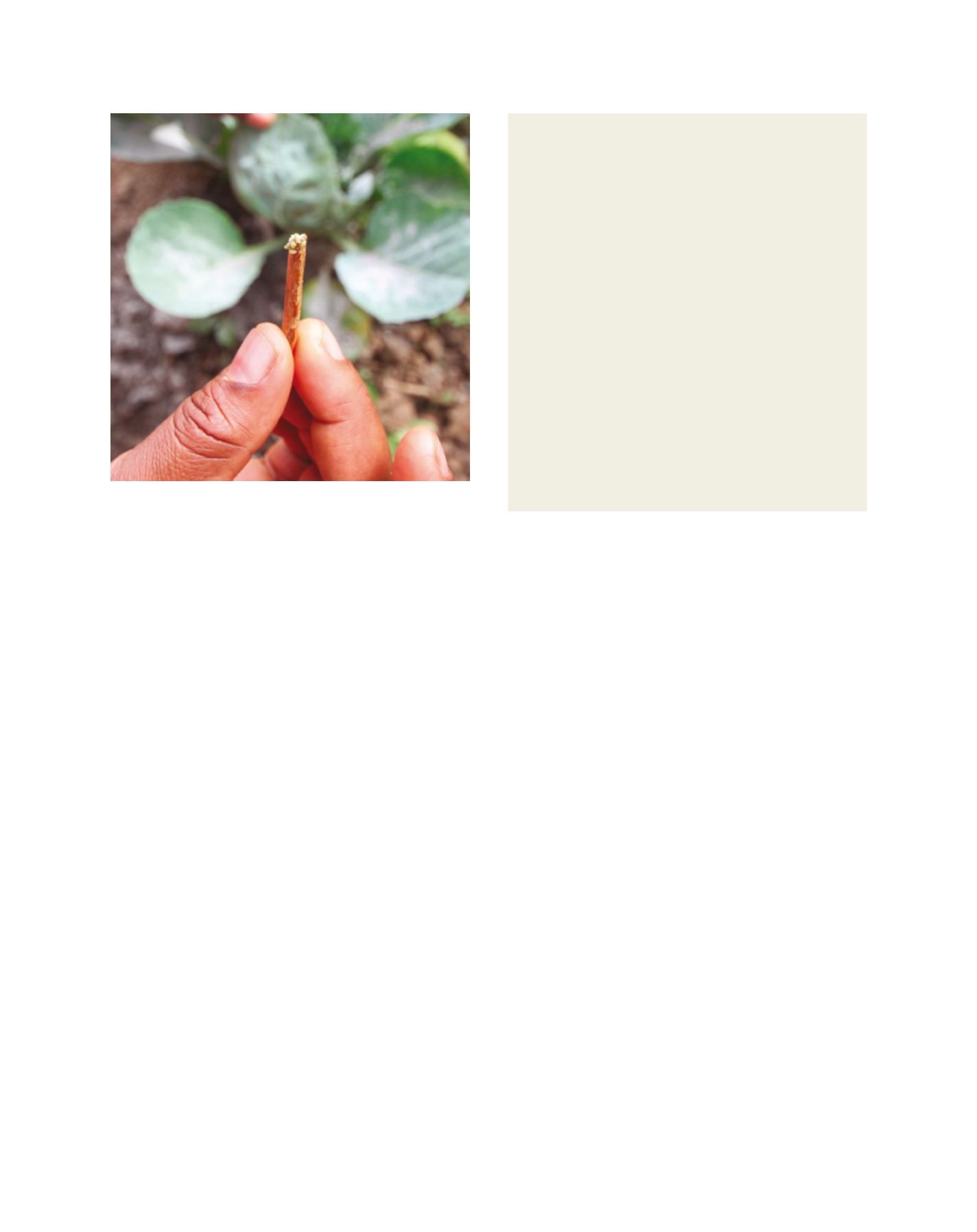
Cochineals affecting cabbage plants in the women’s market garden
of Gaggal, Bantignel
Image: P. Ceci