


 165 / 336

[
] 165
F
inancing
C
ooperation
market-based services. This model can bring together various (and
often unconventional) actors to affect sustainable change.
Case study: Bangladesh
Bangladesh has one of the highest population densities in the world,
with a population of approximately 160 million people and a land mass
smaller than the nation of Greece. According to the Joint Monitoring
Programme in 2010, more than 28 million people in Bangladesh lack
access to an improved water source and 66 million lack access to proper
sanitation. This problem is especially acute in the capital city Dhaka,
which is widely described as a sprawling megacity by aid institutions.
With a population of more than 12 million and an annual population
growth rate of more than 5 per cent, Dhaka has experienced enormous
difficulties in meeting water and sanitation needs. Approximately 85
per cent of urban slum residents in Dhaka do not have access to safe
water, and an estimated 40 per cent do not have a toilet.
Due to rapid urbanization in Dhaka and other major cities, the
Government of Bangladesh has emphasized access to safe drink-
ing water and sanitation facilities in urban areas. Nearly a third of
Dhaka’s population lives in urban slums and lacks legal access to
safe water connections. According to local laws, community resi-
dents need city approval before they can connect to city water pipes,
and this is only given to residents who can provide proof of land
ownership. While government agencies wanted to increase access in
slums, legal restrictions left the Dhaka Water Supply and Sewerage
Authority (DWASA) without the ability to carry out its mandate.
One of
Water.org’s partners in Bangladesh – Dushtha Shasthya
Kendra (DSK) a local non-governmental organization (NGO) in Dhaka
– stepped in to help fill this critical gap. DSK’s founder, Dr Dibalok
Singha, saw that slum residents were forced to pay high prices for unsafe
water supplied by slumlords, or they bought expensive bottled water
from the ‘water mafia’ in Dhaka, often at 15 times the rate that DWASA
charged legal water customers. Dr Singha met with DWASA’s leader-
ship to figure out how they could cooperate and reach those without
safe water access. DSK had a simple solution to a complex problem:
empower the poor to become water and sanitation
customers, and rely on their desire to improve their lives.
Dr Singha convinced DWASA that slum residents would
repay water and sanitation loans if given the opportunity.
In the end, he successfully lobbied the city to provide a
water licence to his NGO on behalf of participating slum
communities. Philanthropic grant funding enabled staff to
build water and sanitation infrastructure, such as house-
hold water connections and toilets.
In 2004, after witnessing the powerful relationship
between DSK and DWASA,
Water.orgrealized there
was an opportunity for its new WaterCredit initia-
tive. After reaching an agreement,
Water.orgprovided
a philanthropic grant or initial ‘smart subsidies’ to
DSK, designed to attract and leverage additional social,
commercial and civic capital and to cover fixed costs
for starting up the new loan development process and
enhancements to its loan tracking system. This enabled
DSK to pilot and roll out water and sanitation loans
in target slum communities. The staff also learned that
additional capital could grow and further scale the loan
programmes, thus creating a natural ‘multiplier effect’.
By taking this crucial first step and believing in the
intrinsic power of the poor,
Water.org, Dr Singha and
DSK were able to reach more underserved communities
with critical services, and increase the focus on the level
and nature of demand.
In this particular WaterCredit programme, DSK
provides loans for both community and household-
level water and sanitation improvements. To initiate
the process, DSK’s staff works with the slum commu-
nity to help form gender-balanced water and sanitation
committees. Each committee then pays to install water
pumps or toilets, and the costs of operation and main-
tenance. The committees also collect and pay the water
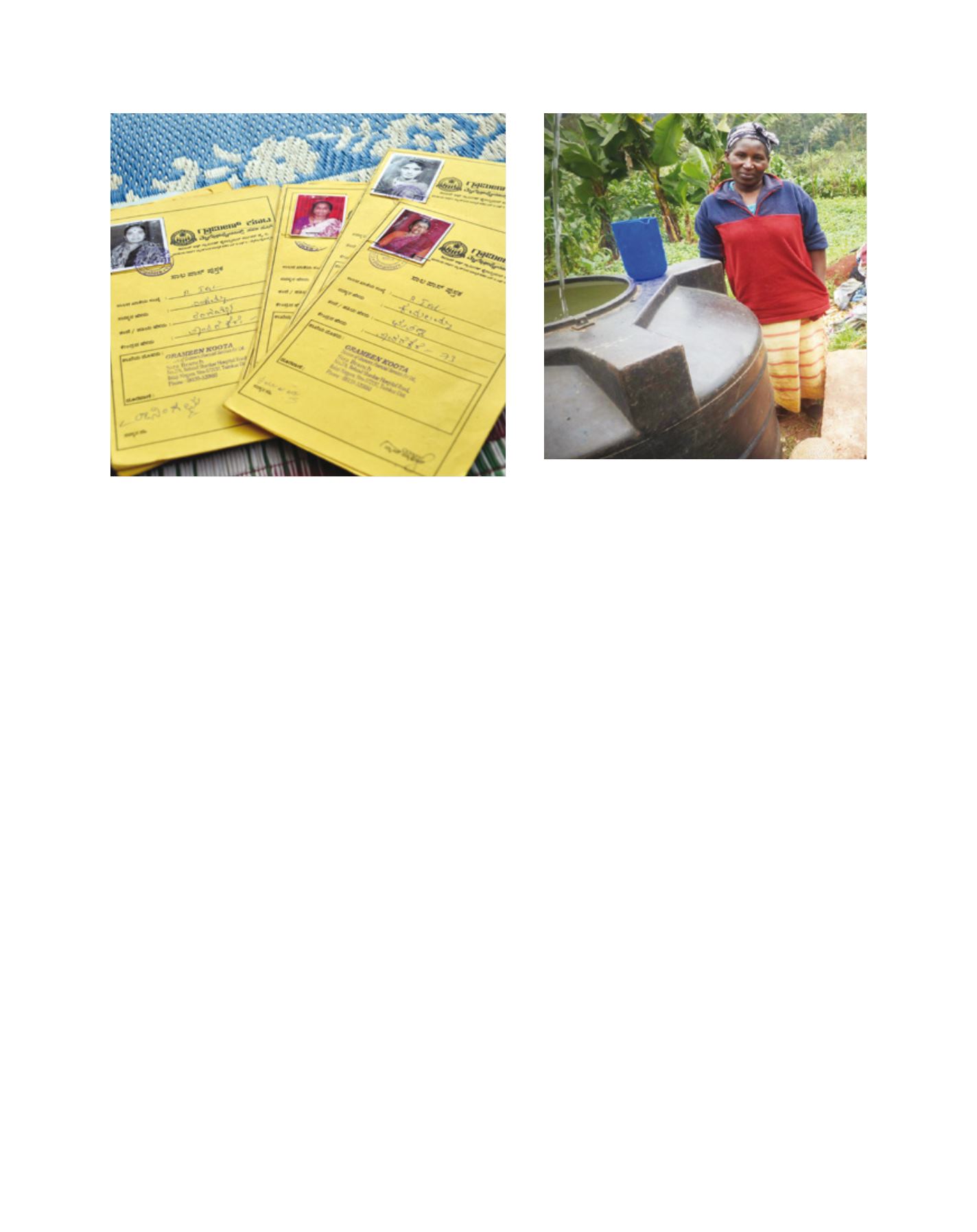
Borrowers are given loan cards to track their loan balance and repayments
Rose Nungari uses her rehabilitated well and storage tank, obtained
with a WaterCredit loan, for household use and to irrigate a garden
Image: Water.org
Image: Water.org