


 168 / 336

[
] 168
F
inancing
C
ooperation
cent of all water required by the city. They participate
in either a promoting or technical group, based on their
expertise, interests and contribution to the Water Fund.
The promoting group works closely with all the parties
involved in the watershed, including public and private
stakeholders, to provide expertise, knowledge and
resources to the Water Fund. The technical group are
tasked with creating sound action plans for conservation
purposes, ensuring that investment decisions align with
the conservation and management plans, programmes
and conservation projects in the watershed.
Taking into account all the different interests and
opinions of the involved parties can be a challenge,
especially when it comes to defining common goals.
Scientific factors can be useful in this respect, as they
define the most important needs of the watershed and
highlight key environmental issues – such as water
supply and the impact of natural disasters. With this in
mind, FAMM’s stakeholders have agreed on the follow-
ing environmental-related goals:
• Flood control: the target is to lower peak flow
in the upper watershed by as much as 750 cubic
metres per second during extreme events. This will
prevent natural disasters in the city basin, which
have increased in Monterrey in recent years as a
result of climate change
• Water infiltration: the target is to increase the water
available for infiltration by reducing surface run-off
by at least 20 per cent.
Other goals to restore and conserve the watershed are set by
the stakeholder group, based on their expert assessments.
Promoting social awareness is also a key objective
for FAMM. Making citizens more aware of their impact
on the watershed can help to encourage responsible
behaviour and drive further sustainability initiatives
led by local communities. In addition, FAMM is keen
to highlight that parties that get involved with local
restoration and preservation field projects can receive
financial support from public authorities.
Science determines more than the strategic direction of
FAMM’s resources and efforts; it directly influences the
intervention plan of the Water Fund. Critical areas that
require intervention are identified and prioritized based on
scientific models to ensure the greatest returns on invest-
ment in terms of the environmental services provided.
Field actions are also defined based on these strategies.
In addition, science factors provide a compelling
argument for the execution of public resources in
accordance with FAMM’s strategic plan, as they dictate
what conservation efforts will be most effective. In
general, demand for resources far exceeds what’s actu-
ally available. Usually, FAMM can only offer around
ten per cent of the required resource per year to work
with, meaning that all activities and initiatives need
to be carefully prioritised. It’s worth noting that the
Water Fund itself should also be looking to gain addi-
tional resources from other parties, such as government
bodies and other local stakeholders.
The Latin American Water Funds Partnership has already begun
developing a governance structure to promote regional coopera-
tion and align efforts and resources for the effective, large-scale and
efficient conservation of watershed in the region. Although some
Water Funds and related initiatives are already up and running, the
partnership expects this governance structure to further improve
existing activities and strengthen the impact of new Water Funds
in the future.
The partnership recognises that, as with any initiative where
several stakeholders are involved to achieve a common goal, it is
very important to determine the Water Fund’s structure, define
the responsibilities of each stakeholder and manage individual
expectations. Ensuring everybody is involved in decision-making
is key – whether they are providing seed capital or other assets/
resources to the Fund. Including public authorities is very impor-
tant, as watershed is a public resource – but this can be complex,
especially when they are subject to political influences and electoral
cycles, which can jeopardise long-term efforts. Given the number
of parties that can be involved, as well as their different motives for
contributing to a local Water Fund, it’s important that participation
incentives are also governed. Ultimately, the structure, or institu-
tional arrangement, of a Water Fund should be tailored according
to local requirements.
Metropolitan Water Fund of Monterrey
Located in northeast México, Monterrey is an industrial city charac-
terized by a thriving private sector, involved public authorities and
social organizations that are passionate about natural conservation.
The MetropolitanWater Fund (FAMM using its Spanish acronym) has
19 stakeholders, representing private companies, public institutions,
non-profit organizations and academia. All of them have interests in
and influence on the local San Juan watershed, which provides 80 per
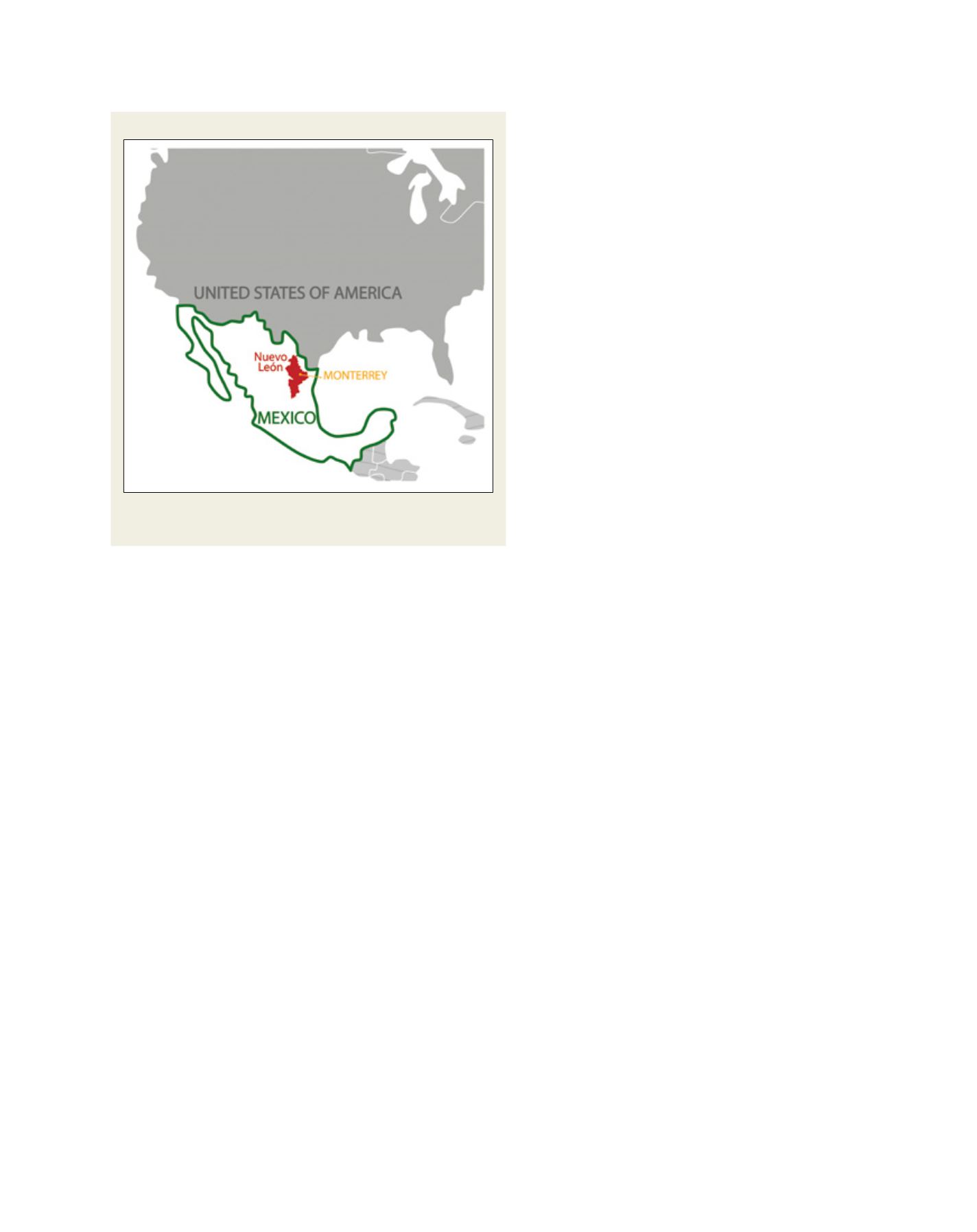
Monterrey, Nuevo León, Mexico
Monterrey, capital city of Nuevo León, Mexico, has experienced numerous cases
of flooding and drought throughout its history