


 189 / 336

[
] 189
W
ater
C
ooperation
, S
ustainability
and
P
overty
E
radication
expected to transfer knowledge outside the community
relatively easily through personal communication.
• The pesantren generally covers primary to senior
high school levels of education, and the demo site
provides one way to introduce education about
water resources in these schools.
• There are about 26,000 pesantren in Indonesia.
Although the exact number has not been recorded
with certainty, the overall estimated pesantren
in the country could empower up to 20 million
people. The success of socialization and the
campaign for sustainable management of water
resources in the school community demo site
location will be used as a model for other Islamic
communities and, ultimately, the general public.
Pesantren Ar-Risalah in the Kudat district was selected
as one of the locations for demo site development.
This has been done in 2012 and activity will continue
in 2013. The Pesantren Ar-Risalah project involved
approximately 2,700 people consisting of boarding
students, teachers and support personnel who are
mostly local people.
Water resources used to meet the daily needs of
the boarders come from groundwater and river water
in Cijantung. Groundwater is used by means of arte-
sian wells, while the river water goes through simple
processing tanks for coagulation, flocculation and
filtration. The quality of the river water used needs
attention, to make sure it meets quality standards for
the allotment of domestic activities such as hygiene and
sanitation. Sewage disposal systems in boarding schools
are still open, or there is open dumping in the environ-
Analysis System (IFAS) course was realized in collaboration with
the International Centre for Water Hazard and Risk Management,
the UNESCO Jakarta Office and LIPI. The objective is to enable
government agencies to use appropriate software (IFAS) for flood
forecasting and warning systems that lead to increasing capacity
in managing water resources under climatic variability and related
extreme phenomena. The course entails the provision of national
digital geographic information system data for the creation of models
at the target river basin as well as local hydrological/hydraulic data
for run-off analyses and model validation.
Demo site for community-based water management
The objective of the demo site for ecohydrology development is to
act as a field station for the implementation of ecohydrology concepts
in the field. The demo site ecohydrology campaign is expected to
be significant in socializing the sustainable management of water
resources in accordance with the concept of ecohydrology. It will also
serve as a natural laboratory for the future development of ecohydrol-
ogy, especially as a tropical Indonesian concern. Ecohydrology demo
site development in Indonesia will be directed to a location demo site
representing the concept of sustainable water resources management
in several different groups, namely an ecohydrology demo site for the
community-based management of water resources.
Community is an important factor in supporting the sustainable
management of water resources. Community groups are expected to
be agents of change in an effort commonly referred to as integrated
water resources management. In 2012, the ecohydrology demo site
for community-based development on water management was estab-
lished at community-based public schools.
Pesantren – traditional Islamic boarding schools – are very
common in Indonesia. They provide a community that is in a strong
position in society, led by a Kiai (a respected Islamic leader). Members
of this community are generally role models in society, and can be
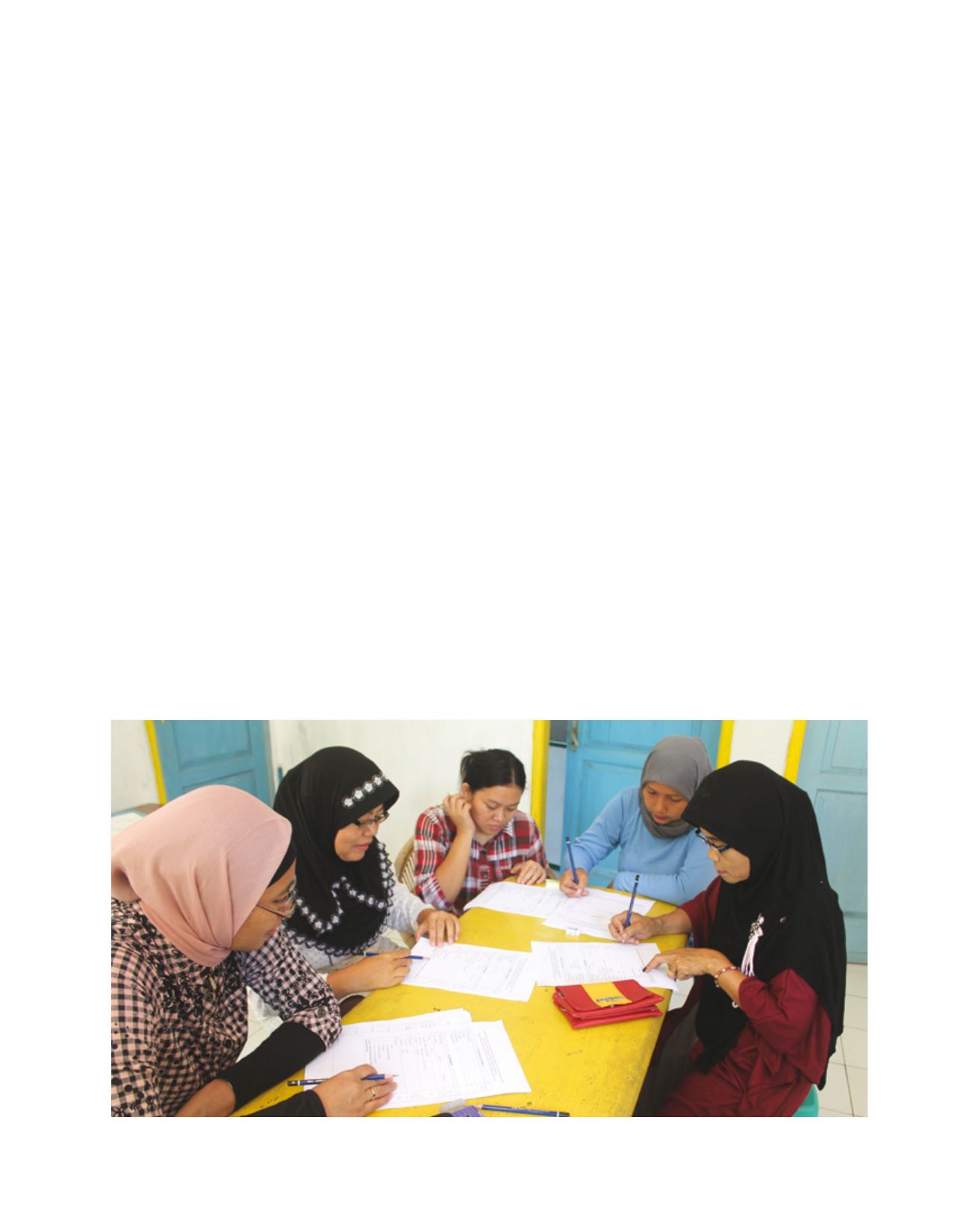
Local people studying water management
Image: APCE