


 190 / 336

[
] 190
W
ater
C
ooperation
, S
ustainability
and
P
overty
E
radication
ment. Solid waste and liquid waste is disposed of in open landfills
in the back yard of the boarding school, while domestic solid and
liquid waste is discharged directly into water bodies through the
pipes without prior processing. This, of course, would be bad both
for local air and water quality and for public health, given the quality
of river water that is used directly. Assessments of the quality of the
raw water used and of waste management for boarding occupants
have made these areas the focus of attention for improving water
resources management at the site through demo site ecohydrology.
Artificial wetland for wastewater treatment
In the early stages of development, demo site ecohydrology at
Pesantren Ar-Risalah Kudat focused on improving the quality of
domestic water and waste management. Domestic wastewater treat-
ment is done by constructing artificial wetlands, hereafter referred to
as ‘wetland’. This wetland functions to improve the quality of domes-
tic wastewater originating from the bathroom, kitchen and any place
of ablution that is not directly discharged into the river water bodies.
Meanwhile, domestic solid waste will be collected in a communal
septic tank where water run-off can flow into the wetland. In order
to improve the quality of water supply to schools, there are future
plans for the manufacture and installation of water treatment plants
at school locations, using river water as a raw material.
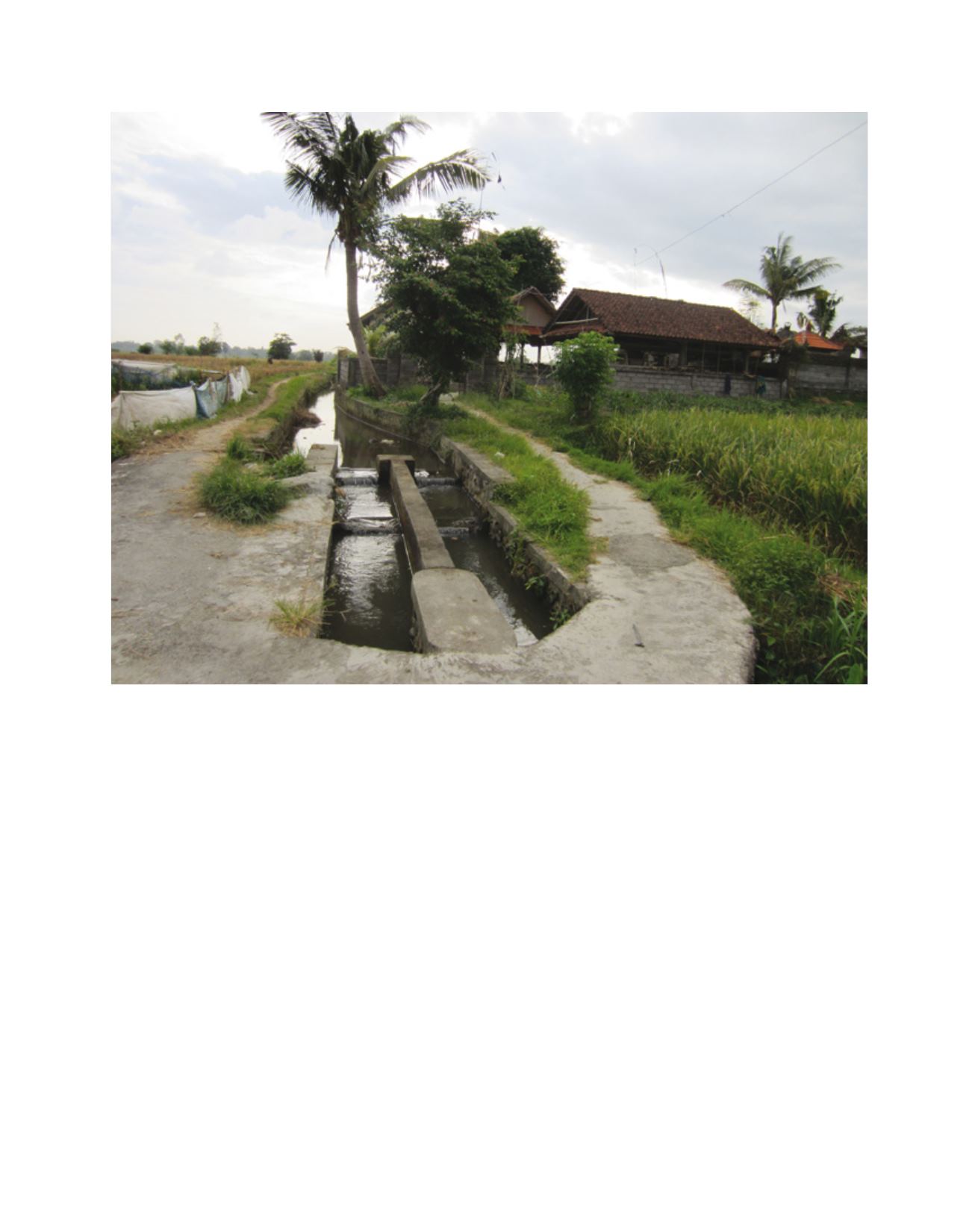
Cultural landscape and the subak system in Bali
Subak is the name of the water management (irriga-
tion) system for paddy fields on Bali island, Indonesia,
developed more than 1,000 year ago. Over that time,
this traditional ecologically sustainable irrigation
system has constantly adjusted to changing situations.
The result is an intricate system which is strongly
interlinked with Bali’s natural, social, cultural and
religious environment.
The cultural landscape of Bali consists of five rice
terraces and their water temples which cover 19,500
ha. The temples are the focus of the cooperative subak
system of water management for canals and weirs,
which dates back to the ninth century. Included in
the landscape is the eighteenth-century Royal Water
Temple of Pura Taman Ayun, the largest and most
impressive architectural edifice of its type on the island.
The subak system of democratic and egalitarian farming
practices has enabled the Balinese people to become the
most prolific rice growers in the archipelago despite the
challenge of supporting a dense population.
Rice, the water that sustains it and subak, the coop-
erative social system that controls the water, have
The subak system: temple, paddy field and water
Image: APCE