


 77 / 280

[
] 77
including both the open ocean and coastal modules, will
require substantial new commitments frommember states
and much stronger intergovernmental mechanisms to
ensure they are sustained.
9
Putting aside the importance of simplicity as a means
to ensure reliability and sustainability, it is clear that pres-
sure will always exist to fill gaps and improve accuracy.
Indeed, many exciting new technologies are being devel-
oped as pilot projects for potential future inclusion in
GOOS and, as with any new technology, there will no
doubt be myriad exciting spin-offs from these innovations.
One example is the recently approved GOOS pilot project,
the ocean tracking network (OTN), which simultaneously
monitors ocean conditions and marine life response to
these conditions by tagging sea creatures with tiny trans-
mitters. These transmitters allow the movement of sea
creatures to be tracked for over 20 years by receivers placed
at one-kilometre intervals along the ocean floor, across
tively boring. In order to serve such a diverse array of users and prod-
ucts, operational observing system components are designed to be
inexpensive, simple, reliable and to adhere to common standards and
protocols. Hardly headline material. As with levees in New Orleans and
highway bridges in Minnesota, for example, the ocean observing system
is designed to unobtrusively provide public services that generally only
receive attention when they fail.
What are these low profile observing system components? As
described in the article
The blue planet – observations of the global ocean
by Baker et al in this book, a network of buoys, moorings, floats, tide
gauges and XBT hydrographic lines that make up the planned in situ
open ocean module is in place. However, the network has to date
reached just over 50 per cent of its design specifications, and current
and projected future levels of national contributions are clearly insuf-
ficient to finish the task. Furthermore, although plans for a coastal
module for the GOOS have been agreed, they have yet to develop
substantially as a global system, but in many cases continue to exist as
a menagerie of disparate national efforts. Full implementation of GOOS,
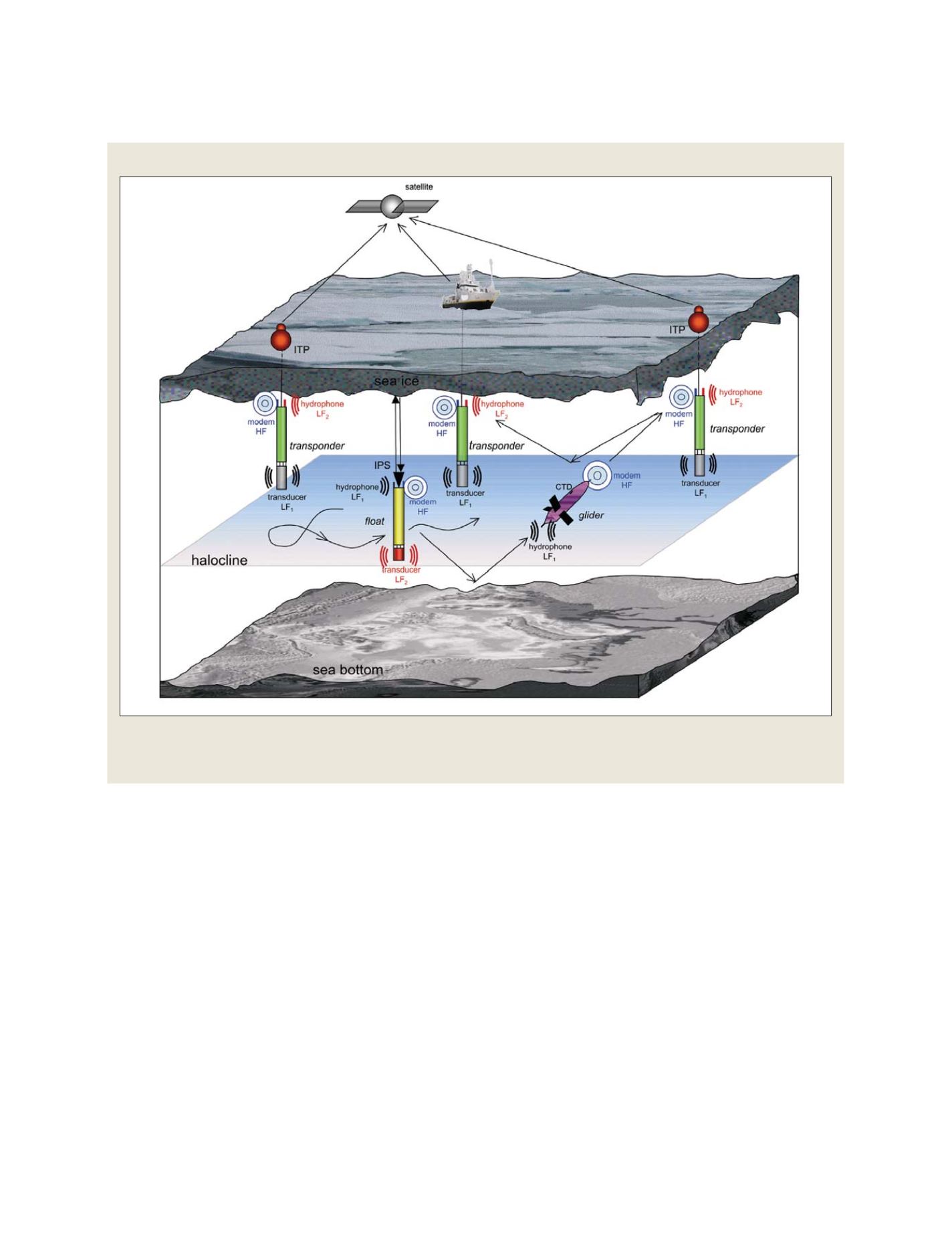
An ocean observing scheme for the Arctic Ocean
The ocean-observing scheme for the Arctic Ocean currently being implemented by the DAMOCLES Integrated Project of EC-FP6. An extensive system of
floats and gliders explore the upper ocean, communicating their data to satellites and receiving measurement-control and navigation information via a
net of ice-tethered platforms
Source: Summerhayes et al, Observing the Polar Oceans During the International Polar Year and Beyond, WMO bulletin 56(4) 2007
GEOSS C
OMPONENTS
– O
BSERVING
S
YSTEMS