

 164 / 192

[
] 164
contemporary cities aspiring to development is reflected
in the ability to be well connected and networked with
the rest of the globe. Part of this connectivity is asso-
ciated with awareness of global problems and threats.
The world is struggling with the unsustainable course
set by Western society just as other regions are striving
to imitate that course. We are facing climate change,
rising populations, drought, floods, hunger, intensify-
ing storms, depleting resources, destruction of human
and non-human habitats, the potential of rising sea
levels and the realization that we cannot maintain a
growing economy within a finite world. Interestingly,
research studies have shown that new generations in the
Gulf are well exposed to global issues. A typical child
is connected to the world in real time via Blackberry or
iPhone. Availability of Internet for children and youth in
the Gulf is similar to that in some of the most developed
countries in the west. Gulf children and youth also travel
extensively, accompanied by their parents or alone.
ESD: Gulf universities’ experience
There are urban planning departments in all six Gulf
states.
3
It is worth looking at the nature of these
programmes, and their philosophy, vision and mission,
to understand their ties with sustainability concepts and
principles. An important quality of ESD is that of envi-
sioning – being able to imagine a better future. The
premise is that if we know where we want to go, we
will be better able to work out how to get there. This
requires critical thinking and reflection – learning to
question our current belief systems and to recognize
the assumptions underlying our knowledge, perspec-
tive and opinions. Critical thinking skills help people to
examine economic, environmental, social and cultural
structures in the context of sustainable development.
of ‘sustainability’ that is most often associated with environmental
sustainability. It addresses whether actions taken by humanity are
degrading the Earth’s carrying capacity to the point where the planet
will no longer be able to sustain its biodiversity.
2
Sustainability is
not only about surviving injustice, wars and violence. Rather, it is
multi-dimensional (integrative, ethical and active), as it is only with
an inclusive perspective that humanity’s consciousness, communica-
tion and actions at any level will begin to be transformed.
Emerging Gulf urbanization
According to official statistics concerning the development of the Gulf
States, this decade has seen qualitative and quantitative leaps. For a
country like the United Arab Emirates, urban development is a major
concern of policymakers, planners, public officials and environmental
advocates. The United Arab Emirates has been progressing steadily on the
path of growth and development over the last three decades, propelled by
an oil-rich economy. Although not affluent in other natural resources, the
country has scored high on development indices in recent years due to
unprecedented economic growth, high per capita income and vigorous
social development. The nations in the ArabianGulf region have emerged
as a hub of commerce, stability, security and peace. According to the
2005HumanDevelopment Index Report compiled by the UnitedNations
Development Programme (UNDP), the Gulf States have risen substan-
tially in rank among the developed nations of the world. Because of their
economic growth and relatively open immigration policies, the Gulf
States have attracted large numbers of people from all over the world,
particularly from Asia and Europe, and have urbanized rapidly over a
comparatively brief time frame. Prominent cities like Dubai, Manama,
Doha, Abu Dhabi and Riyadh have expanded to several times their previ-
ous sizes, even as recently as the 1970s and 1980s. Today, these cities
feature prominently on the global map of emerging places.
Education and global issues:
How does education connect Gulf cities to the world in the age of
globalization? According to numerous researchers, the challenge for
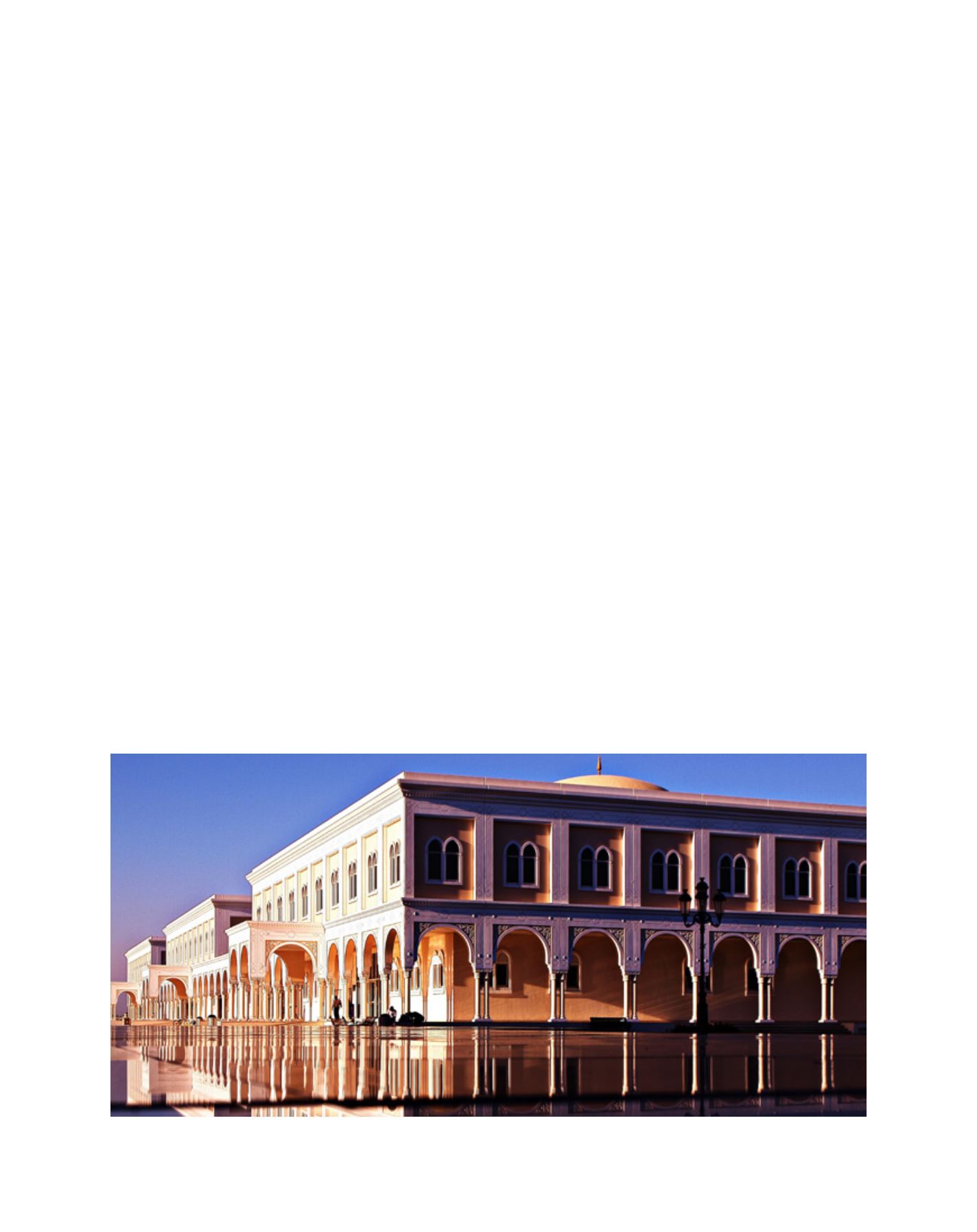
The American University in Sharjah (above), the University of Sharjah and Ajman University opened departments of design and architecture
Image: Basil D Soufi