

 159 / 192

[
] 159
A new educational practice requires a new pedagogy. That is why
in recent years we have insisted on the need for an ecopedagogy, one
that is based on sustainability. Ecopedagogy overcomes the anthro-
pocentrism of traditional pedagogies and establishes a symbiosis
between human beings and nature as an underlying assumption.
The Earth comes to be regarded as a living being, as Gaia. Hence it
would be better to refer to an Earth pedagogy.
What strategies, therefore, are needed to reform current formal
education curricula?
One of the greatest challenges we have when it comes to trans-
forming educational practices and embracing sustainability is to
overcome the naturalistic regard we have towards the environment
and to embrace a systemic and holistic view, which contains multiple,
undetermined and interdependent causalities to conceive a learning
environment of sustainable management beyond the promotion of
isolated actions (reducing, reusing, recycling). Without nourishing
a dialogue in the community, it is impractical to develop a curricu-
lum of clean technologies. We must integrate the local economy
with energy efficiency initiatives, human interaction and the envi-
ronment at large to achieve sustainable consumption, and develop
green technologies, renewable resources, responsible consumption,
human rights, shared principles, power relations and ecological
interactions. These elements can then be gathered together to create
systematized knowledge and form new living habits.
One cannot talk about sustainability without talking about educa-
tion for sustainable consumption. The current economic model in
the developed world cannot be extended everywhere, otherwise we
would need one more planet – or even up to six planets – to be able
to feed and sustain everyone. What is needed is a new model – a
more sustainable one – which can protect the environ-
ment and people’s health.
The idea of sustainability, broadly understood,
encompasses a whole new project of civilization.
Applied to pedagogy, it can have implications in all
fields of education, not only in environmental educa-
tion. At the Paulo Freire Institute, we consider the
concept of sustainability as an interdisciplinary
component in all our projects of teaching and learning.
In order to achieve this, we have developed a concept
and vision of an ecopedagogy, initially called Pedagogy
of Sustainable Development, as an appropriate peda-
gogy for environmental education and transformative
learning. We believe that sustainability is the dream
of living well – a dynamic balance between humans
sustaining themselves and humans looking after the
environment.
These new transformative learning practices based
on sustainability are spreading around the world. One
particularly good practice gaining adoption is the
Seeds of Spring Project. It was developed by the Paulo
Freire Institute in the municipality of Osasco, Brazil.
Started in 2006, this project is based on the principles
and values of sustainability. It promotes active involve-
ment of children and young persons in exercising
citizenship from childhood. Groups of children (Seeds
Groups) chosen by their peers are organized to discuss,
propose and commit themselves to suggestions and
actions related to the Eco-Political-Pedagogical Project
(EPPP) in schools from the standpoint of sustainabil-
ity. In weekly meetings, they participate in practical
activities that involve exercises of ‘reading the world’
(Paulo Freire), which aim to establish the vision chil-
dren have of their school, neighbourhood, city, life
in common, health, leisure, sports, culture and other
matters significant to their situation in each school.
Children and teenagers are guided towards identify-
ing unsustainable practices and finding solutions, as
they seek the improvement they desire for the school,
neighbourhood and city. They become committed to
their proposals for change, and also to becoming part
of what they wish to see achieved.
In summary, I think that sustainability is a powerful
concept for transformative learning. It is an opportu-
nity for education to revolutionize old systems based
on competitive principles and values, and to intro-
duce a culture of sustainability and peace in school
communities. Sustainability can be a fundamental
category for rebuilding current educational systems,
which are still based on a predatory view of the world.
Environmental education and ESD are fundamental
axes to these reforms when they are associated with
human rights, gender rights, democratic rights, peace
and sustainability. That is why I believe that the concept
of sustainability will contribute to the construction of
a new quality in education, a social-environmental
quality, which will change the paradigm of education
that has, ultimately, been destroying the planet since
before the 19th century.
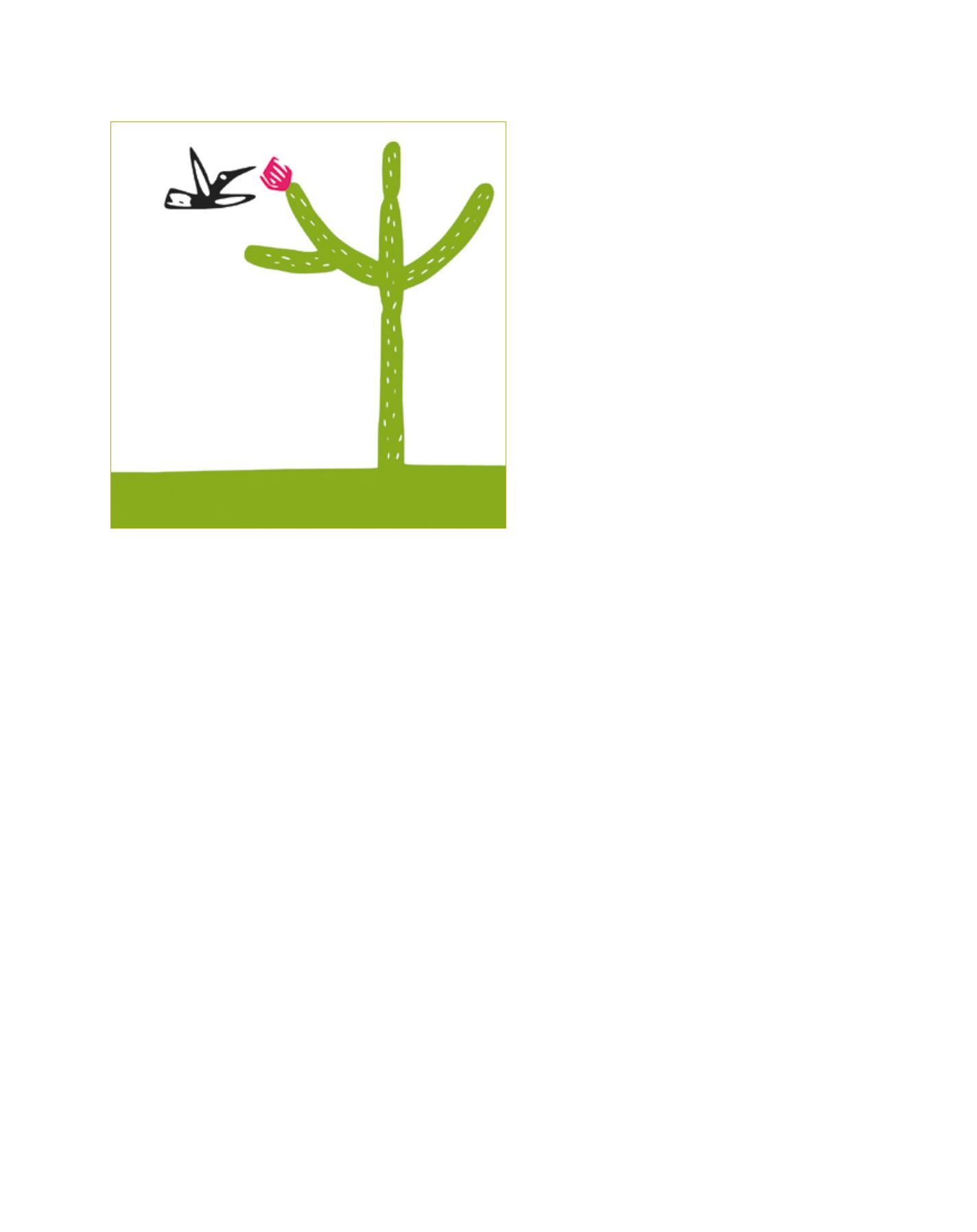
The hummingbird feeds on the nectar collected delicately from the flowers, without
harming the plant, in a sustainable way. The mandacaru (Cereus jamacaru), a tree that
is the symbol of the Northeastern Brazilian backcountry, sprouts only when it is going
to rain. It is a signal of life on the drying land
Image: Paulo Freire Institute