



 270 / 288

[
] 271
C
apacity
D
evelopment
identifying sources is a quest.Mobilizing resources and funds
demands energy and best practices must be shared.
Date rescue must be encouraged for other reasons,
namely because it contributes to making various
communities work together towards a single goal:
developing awareness and educating about risk, in the
framework of climate change.
A final word
It is a critical obligation to advocate for, and support,
data rescue. A strong voice has to come from the Global
Framework for Climate Services. Resources are critical,
of course, but our example aims at showing that this can
be dealt with. Research projects are gradually bringing
onboard data rescue work packages. It is important to keep
in mind that data rescue is not an aim; it is a tool, the input
to homogenization and reanalysis; it feeds climate science.
NMHSs have to be heavily involved, since they inherit
from a long history. Similarly, data rescue is an effort that
needs collaboration with academic, climate, history and
archive scientists. The construction of a research project,
enabling targeted data rescue, is valuable, as are systematic
enterprises. Of particular note is the original public-private
partnership in our example with the support of the founda-
tion of amajor French and international bank, BNP Paribas.
We have challenges ahead, due to resources. But we
would like also to emphasize that data rescue tells us that
we have to think now for the future. We know that we
have to recover a memory of the past: this must remind us
that we have a duty to observe current data that will help
future generations of climatologists to answer the questions
they will be asked. These scientists will appreciate that our
generation, today, has enabled them to work and deliver to
societies a few decades from now. We know data rescue is
critical; let us not forget that data seeding is also vital.
The Fondation BNP Paribas international jury decided that this
action should be one of the supported projects, allowing a very
significant fee. This was not only a huge financial support, but also
an authoritative message that data rescue is a critical contribution
to climate sciences and to culture – and also to adaptation. This
action is now underway. The rich potential is already confirmed as
decontamination operations begin.
Beyond meteorology and climate science
Météo-France is acting with few scientists at the forefront on these
matters in France, spreading the message of the importance of data
rescue. The example is being followed by many communities which
are used to closely interacting with meteorologists – for example,
hydrologists. Of course, in the past a lot of scientists have carried
on such efforts – but the message now is that data rescue has to be
considered as a systematic eneterprise, run with all the necessary
priority and support: climate change imposes a higher momentum
where, traditionally, only a few isolated scientists were trying to act.
Data rescue must be considered as a real climate service. Indeed, it is a
long chainof actions. At each step, close partnerships have to be established
with various actors: priorities are given by climate scientists, while oppor-
tunities and clues are permitted by historians or archivists. Searching and
Source: Météo-France and Archives Nationales
Source: Météo-France and Archives Nationales
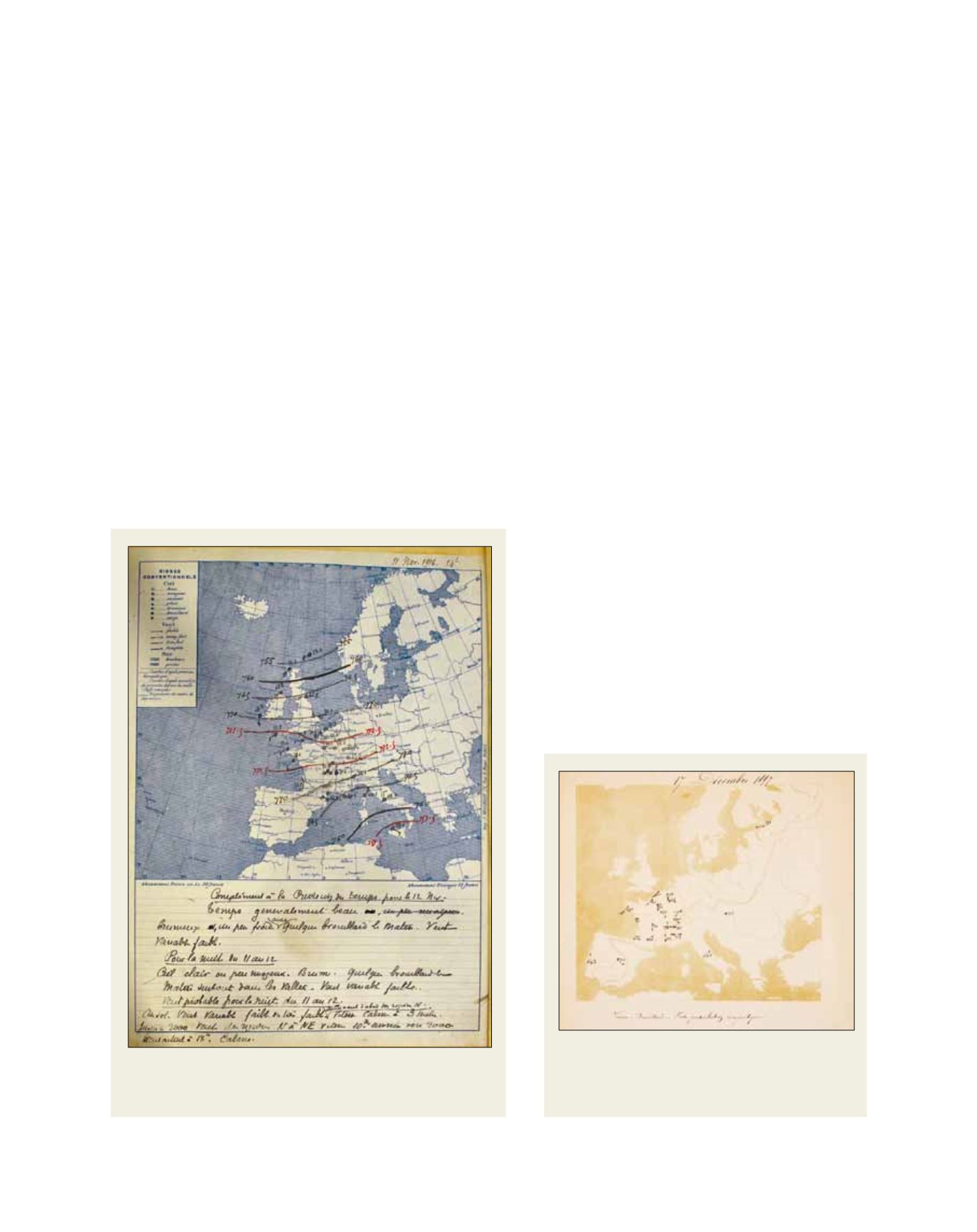
A map from November 1916 found in the French archives and currently
undergoing asbestos decontamination in a joint effort between the Archives
Nationales and Météo-France, sponsored by Fondation BNP Paribas
Following after the destruction of the allied fleet in the Black Sea by
a storm, during the Crimean war, a weather service was established
in France; this chart was drawn soon after, in 1857, and shows a
French network but also connections with other European countries