



 69 / 288

[
] 70
A
griculture
interventions at watershed scale have shown a win-win
situation for upstream rainfed farmers with a positive
trade-off in terms of a 30 per cent increase in incomes,
with reduced run-off to the Osman sagar providing
drinking water to Hyderabad, India with an additional
cost of US$4 million.
These interventions improved green water use effi-
ciency by 64-72 per cent, run-off reduced from 19 per
cent to 8 per cent and enhanced groundwater recharge
from 8 per cent to 20 per cent at the basin level. They
also built resilience during the drought year, as evident
from the data at Kothapally benchmark watershed. Here,
in the 2002 drought year there was no change in the
share of agricultural income to total family income in the
watershed, whereas non-watershed villages saw a drastic
reduction of agricultural income from 44 per cent to 12
per cent of family income. Families in non-watershed
villages had to migrate for their livelihoods, whereas in
Kothapally, farmers could manage their livelihoods.
ICRISAT and the Government of Karnataka have taken
a knowledge-based, bridging yield gaps mission-mode
initiative by forming a consortium and a network of stake-
holders for sharing their knowledge about the weather as
well as soil health and improved management practices
covering all the 30 districts in the state. During the 2011
rainy season, the soil-test based nutrient management
interventions along with improved seeds, seed treat-
To provide the necessary knowledge to the farmers, an ICRISAT-led
consortium comprising of national agricultural research systems,
development agencies like government line departments and non-
governmental organizations provided technical backstopping
to the community. Soil health assessment, stress-tolerant high-
yielding cultivars, water analysis and so on were used as an entry
point for building rapport with the community. Improved rain-
water management and harvesting resulted in ensuring increased
green water use efficiency as well as augmenting water resources
(ground and surface water) through low-cost water harvesting
structures. Through watershed management, groundwater avail-
ability increased in benchmark watersheds in different states of
India, Thailand, Vietnam and China.
6
The diagnostic participatory
soil health assessment in the watershed revealed widespread defi-
ciencies of zinc, boron and sulphur in farmers’ fields which were
holding back the potential of rainfed agriculture in the regions.
7
Soil-test based plant nutrient management, along with seeds
of improved cultivars, seed treatment and other soil and nutri-
ent management practices, showed up to four-fold increases in
crop yields at different benchmark watershed locations in India,
Thailand, Vietnam and China. In addition, participatory watershed
management reduced soil loss (by two to four times), increased
groundwater recharge (2-3 m rise in the water table), reduced
run-off (30-60 per cent), increased greenery cover and improved
economic gains for the farmers. Social capital – in terms of collec-
tive action, institution building and self-help groups – provided
add-on benefits from the integrated watershed management. These
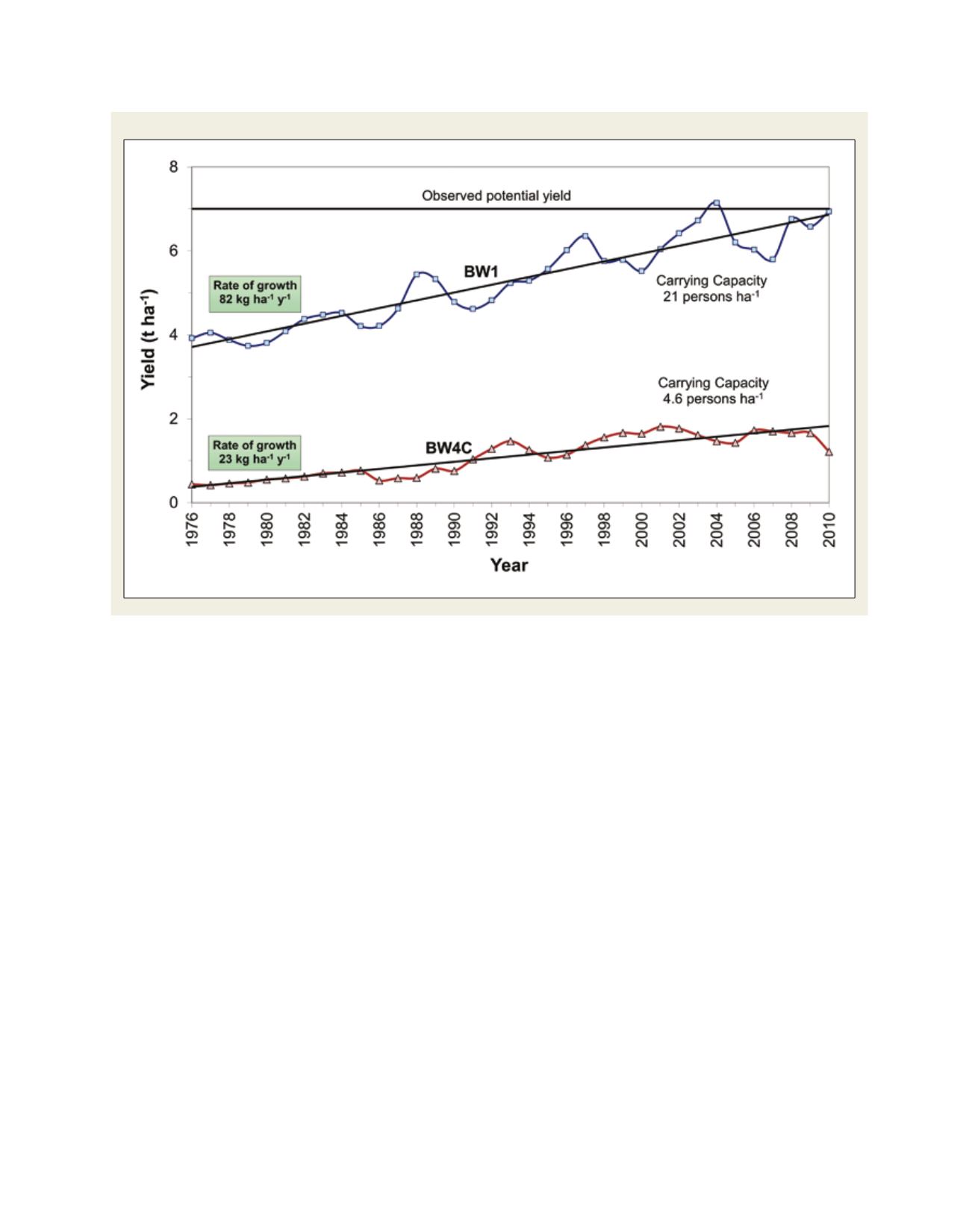
Vast untapped potential of rainfed agriculture, (long term experiment at ICRISAT)
Source: ICRISAT