


 115 / 218

[
] 115
doing so, it has shown that governments must first dispel the
notion that there is a trade-off between growth and being envi-
ronmentally friendly. As a developing country that imports 70
per cent of its energy, India cannot ignore the need for strate-
gies in the building industry that will reduce consumption by
enhancing the country’s energy security.
Energy security is not primarily about generation so much
as it is about achieving energy efficiency. The question that
BCIL has often asked is: if economic agents reduce their energy
use, and therefore their costs, how can this be bad for the
growth and productivity of a company or government?
If you observe the quality of a product and service, or
customization in the marketplace, you will see that until very
recently, these goals were considered costly to achieve. What
BCIL has effectively done over the past decade, with every evolv-
ing project, is to break free from this dominant logic and use
quality and customization as means to both acquire customers
and reduce costs. This is both applicable at the capital stage of
construction, and at the post-project stage when reduced energy
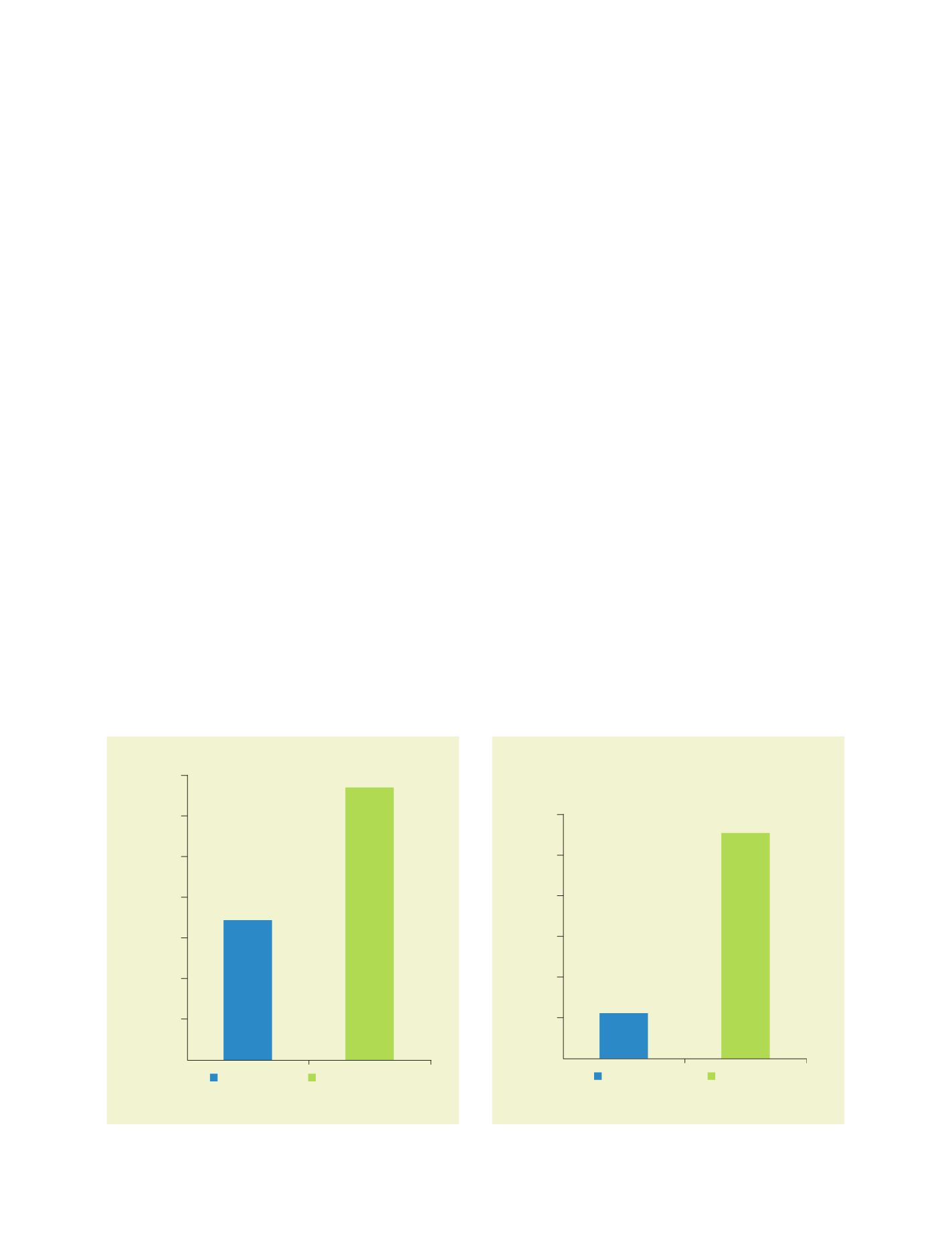
and water use brings financial savings to customers. The graphs
accompanying this article illustrate the approach, the strategy
and the process management methods that are employed to
achieve such goals at the brick-and-mortar level.
Incentives and subsidies only encourage excess use, and waste
precious resources. Energy efficiency does not need any incen-
tive, for it always shows a positive impact on corporate bottom
lines across the board. That is adequate motivation for compa-
nies like BCIL, and should be so for all corporations. Subsidizing
energy or water costs, instead of focusing on their efficiency, is
against growth, as indeed it is against sustainability.
As a corporate enterprise, BCIL has been mindful of the
comfort and convenience that our products offer to our
customers, be it in the segment of the urban rich or the rural
poor. Normal market behaviour suggests that higher comfort
means higher use of resources.
“sustainability is the key to winning tomorrow’s markets.” And
Kofi Annan said recently: “I hope corporations understand that
the world is not asking them to do something from their normal
business; rather it is asking them to do business differently.”
BCIL’s raison d’etre
In 1994, a fledgling group of development workers in the sub-
Himalayan districts of India chose to move away from ‘social
models’ of development with grants and subsidies. The group
established an enterprise that sought to identify an array of
technologies in building, water and energy management that
could demonstrate resource-sensitivity while also being finan-
cially viable. Eleven years down the road, Biodiversity
Conservation (India) Ltd. (BCIL) has shown that sustainabil-
ity can be a central platform for business growth.
In 1995, its first year of operations, BCIL had a business
value of USD 500,000. From this modest beginning, it has
grown to become a USD 25 million enterprise. This clearly
suggests that markets are both willing and in need of processes
and technologies that make no compromise on the defined
urban frameworks of development, comfort and convenience,
while delivering efficiency in natural resources.
This philosophy lies at the core of BCIL, which is India’s
largest Sustainable Built Environment (SBE) enterprise today.
BCIL has made a case in every business and development
forum for ending the present perverse system of offering subsi-
dies and incentives in the form of artificially lower prices for
‘green’ technologies. BCIL sees a highly productive marriage
between the two forces of growth and environmental respon-
sibility, which need to be made compatible.
With 330 per cent annual growth registered in just the past
year of performance, BCIL is a standing testimony for moving
away from such regressive thinking on ‘nurturing’ green devel-
opment. Since its inception, BCIL has promoted successful
business models that have mainstreamed the ‘alternative’. In
0
200
400
600
800
1000
1200
1400
Zed SSB and
laterite walls
Conventional solid concrete
blocks and burnt clay bricks
CO2 emissions – MT
769.31
1360.01
External walls
Home lighting
Source: BCIL
0
50
100
150
200
250
300
CFL lights
Halogen and
flouroscent lights
Kwh
56.92
269.85
Source: BCIL