



 119 / 218

[
] 100
Glaciers and ice caps in the Nordic countries have retreated
and advanced during historical times in response to climate
changes, which are believed to have been much smaller than
the greenhouse-induced climate changes that are expected
during the next 100–200 years. These changes have in many
cases left clear marks on the landscape in the neighbourhood
of the glaciers.
Simulated changes in ice volume and glacial runoff
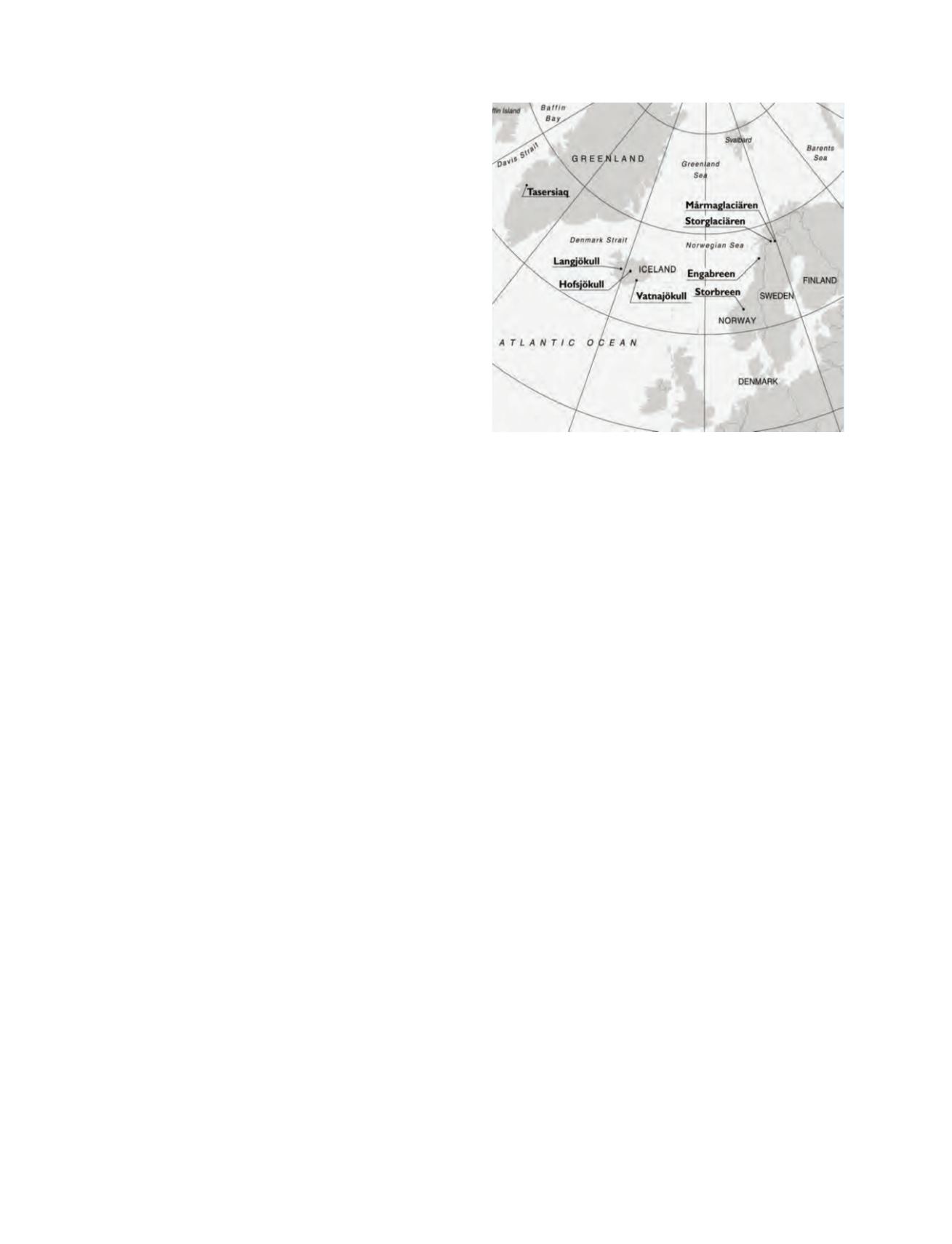
Several ice caps and glaciers in the Nordic countries were
studied within the CE project using mass balance and dynamic
models to project future changes in ice volume and glacial
runoff based on scenarios for future climate change.
In simulated ice wastage for the modelled glaciers, simula-
tions with a 2D ice flow model are run to 2200, but the
Norwegian and Swedish glaciers are only run to 2100 because
of limitations in a simplified dynamic model used for these
glaciers. The time evolution of ice volume has a similar char-
acter for the modelled glaciers, except for Engabreen in Norway
and Mårmaglaciären in Sweden. The modelled ice volume is
reduced by more than half within the next 100 years, and the
glaciers essentially disappear in 100–200 years after the start
of the simulations, given that the rate of warming with time
remains the same. One of the Norwegian glaciers retreats more
slowly because of a substantial increase in precipitation, which
is projected by the CE scenario for the area where this glacier
is located.
The projected change in the mass balance of the glaciers
leads to a marked increase in runoff from the area covered by
ice at the start of the simulations. Due to the large amplitude
of the projected changes, the changes with respect to the
runoff at the start of the simulations are similar to changes
with respect to a 1961–1990 baseline, which was not explic-
itly modelled for most of the glaciers. By around 2030, annual
average runoff is projected to have increased by approxi-
mately 0.4–0.7 m
w.e
.a
-1
for the Norwegian and Swedish
glaciers, and 1.5–2.5 m
w.e
.a
-1
for the Icelandic ice caps. The
runoff increase reaches a comparatively flat maximum
between 2025 and 2075 (except for Engabreen in Norway)
when the increasing contribution from the negative mass
balance is nearly balanced by the counteracting effect due to
the diminishing area of the glacier. For all the glaciers, this
maximum in relative runoff increase is over 50 per cent with
respect to the current runoff from the area presently covered
with ice.
For the Icelandic ice caps, the specification of a compara-
tively large change in climate during the initial decades of the
simulation, based on the observed climate of recent years, and
the seasonality of the climate change with the largest warming
in spring and fall, leads to a rapid increase in runoff with time.
The simulated runoff changes may be compared to average
runoff from these ice caps between 1981 and 2000, which is in
the range 2.4–4.1 m
w.e
.a
-1
. In model results for Engabreen in
Norway, although the precipitation increase for the other glac-
iers is of much smaller importance than the temperature
change, the assumed precipitation change can significantly
alter the simulation results in cases where substantial precip-
itation changes take place. The fact that this only happens for
one of the glaciers highlights the uncertainty of the climate
change scenario.
These results clearly suggest large changes in runoff from
glaciated areas, which are projected to have reached quite
Location of the glaciers and ice caps studied in the CE project
significant levels compared with current runoff, well before
2030. The associated changes that may be expected in diurnal
and seasonal characteristics of glacial runoff will come on top
of the changes in the annual average.
Hydropower is the most important renewable source of elec-
tricity in Iceland and it is the renewable energy source most
strongly affected by climate. The results from the CE project
and the related national research programmes show that this
impact can be quite strong. Global warming will shorten the
winter season, make it less stable and lengthen the ablation
season on glaciers and ice caps. This leads to a more evenly
distributed river flow over the year, which is a profitable situ-
ation for the industry.
There is also potential for increased hydropower production
as the highest modelled increase in river flow is simulated in
highland areas that are most important for hydropower. This
implies that the projected hydrological changes may be
expected to have practical implications for the design and oper-
ation of many hydroelectric power plants, and also for other
use of water, especially from glaciated highland areas.
One negative aspect is that the new annual rhythm in runoff
indicated in the simulations will put more stress on the spill-
ways. They will probably have to be operated more often in
winter, as the unstable winter climate will generate more
frequent sudden inflows when reservoirs may be full. This
will also have an impact on the infrastructure with more
frequent flooding problems downstream at the reservoirs.
These areas are normally adapted to the present-day climate
with stable winters and without high flows from autumn to
spring.
In summary, the power industry needs to develop a new
strategy characterized by flexibility because it must be possi-
ble to adapt the operation and even the design of power plants
as climate change leads to changes in the discharge and season-
ality and other hydrological characteristics. Continued research
on climate change is essential to address the added uncertainty
with which the industry is faced due to this situation and in
order to supply the necessary information for proper adapta-
tion to the evolving climate.
Image: Fenger (2007)