



 125 / 218

• Existing NMHSs communications for technical data,
sector-relevant information, and public information are
critical elements for all aspects of disaster risk assessment
processes and early warning practices. When associated
with accumulated data and information resources, such
communications facilities provide a basis for wider profes-
sional synergy and commercial engagement in managing
disaster risks.
3.
Knowledge
– use knowledge, innovation and education to
build a culture of safety and resilience at all levels:
• The extensive influence of weather, water and climate
throughout societies provide considerable opportunities
for the development and delivery of educational materials
– for policy relevance, professional training, private and
public educational curricula, and public information and
awareness
• Opportunities abound to link weather, water and climate
information and knowledge with wider societal awareness
and policy commitments to disaster risk management
opportunities – prior to the onset of (as well as follow-
ing) emergency or crisis conditions
• Multi-disciplinary and wide-spread, policy relevant
research agendas that relate to weather, water, climate, and
disaster risks can be spearheaded by NMHSs, with partic-
ular relevance given to their shared economic, commercial
or social implications
• Develop joint NMHS – educational institution programmes
with research, learning, or professional training opportu-
nities that marry weather, water, climate and disaster risk
interests and insights.
4.
Reduce underlying risk factors
that increase the likelihood of
disasters by involving (‘mainstreaming’) disaster risk aware-
ness and management with other professional or sectoral
subject areas:
• Associate climate and disaster risk interests, data and
communications abilities within NMHSs explicitly with
the roles and interests of other professional, commercial
and policy requirements of related sectors, including those
of:
- Agriculture, animal husbandry, fisheries
- Food processing and distribution
- Water resource use and management
- Environment, natural resource management
- Health
- Energy generation, distribution, and use
- Transportation
- Tourism, recreation and sports
- Construction, engineering, critical public infrastructure
- Information and communications technology
- Space technology, remote sensing, planning and land-use
analysis
- Economics, financial investment, risk transfer, insurance
- Social benefits, public information and engagement,
community participation.
5.
Strengthen disaster preparedness
for effective response:
• Provide data and historical knowledge as contribution to
the creation, review or revision of national disaster and
risk management legislation, land-use regulations, zoning
practices, etc
• Prior establishment of data and information requirements
of governing authorities, emergency services and/or
commercial interests related to disaster requirements in
air, on land or water at the time of crisis or as may be
appropriate for longer-termed climatic threats such as
social and economic implications of El Niño, global
warming, etc
• Prior established roles and capabilities related to data,
information, analysis or research related to weather, water
or climate and disaster risk implications following crisis
management / emergency response event; post facto
lessons learned and communicated to wider community
of interests, within an immediate affected community,
regional, national, provincial officials or metropolitan local
authorities and/or specific business interests affected by
the crisis.
The challenge now is to turn these many possibilities and
opportunities into practical measures and activities at all levels,
and within means by which progress in disaster reduction can
be measured. Contrary to conventional public views, there is
an abundance of technical knowledge, professional experience
and even specific examples especially within the professional
communities associated with weather, water and climate, that
can guide and inform efforts to lessen disaster risks much more
widely and with considerable effectiveness.
9
A great need remains, however, to sustain the allocation of
resources and to realize institutional capabilities to use, and to
share more widely, what is already known, so that more people
may be safe from disasters by reducing their vulnerability to
natural hazards.
[
] 123
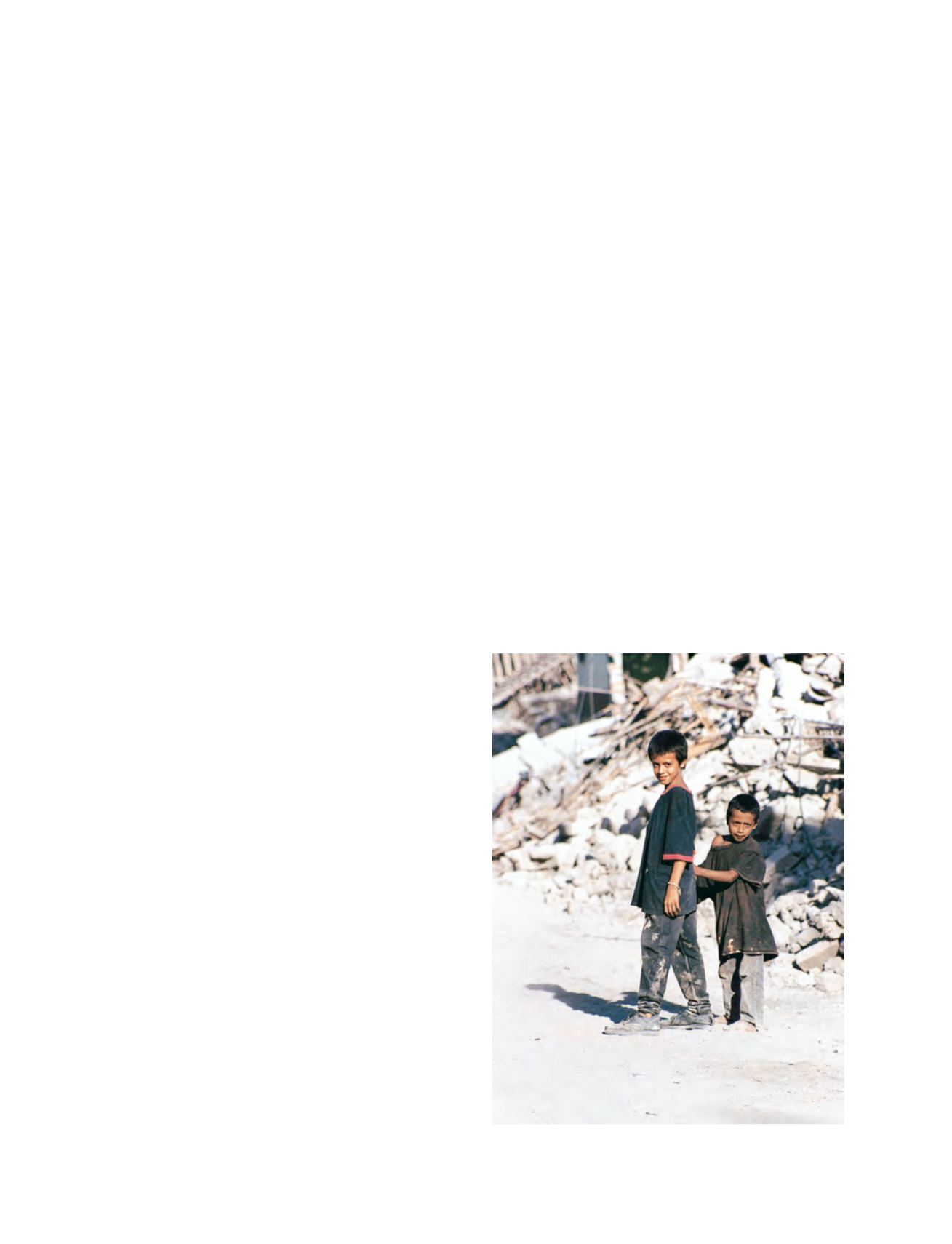
El Salvador Earthquake, 2001
Photo: Mr. Jorge Jenkins, PAHO