



 129 / 218

[
] 127
T
HERE HAVE BEEN
many recent studies suggesting that
losses due to flooding have increased over the past
twenty years. Some studies claim that these losses have
been increasing at a faster rate than growth in population and
economic development. This in turn suggests that the number
of people in danger, the amount of property at risk and the
frequency of severe events may also be growing.
Flood forecasting and warning systems are an integral part
of emergency and floodplain management. Effective flood
warning systems maximize the opportunity for the imple-
mentation of response strategies aimed at securing the safety
of people and property, and reducing avoidable flood damage.
The total flood warning system concept has been promoted to
represent all of the elements of a system that need to work
together to provide effective forecasts and warnings. The total
system includes elements of monitoring, prediction, interpre-
tation, message construction, communication and protective
behaviour. For flood warning systems to be effective, they must
provide information for emergency service groups and the
public, that is timely, accurate, easy to understand and clear in
its practical application.
Specific requirements will depend on local conditions,
including the scale of the problem and the level of access to
information. However, as a general principle, initial require-
ments are:
• Advance warning of when a river will reach a specified
height that will cause flooding
• Sufficient warning lead-time for appropriate protective
action to be taken
• Awareness of the potential future level of flooding
• Assure awareness of the flood risk in the threatened
community.
Basic hydrological information, river height and flow, catch-
ment modelling capabilities and any additional weather
information that will contribute to the warning lead-time are
essential factors to the forecast and warning agency.
Concerns of information providers and user expectations
The primary issues and concerns for information providers
include the operation and maintenance of monitoring systems,
the quality of modelling capabilities, the accuracy (measure of
uncertainty) of the forecast and the amount of warning lead-
time that can be provided. In particular, key steps undertaken by
information providers include the operation of in-situ monitor-
ing and measuring devices (both rainfall and river level) and the
Disaster mitigation and preparedness:
flood forecasting and warning
Mr Bruce Stewart, President, WMO Technical Commission for Hydrology
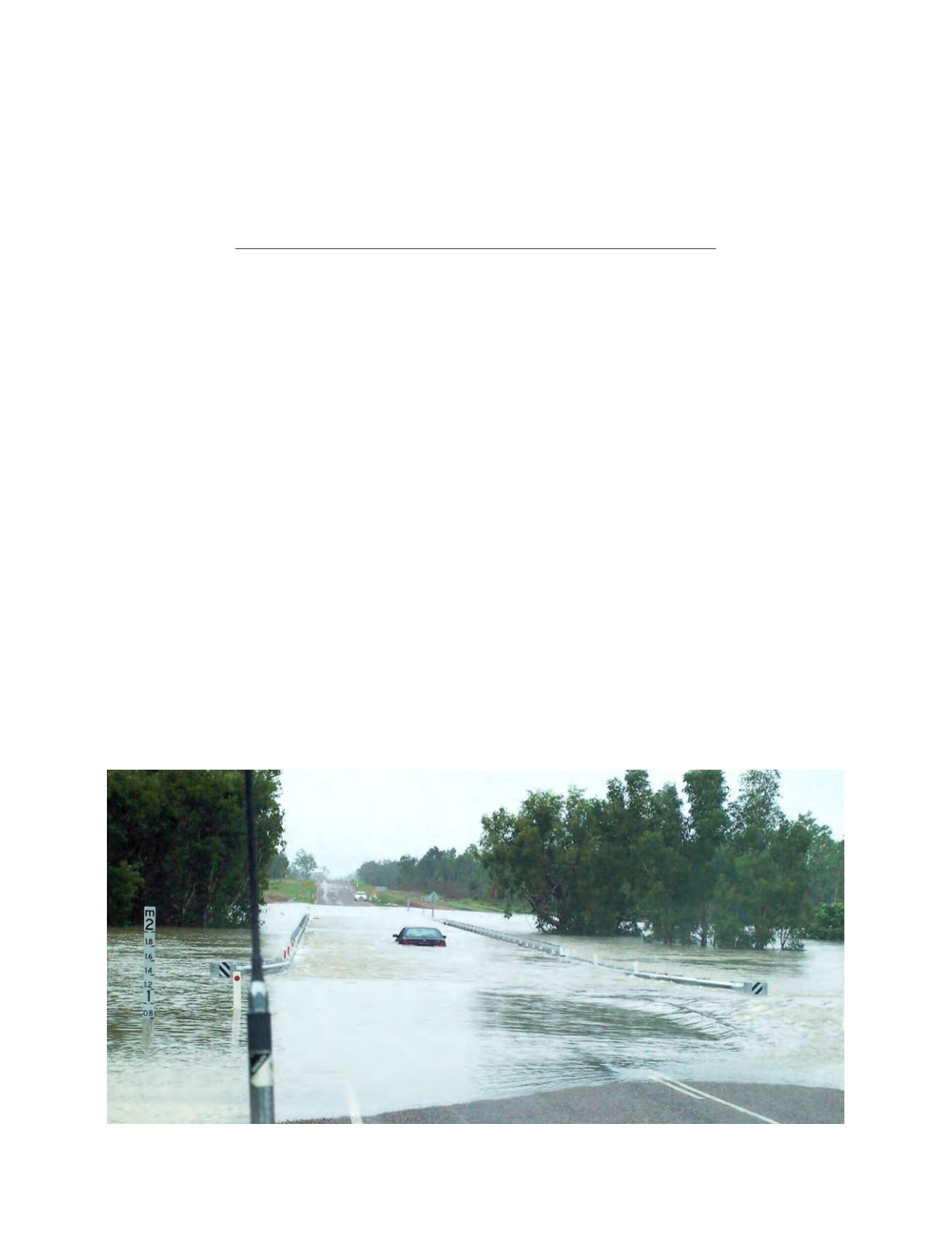
Flood impact is usually widespread