



 132 / 218

[
] 130
describe the data and processes that FEWS NET uses to provide
decision support.
Remote sensing in FEWS NET analytical processes
Biophysical data provides information on the yields of the food
production equation, and threats to pastoral resources and ulti-
mately to the agricultural economy as a whole. To identify
abnormally wet or dry periods, FEWS NET relies on data on
vegetation, temperature, and rainfall derived from remote sensing
and local measurements when they are available. Currently, the
FEWS NET early warning function begins with a weekly assess-
ment process that includes members of NASA, NOAA, USGS,
USDA, USAID, the University of California at Santa Barbara
(UCSB), and a variety of technical specialists in Africa, Central
America, and Afghanistan. The data includes precipitation gauges
and gridded data from merged satellite models; vegetation data
from the Advanced Very Hight Resolution Radiometer (AVHRR),
Système Pour l’Observation de la Terre (SPOT), MODIS and
Landsat; gridded cloudiness products; global climate indicators;
precipitation forecasts (24-72 hours); modelled soil moisture;
gridded fire products; snow extent products; hydrological models
for flood forecasting; and seasonal forecasts.
Rainfall has been used extensively to drive many models,
but rainfall measurements are notoriously prone to errors.
Errors can occur in approximating the degree of cloudiness,
the amount of rain that has fallen from these clouds, the inten-
sity of the rainfall, the impact of topography on rainfall, the
sensitivity to the density of the rainfall measurements and accu-
racy of local rainfall gauge measurements, and other effects
which result in significant random error and non-negligible
bias.
6
Fortunately, scientists have found a much more stable
proxy for rainfall measurement. In addition to making rainfall
and analysis, FEWS NET decision support and reporting are
carried out primarily by a USAID contractor which employs
most of the social scientists involved in the project, as well as
the FEWS NET local representatives in the field. Data prod-
ucts and dissemination mechanisms are focused on ensuring
that effective products are developed and the right people see
them promptly. By defining FEWS NET’s primary audience as
local decision makers, locally relevant, actionable policy infor-
mation is generated which can then be disseminated to
audiences at a variety of decision-making levels – local,
regional, and international.
Linking early warning activities to effective intervention
requires both short- and long-term actions.
3
Short-term response
to an identified hazard involves preparedness and contingency
planning that allow immediate response to the situation. FEWS
NET has become increasingly involved in contingency planning
as a method of generating relationships with local government
actors and decision makers who are the audience for its products
and therefore must be involved in any determination of and
response to crisis conditions.
4
Participation of local decision
makers, national government agencies, and non-governmental
personnel is critical to achieving FEWS NET’s goal of reducing
the loss of lives and livelihoods during food crises. Contingency
planning and the strengthening of networks of decision makers
will ultimately reduce overall vulnerability to these climatic
hazards.
5
Food security has three main components: food availability,
food access, and food utilization. FEWS NET focuses on collect-
ing data on food availability from biophysical parameters and
food access through socio-economic datasets. Other organiza-
tions investigate food utilization, for example the individual’s
ability to use the food they eat effectively. The next two sections
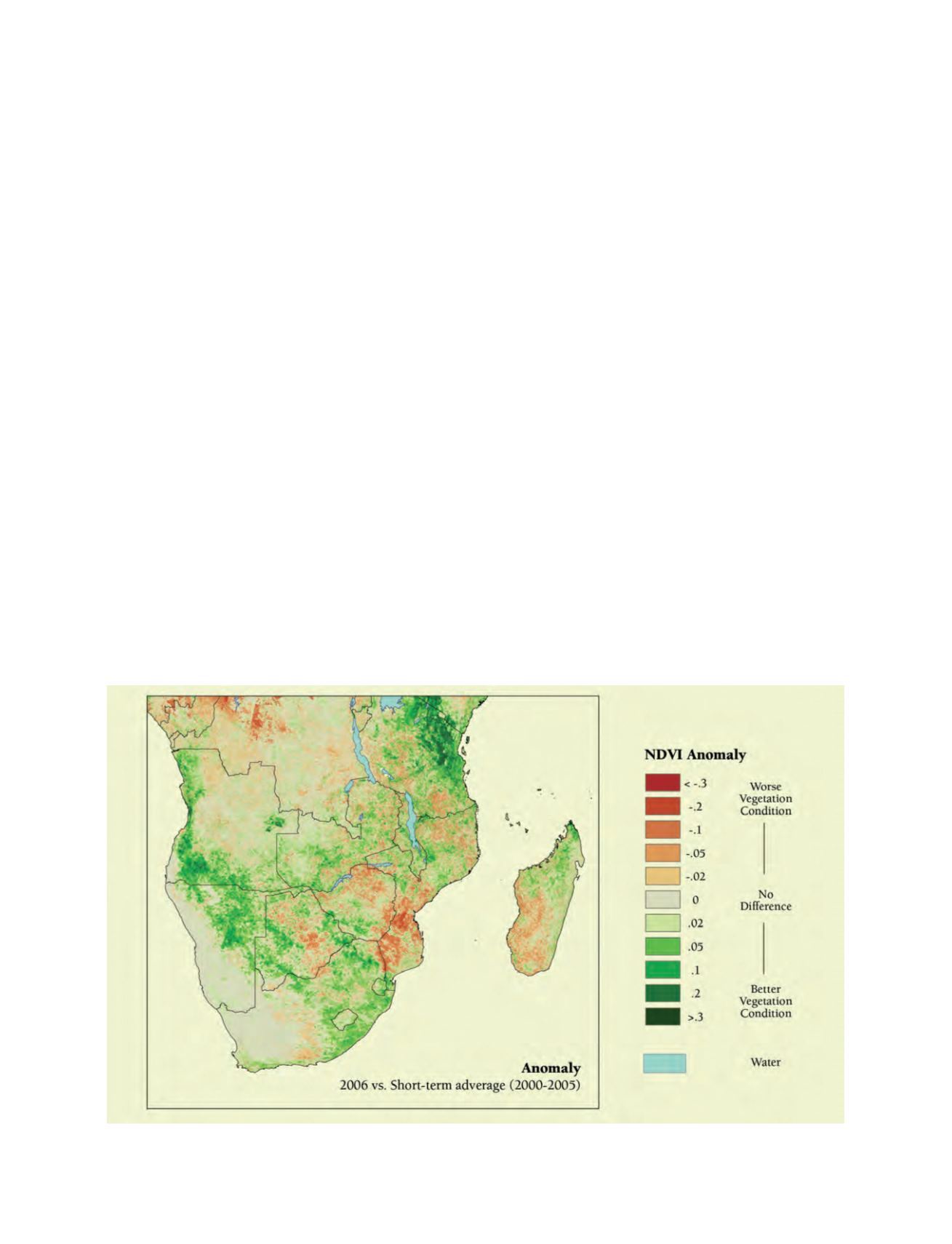
Vegetation data anomaly from MODIS for southern Africa, from 19 Dec 2006 – 03 Jan 2007
Source: NASA