



 130 / 218

[
] 128
occur at any time, but also that there can be long periods
between events, during which awareness can decline.
In a more practical sense, it is imperative that the mainte-
nance and operational capability of service providers is
ensured, and that users understand the importance of the
sustainability of these systems. Furthermore, users must be
aware of, and grasp the implications of the capabilities and
limitations of the warning systems. This includes the vital
understanding that the total system will only be as strong as its
weakest link, and therefore all components must be regularly
reviewed and examined. Lastly, both parties must appreciate
that advances will require an investment in research to improve
the scientific and technical facets of the service.
Service providers, of course, have an equal responsibility to
maintain the relationship. They must understand the specific
requirements of the users in each situation, determine the key
trigger points as well as when and what type of action should be
taken. However, it is also necessary to consider social and cultural
issues. There is no one specific solution for all situations, and
even within a community, vulnerabilities differ and thus require
different approaches for the effective warning of each group.
There should also be common recognition that with growing
populations and economies, and also the possible implications of
climate change, the community at risk may be increasing and
therefore that problems can arise in previously unaffected areas.
Ultimately, success relies on a balance in the relationship
between the users and providers. Vitally, contact must be main-
tained between the two. Most users and providers have other
roles and responsibilities, and therefore interaction and coordi-
nation must be formally set in place and regularly reviewed. It
is also vital to recognize the important role of the media in the
provision of services, and to consider how to optimise this under
current arrangements. Finally, adequate feedback and event
review mechanisms must be implemented, with the conditional
understanding that mistakes will occur and that while negative
consequences can be minimized through the application of risk
management approaches, having resilient community structures
in place to learn from such failures is also essential.
development of hydrological models that can use current and
forecast information to provide estimates of future flood levels.
Information users including the emergency services, indus-
try, the community at risk and the media, are primarily
concerned with access to the information, its accuracy, and
understanding the actions they need to take. Users expect to
receive accurate and timely information on which they can
make specific decisions and undertake prescribed actions, such
as providing supplies and equipment, prompting evacuations
or building sandbag levees. Users also need information on the
expected period of inundation, the possibility of follow-up
events and the status of key services such as power, water
supply and sewerage.
A further issue is that providers need to be prepared to ‘persuade’
users. Users must be sensitized to the information that will be
provided, so that they are ready to take the right action. Public
education also plays a role here, but it is not the whole story.
In the case of floodplain management, users require advance
information on areas and services at risk of flooding. This
allows them to undertake appropriate and effective land-use
planning, thus mitigating the impacts of future flooding. Such
information is also valuable in the development and construc-
tion of physical flood control works. However, a balance
between structural and non-structural measures aimed at
‘living with floods’ is promoted.
How to optimize information delivery
Delivery processes usually fall into ‘push’ or ‘pull’ mechanisms.
Because of the need to deliver information promptly and effi-
ciently to all of the required recipients, most information is
provided using push techniques. These will vary from situa-
tion to situation, but include facsimiles, phone calls, SMS
messages, e-mails, sirens, loud speakers, radio, television and
word of mouth. The delivery mechanism will depend on the
characteristics and location of the community at risk, the
amount of lead warning time required and the capabilities and
limitations of the early warning system in place.
Consultation and communication are therefore the key
elements in determining the optimum delivery mechanism in
each case. This must involve discussions and input from all of
the responsible authorities and stakeholders, and in particu-
lar the community at risk. National Meteorological and
Hydrological Services, water authorities, emergency service
agencies and local government groups must work together to
develop and implement sound and sustainable systems. The
community at risk must understand when it is best to imple-
ment prescribed actions, and the possible consequences of such
actions. The media can therefore play a significant role by
warning of danger, but also by contributing to community
education and preparedness.
The importance of community awareness should not be
overlooked. The use of pamphlets, fridge magnets, newspaper
articles, school education programmes, television shows and
community groups should be strongly considered. In parti-
clular the Internet is invaluable as both an information source
and a service delivery mechanism.
Bridging the gap between users and providers
A healthy relationship between users and providers is essential,
but presents numerous challenges. A fundamental, shared
understanding of the risk that floods represent is needed. This
includes the recognition that floods are event-based and can
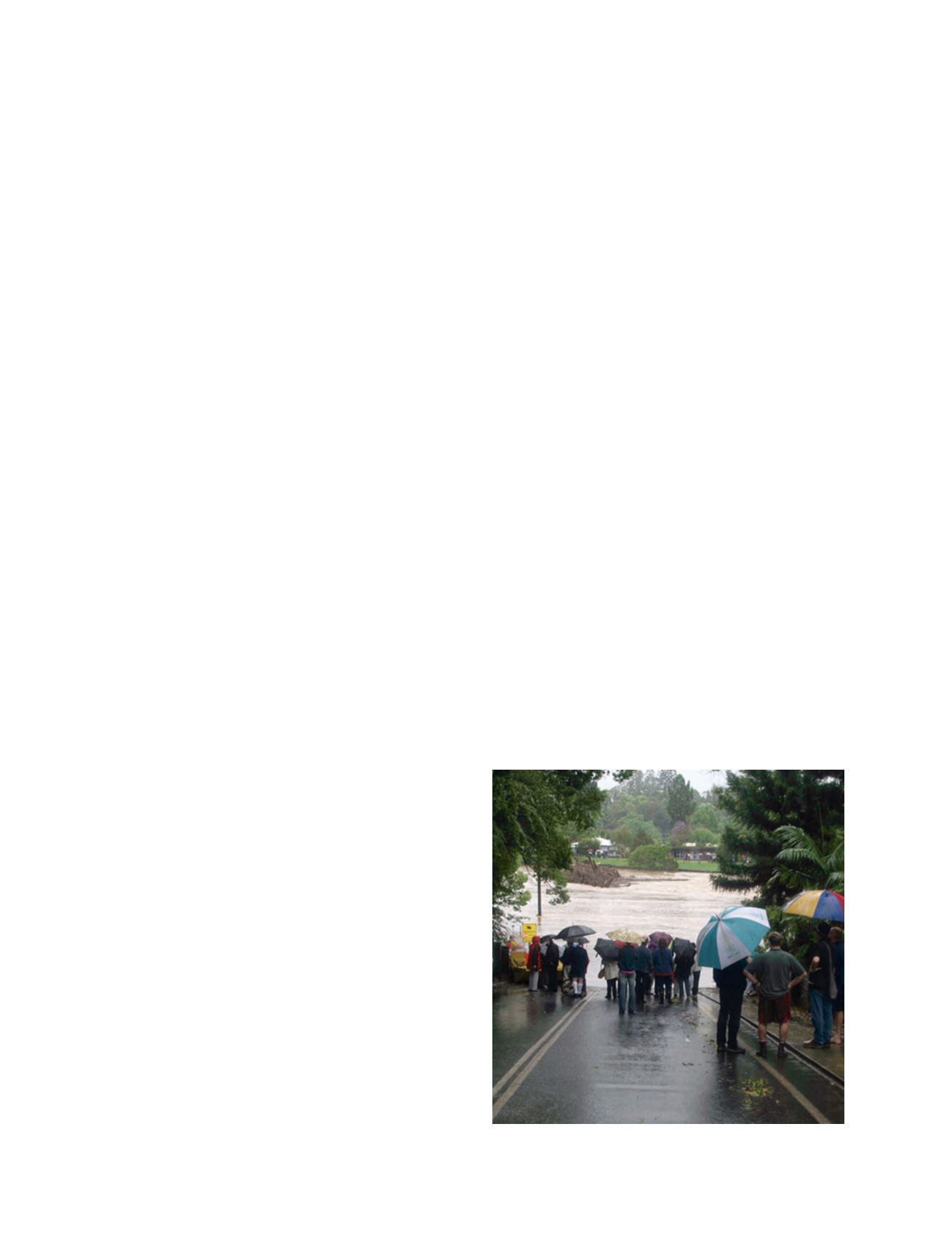
Floods affect significant sections of the community