



 126 / 218

[
] 124
A
PPROXIMATELY ONCE A
year, a catastrophic earthquake
– measuring magnitude 7.0 or greater on the Richter
scale – strikes somewhere on Earth. These quakes can
claim thousands of lives, cause billions of dollars of damage
and trigger tsunamis, floods, and landslides in their wake. The
destructive potential of these catastrophic earthquakes has
increased in recent years with the emergence of large cities,
high dams and other facilities whose destruction would pose
an unacceptable risk to society. It is generally accepted that a
successful effort to reduce the risk associated with earthquakes
and other natural disasters will require the convergence of a
wide variety of knowledge and observations, including the
latest in space technology and remote sensing. The growth in
global earth observations and the maturation of the Global
Earth Observation System of Systems (GEOSS) may make such
a convergence possible in the near future, and allow the bene-
fits of an integrated earthquake monitoring system to become
a reality.
There have been numerous studies and publications identi-
fying electromagnetic (EM) anomalies associated with
pre-seismic activity, and several theories have been formulated
to explain their causes. There is a strong indication that devel-
opment of an earthquake hazard prediction scheme requires
diverse interdisciplinary and integrated efforts. Such an inte-
Learning new methodologies to deal
with large disasters: near space
monitoring of thermal signals associated
with large earthquakes
Dimitar Ouzounov, Shahid Habib, Fritz Policelli and Patrick Taylor,
NASA Goddard Space Flight Center
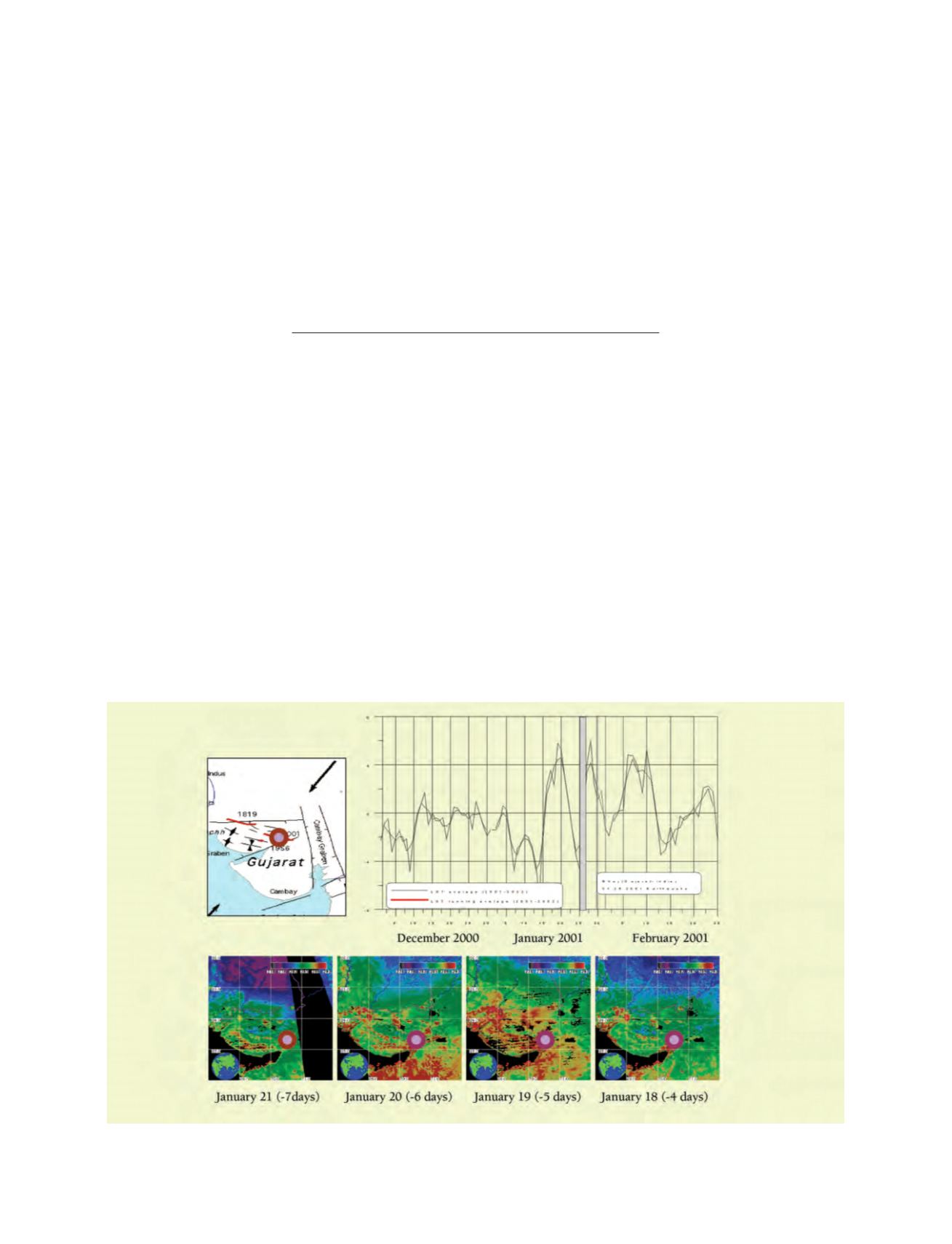
Time series mean nighttime MODIS/Terra LST, 100x100 km anomaly, comparing 2001 vs 2002 over the Bhuj, Gujarat region, M7.6 Jan 26, 2001
Source: R.P. Singh