



 136 / 218

[
] 134
Case study: Accra, Ghana
Women in Alajo, Accra, observed that patterns of rain and
flooding have become unpredictable since the 1980s: “In
some years the rain will fall greatly and destroy everything
and other times nothing will happen.” They noted that it used
to rain heavily in June and July but since 2000, the heavy
rains sometimes start earlier than June and in other years after
July. Consequently, it is difficult to prepare for flooding in
Alajo.
Men in Alajo described the impact of the flooding on their
lives: “Flooding makes people go hungry for days.” Slum
dwellers’ livelihoods depend on such activities as small-scale
commerce, petty trading and artisanal trades, which are
disrupted by floods: “Flooding makes the inhabitants of Alajo
unable to do anything.” People lose working time, economic
opportunities and income during floods. Several Alajo resi-
dents engage in petty trading and petty merchandising in
wooden kiosks which do not withstand the force of the floods.
The immediate impact is the loss of livelihood support for
food and bills, including children’s education and health bills.
In the Alajo community people dealt with the June and July
2006 floods in a variety of ways. Some used blocks, stones and
furniture to create high places on which to put their most valu-
able possessions during floods. Some placed their items on top
of wardrobes and in the small spaces between ceilings and
roofs, sharing such high places with others who have no similar
‘safe’ sites. Others temporarily moved away from the area to
stay with friends and family during the flood.
One woman in Alajo described her experience: “As soon as
the clouds gather I move with my family to Nima to spend the
night there. When the rain starts falling abruptly we turn off
the electricity meter in the house. We climb on top of our
wardrobes and stay awake till morning. Our house was built in
such a way that ordinarily water should not flood our rooms,
but this is not so. Our furniture has been custom made to help
keep our things dry from the water. For instance, our tables
are very high and so also are our wardrobes, they are made in
such a way that we can climb and sit on top of them. These
measures are adaptive strategies as old as I can recollect. I have
two children but because of the flood my first child has been
taken to Kumasi to live with my sister in-law.”
When residents of Alajo were in danger, they resorted to self-
help or were rescued by other members of the community
using locally manufactured boats, for example, not by any
government disaster agency: “When the rain and the floods
come, women and children suffer. You can be locked up for up
to two days with the flood. Sometimes we take our children
out from the room to the rooftop. Then people bring boats to
evacuate people.”
The research found more evidence of individual, rather than
collective coping strategies. Sometimes people share protec-
tive storage or accommodation on higher ground. Spontaneous
community action to unblock drainage channels is relatively
rare. However, no coordinated action for emergency shelter or
rapid response to flooding appears to exist in the studied cities.
That said, local people in poor communities have an acute
awareness of the solutions that are required and possible, and
have strong views on who is responsible for taking action.
However, there are different levels at which the various stake-
holders in flood mitigation can operate to contribute to creating
solutions.
Responsibilities and actions
The management of localized flooding, resulting from inade-
quate drainage, should be undertaken by the affected
communities themselves. This is where local voluntary groups,
with assistance where necessary, could be highly effective.
Local communities are stakeholders in the good drainage and
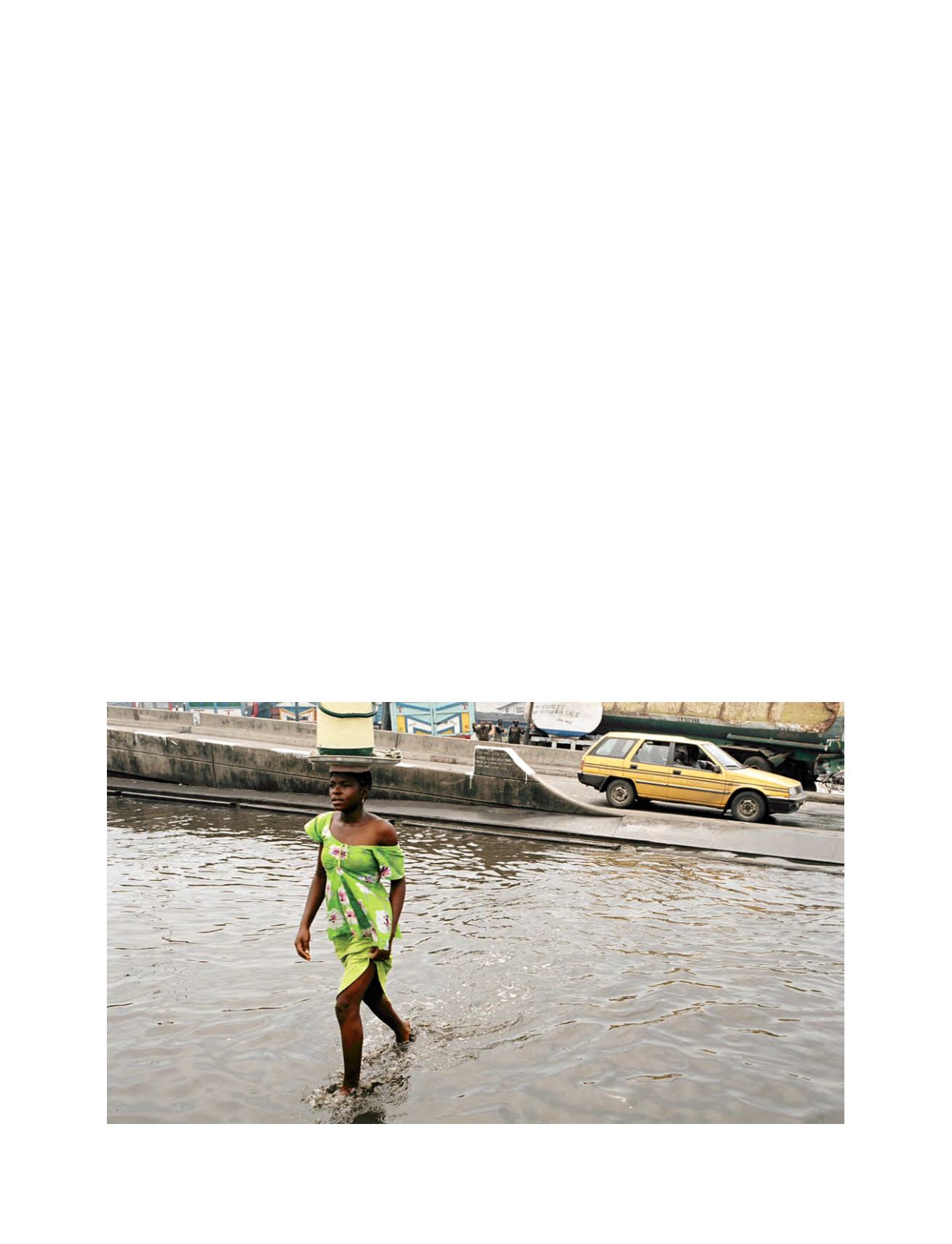
Urban flooding in Lagos, Nigeria
Photo: Gideon Mendel/Corbis/ActionAid