



 141 / 218

• Implementation of pilot projects on climate change
impacts in the water, health and agricultural sectors
• Generation of statistically downscaled climate scenarios
for Jamaica, Trinidad & Tobago, and Barbados
• Development of a regional public education and outreach
strategy on climate change.
Within the context of the capacity building programmes, CIMH
staff benefited from training related to detection and analysis
of trends in climate data. This training supports CIMH’s
ongoing development of climate change products using its
extensive climate databases. The climatic databases currently
being stored at CIMH are being used by individuals partici-
pating in climate change research.
The Mainstreaming Adaptation to Climate Change (MACC)
initiative builds on the achievements of CPACC and ACCC.
This initiative, which runs from 2004 to 2007, received USD
5 million of funding from GEF and is being implemented by
the World Bank and executed by the regional Caribbean
Community Climate Change Centre. The MACC initiative
seeks to:
• Further build capacity in the region to address climate
change issues including the mitigation of vulnerabilities
identified under the CPACC initiative
• Rehabilitate and strengthen climate change data collec-
tion and monitoring networks
• Extend the analysis of the impacts of climate change on
critical sectors (including water resources, tourism and
agriculture) within the Caribbean region
• Expand public education and outreach programmes.
The CIMH’s role within the MACC initiative is considerably
greater than in previous initiatives. In particular, CIMH will
be a key participant in the reestablishment and maintenance of
sea level monitoring stations, installed under the CPACC initia-
tive and currently inoperable. This inoperability reflects to
some degree the low priority that some national government
agencies have assigned to global climate change monitoring
during CPACC. It is hoped that by placing the responsibility
for maintaining these stations within a regional organization,
the performance and sustainability of the sea level monitoring
network will be significantly improved.
The CIMH is also taking a leading role in sectoral analyses
that examine the impacts of climate change on agriculture and
water resources in the region. The CIMH will be a key regional
institution involved in the design and simulation of the climate
change scenarios used to support sectoral analyses.
Future directions
Reduction of the risks posed to life and to the economy is
bringing climate change preparedness to the forefront in the
Caribbean. As a result, regional institutions are expected to
provide leadership in these areas. The CIMH, through its
mandate and training programmes, is integral to weather-
and climate-related risk reduction, preparedness and miti-
gation programmes in the area. As such, CIMH plays an
important role in the mainstreaming of adaptation and miti-
gation strategies related to climate change and other weather
phenomena.
With this in mind, CIMH is expanding its role in these areas
beyond the provision of support for regional programmes. In
particular, the organization intends to include aspects of natural
disaster risk reduction, preparedness, and mitigation in its train-
ing programmes. This integration will encompass both weather-
and climate-induced events, and will build on relationships that
CIMH has developed with regional organizations.
More specifically, CIMH intends to include aspects of
weather and climate modelling in its training programmes,
along with projects emphasizing multidisciplinary data analy-
sis and decision-making to sensitise students to integrated
disaster management environments. CIMH staff will continue
to build on completed and ongoing work on natural risk reduc-
tion to assess the impacts of climate change and climate
variability on food security and water resources.
[
] 139
5
5.5
6
6.5
7
7.5
8
8.5
9
Year
Difference in Temperature(Deg C)
1971
1972
1973
1974
1975
1976
1977
1978
1979
1980
1981
1982
1983
1984
1985
1986
1987
1988
1989
1990
1991
1992
1993
1994
1995
1996
1997
1998
1999
2000
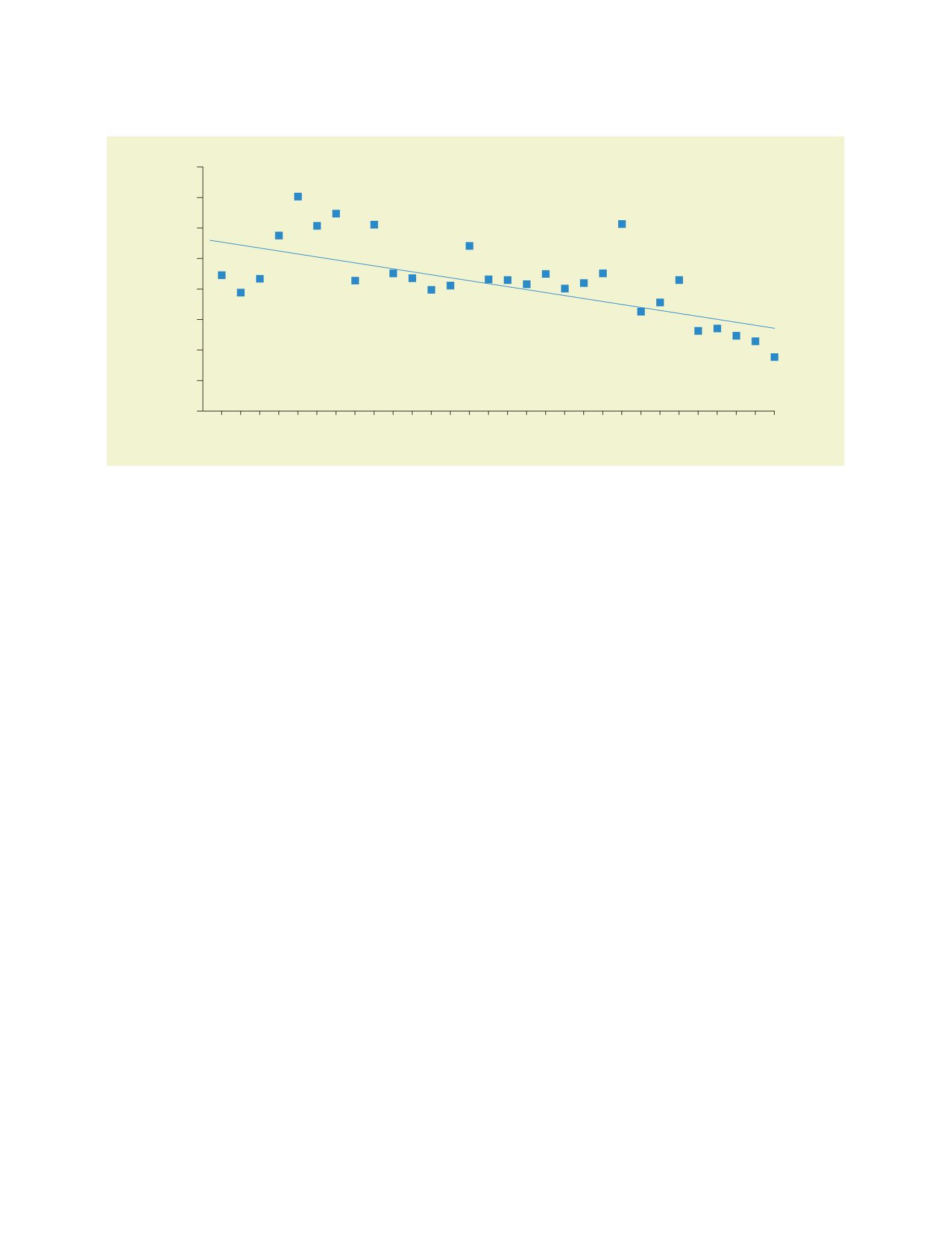
Temperature trends on Barbados during the period 1971-2000: Decreasing diurnal temperature range
(squares represent the measured data; solid line represents the inferred linear trend)
Source: Caribbean Institute for Meteorology and Hydrology (CIMH)