



 144 / 218

[
] 142
A
CCORDING TO THE
Korea Meteorological Administration
(KMA), the average temperature in Korea is increasing.
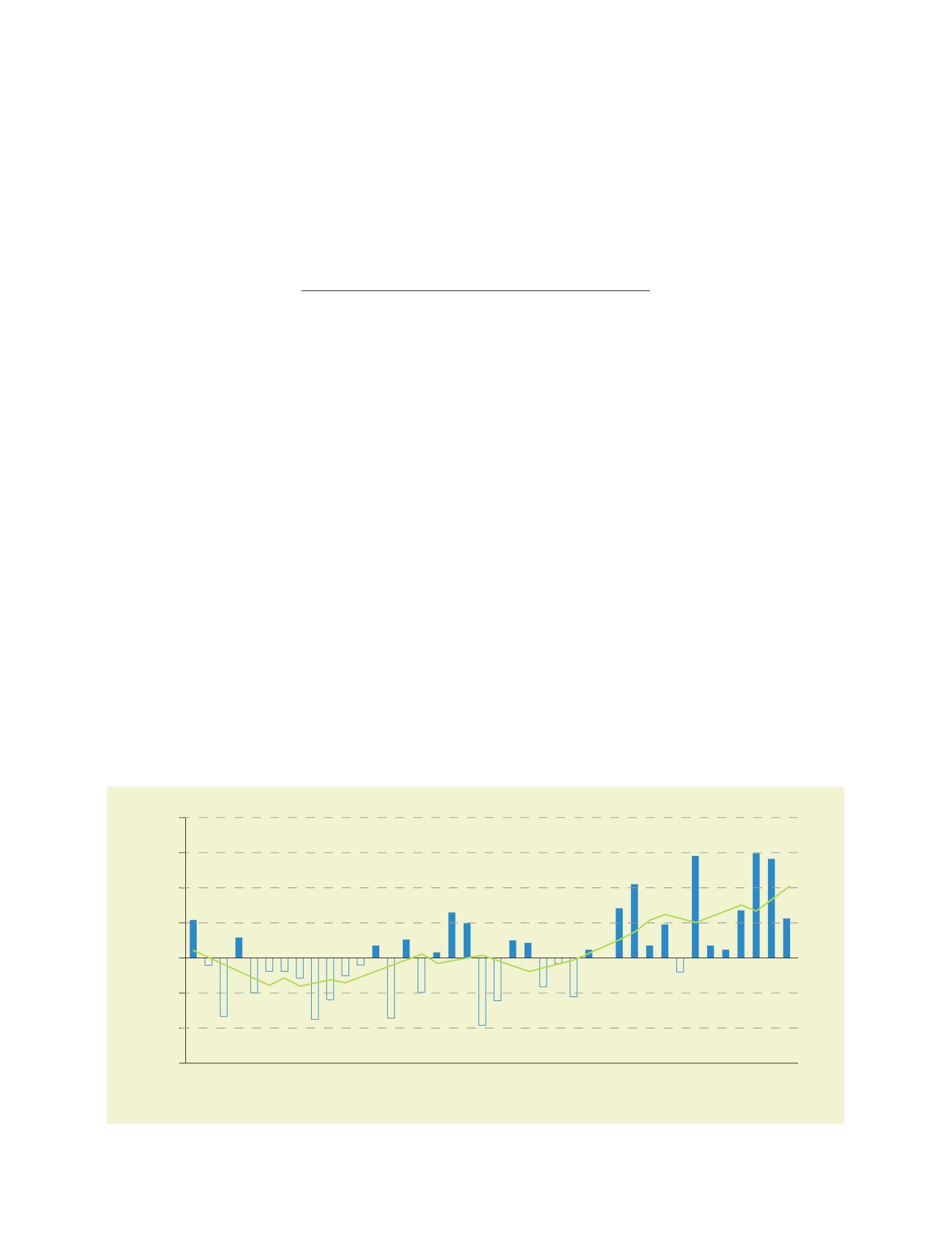
The annual average temperature from 1908 to 1940 was
recorded between 10 and 11 degrees Celsius, whereas it was
recorded between 12 and 13 degrees Celsius from 1970 to recent
years. This trend can be seen clearly when comparing monthly
average temperatures. In April, from 1960 to 1965 the average
temperature was 11.5 degrees Celsius, and from 1995 to 2000
it was 12.9 degrees Celsius in the same month. Temperature
demonstrates a dramatic increase after 1987. It was also found
that the temperature in the eastern coastal area of the Korean
peninsula has increased by 1.8 to 2.0 degrees Celsius during the
last century, which exceeds the global average.
Because of climate change in the Korean peninsula, new
threats from natural disasters such as floods, droughts, wild
fires, and blizzards are emerging and the ecosystem is changing,
including the spatial and seasonal coverage of cultivating plants.
In the last three decades the temperature in Korea increased by
1.2 degrees Celsius, which again exceeds the global average 0.8
degrees Celsius. The impact of temperature increase is more
severe in urban areas during the winter. Korea has had almost
continuous, abnormally warm winters since 1986.
In the 1960s and the 1990s the average temperature in
January, and monthly minimum temperature in metropolitan
areas such as Seoul and Daegu increased by 2.7 degrees Celsius
and 3.0 degrees Celsius, respectively. This increase is believed
to be related to human-induced environmental factors such as
increased consumption of fuel, population, emission, build-
ings, traffic, urbanization and deforestation. Conversely, in
preserved rural areas like Chupungryeong, temperature
increase was found to be as low as 0.4 degrees Celsius.
The pattern of precipitation is also changing. In Korea 40 to
60 per cent of annual precipitation is concentrated during the
summer, i.e. from June to August, and is affected by typhoons
and monsoons. Recently, the activity of the seasonal rain front
has become irregular and the overall precipitation is decreasing
during the wet season. However, the precipitation by typhoons
and concentrated rains after the regular wet season is increasing.
The rising incidence of natural
disaster events on the Korean Peninsula
due to climate change
Dugkeun Park, PhD, Senior Analyst,
National Emergency Management Agency (NEMA), Seoul, Korea
-1.5
-1.0
-0.5
0.0
0.5
1.0
1.5
2.0
Temperature Deviation (˚C)
1961
1964
1967
1970
1973
1976
1979
1982
1985
1988
1991
1994
1997
2000
Year
Changes in annual average temperature in the Korean Peninsula from 1961 to 2000
Source: KMA