



 147 / 218

[
] 145
I
NDIA
,
DUE TO
its unique geography and climatology, is
prone to a large spectrum of natural disasters ranging from
avalanches in the snow-clad Himalayan slopes, to tsunamis
and tropical cyclones along the coasts in the southern penin-
sula. Floods, droughts, cyclones, earthquakes and landslides
have been recurrent phenomena. About 60 per cent of the land-
mass is prone to earthquakes of various intensities; over 40
million hectares is prone to floods; about eight per cent of the
total area is prone to cyclones and 68 per cent of the area is
susceptible to drought.
Between 1990 and 2000, an average of 4,344 people lost their
lives and about 30 million people were affected by disasters
every year. Increasing population densities, changing land-use
patterns and climate have contributed to the vulnerability,
particularly to that of the poverty-ridden communities in the
region. These factors are set to exacerbate as time goes on,
leading to irreparable damages affecting sustained develop-
ment. The major positive aspect is that due to the intricate
linkages among these issues, actions initiated to mitigate the
effects of any one will have collateral benefits.
The climate change context
Climate change is not only a major global environmental
problem, but is also an issue of great concern to a developing
country like India. The changes observed in the regional
climate have already affected many of the physical and biolog-
ical systems and there are indications that social and economic
systems have also been affected. Climate change is likely to
threaten food production, increase water stress and decrease
its availability, resulting in a rise in sea level that could flood
crop fields and coastal settlements, and increase the occurrence
of diseases such as malaria.
India is a large developing country with a population of over
one billion, whose growth is projected to continue in the
coming decades. Its rural populations depend largely on the
agriculture sector, followed by forests and fisheries for their
Adapting to climate change through
resilience to natural disasters
Sanjiv Nair, G Srinivasan and KJ Ramesh,
Department of Science & Technology, New Delhi, India
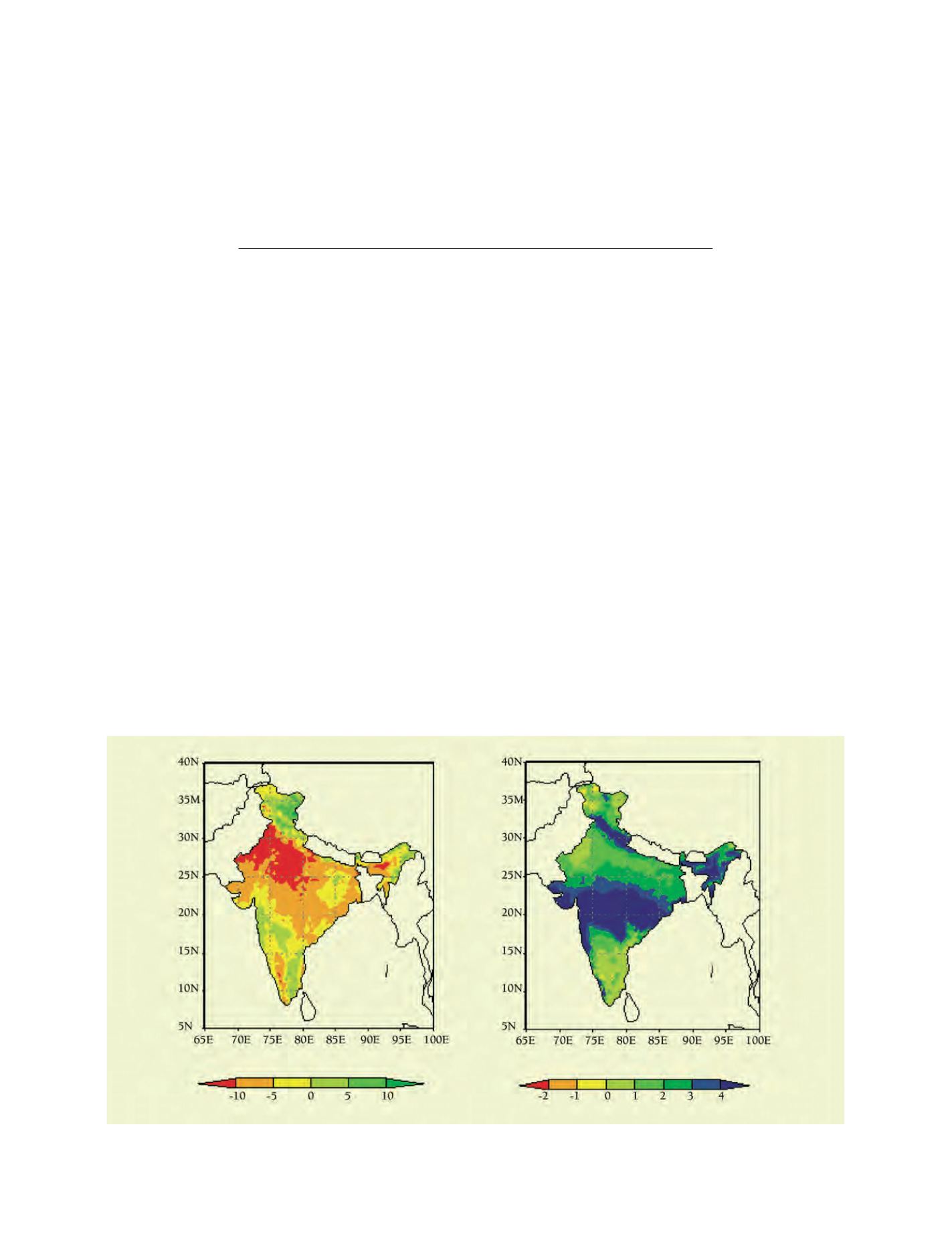
Climate change scenarios over India produced by Hadley Center PRECIS Regional Climate Model showing
expected changes in number of rainy days (left panel) and rainfall intensity (mmday-1) of rainy days
Source: : Krishna Kumar, Indian Institute of Tropical Meteorology, Pune, India