



 151 / 218

[
] 149
will help to suppress fires while they are small, under normal
conditions. Repeated, frequent incidence of fire disrupts the
economy of a region, and in the long term may challenge the
sustainability of biodiversity and of forest activities. Recovery
actions after a fire can minimize the loss of biodiversity, loss of
soil, and other irreversible effects in burned areas.
An ever-increasing problem is that of the urban/wild land
interface, in which wildfires reach populated areas, from
isolated houses to the suburbs of large cities. This problem is
associated with many factors, including the desirability of
living ‘closer to nature’, the lack of planning and management
in some areas, as well as changes in the climate.
Smoke produced by fires can be as much a problem as the fire
itself. Smoke can travel a long way from the site of the fire and
persist for long periods of time, limiting visibility and creating
a health hazard in populated areas.
It is imperative to change attitudes to forest fires around the
world, particularly in those regions where fires are mainly caused
by human actions. We know that it is not possible or even desir-
able to exclude fire entirely from nature, but incidences of
anthropogenic forest fires should clearly be eliminated.
An increase in fire prevention activities is needed everywhere,
ranging from the planning and management of forested and rural
areas to the creation of well-organized fire detection and initial
attack services to stop fires while they are still small. Investment
in expensive fire-fighting equipment – although necessary up to
a point – is not the solution to the problem. It never will be if
other activities are not carried out, including the fundamental
involvement of the entire population in this common effort.
Forest fire incidence is not uniform throughout the world,
but everywhere it is the result of both natural and anthro-
pogenic factors. Climate change is already bringing an
increased risk of forest fires, and this tendency is likely to lead
to even larger and more widespread problems in the future.
Science and technology can support man in managing and
controlling fire in rural areas, but not in mastering it and even
less in eliminating it from nature. A common effort by all insti-
tutions and citizens is required to minimize the incidence of
fires, especially in these days of high risk. Man is part of this
problem and must be part of its solution.
Even in areas of the world where fires are mainly caused by
human actions, there is a strong correlation between good
burning conditions and fire incidence. It is therefore convenient
to express these burning conditions in the form of a fire danger
index. This index is based on meteorological parameters and
takes into consideration the fire history of the region. Its estab-
lishment is a very basic step towards the management of forest
fires. The Canadian Fire Weather Index is rapidly becoming a
common standard for the assessment of fire danger worldwide.
Natural fires caused by lightning have, over millennia, modi-
fied natural vegetation to balance and contain biomass growth.
In some regions this fire cycle has a period of tens of years,
while in other regions it can take several centuries before a
given area is burned again. In some areas of the world, where
intensive forest exploitation is not possible, this natural cycle
still occurs. However, human intervention has changed this
pattern, sometimes introducing new species and controlling
fuel accumulation cycles through harvesting. The result is that
it is increasingly difficult to protect both native and introduced
species from fire.
4
Climate change, with its likelihood of a rise in temperature
and a decrease in relative humidity, is likely to exacerbate fire
risks, and even to promote fire risk in currently less fire-prone
areas. Increased temperature and reduced precipitation in the
long term will modify vegetation cover, promoting fire-prone
species. Global warming, with the increase of energy in the
atmosphere, will produce greater variability in meteorological
conditions. As a consequence, fire seasons will be extended,
and the number of very high-risk days will tend to increase.
As a result of these changes, many countries have already expe-
rienced increased fire incidence over the last decade.
Forests act as a sink for carbon monoxide and contribute to
settle the overall balance of carbon in the atmosphere. But
when they burn, not only is this sink effect lost, but very large
quantities of carbon monoxide, carbon dioxide and other
noxious products are also emitted, compounding the problem.
The role of man
From initially passively observing fire working in nature, man
began to use it to clear vegetation for habitation, crops and
grazing. In modern times the destruction of natural habitats
has been restricted, and some areas have been legally protected.
Prior to this there had been a kind of equilibrium, due to an
extensive consumption of biomass by fire. The exclusion of
fire in this context, in combination with other social and
natural factors, brought about an accumulation of vegetation.
Episodic fires that threatened human life and property created
the need to suppress them in an organized way. In response to
this some countries reintroduced fire in controlled conditions
in a tentative effort to re-establish the natural balance. In spite
of this effort, fire remains a threat not only to natural and culti-
vated areas, but also to urban areas.
Forest fires are unique among natural disasters in that human
intervention can be effective at all stages of their development:
before, during and after. In non-natural landscapes such as
rural areas and forest plantations, the organization of the area
and the way the plantations are planned and managed can
modify the conditions that facilitate fire ignition and spread.
The choice of species and reduction of fuel loads can contribute
to reducing fire impact in most high-risk conditions, with the
exception of the very extreme. The existence of fire-breaks and
a distributed network of fire detection and fire-fighting systems
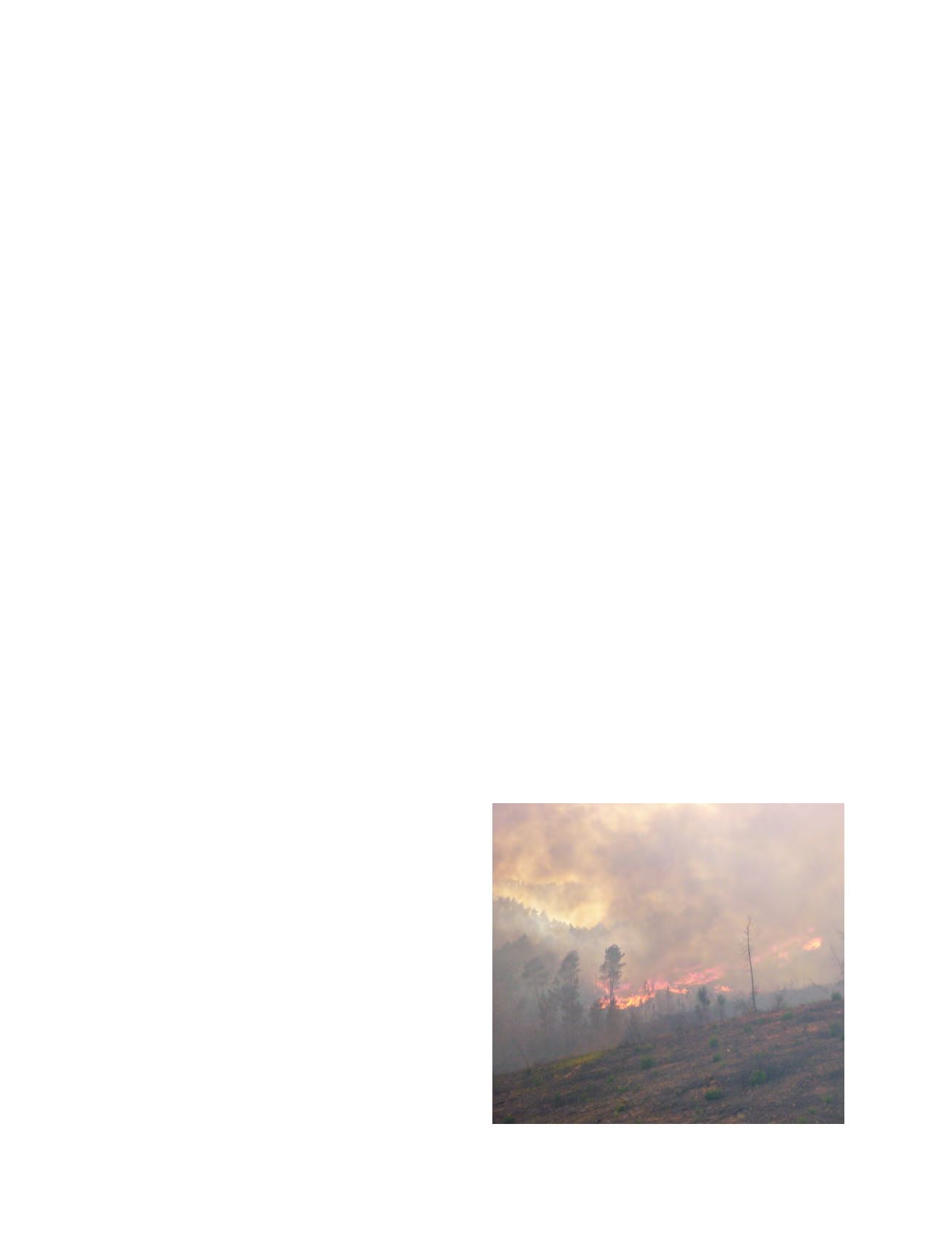
Fire spreading in a valley near Maxial-Sertã, Portugal, 6 August 2003
Photo: Luis Pita/ADAI