



 152 / 218

[
] 150
F
OREST FIRES ARE
one of the most serious natural risks
affecting Portugal, especially during the summer time.
They are dependent on many factors and produce
various effects, making them a very complex and challenging
problem. For the deflagration of a forest fire it is necessary to
have combustible substance and a source of heat. Its evolution
depends on atmospheric conditions and the state of the vege-
tation.
In countries with a Mediterranean climate, the predominant
meteorological conditions over the summer months such as
heat and dehydration of vegetation encourage the occurrence
of forest fires. Portugal has a relatively long warm and dry
season, during which wild fires can occur. In the period of the
fire season, considered to be between May and October,
Portugal suffers a large number of forest fires and burnt area.
Forest fire spread is related to social factors, often consuming
a vast forested area.
In Portugal, different institutions are directly involved in the
prevention and combat of forest fires. These include the
Portuguese Civil Protection and Fireman Service, the Forestry
Service and the Portuguese Institute of Meteorology. In recent
years, research and a successful collaboration between these
institutions has led to a better understanding of the deflagra-
tion and propagation of the forest fires and the investment of
time and resources to provide guidelines and possible solutions.
When evaluating the global risk of forest fires, it is absolutely
essential to take into consideration the impact of meteorolog-
ical conditions. The fire risk brings together detailed
information from meteorological net stations all over the world,
aiming to provide a very precise analysis of meteorological
conditions, weather forecasts and climate conditions affecting
all domestic territories.
The research from the Portuguese Institute of Meteorology
includes, beyond all the general meteorological information,
specific products, such as the Fire Weather Index (FWI) of the
Canadian System and the Combined Risk Index of Forest Fire
(ICRIF), which are all directly used to support the prevention
of forest fires. This information is made available to all national
entities that have responsibilities in the prevention and combat
of forest fires. A daily brief is established between the Weather
Forecasting Centre and the National Civil Protection and
Fireman Centre. The information is made available to the
public during the most critical parts of the year.
Fire Weather Index
The information distributed by the Portuguese Institute of
Meteorology is based on the Fire Weather Index (FWI). The
calculation of the FWI includes several meteorological vari-
ables; the temperature, the relative humidity of air, the wind
speed at surface and the amount of precipitation observed in
all the meteorological stations, taking into account the fore-
cast for the next two days.
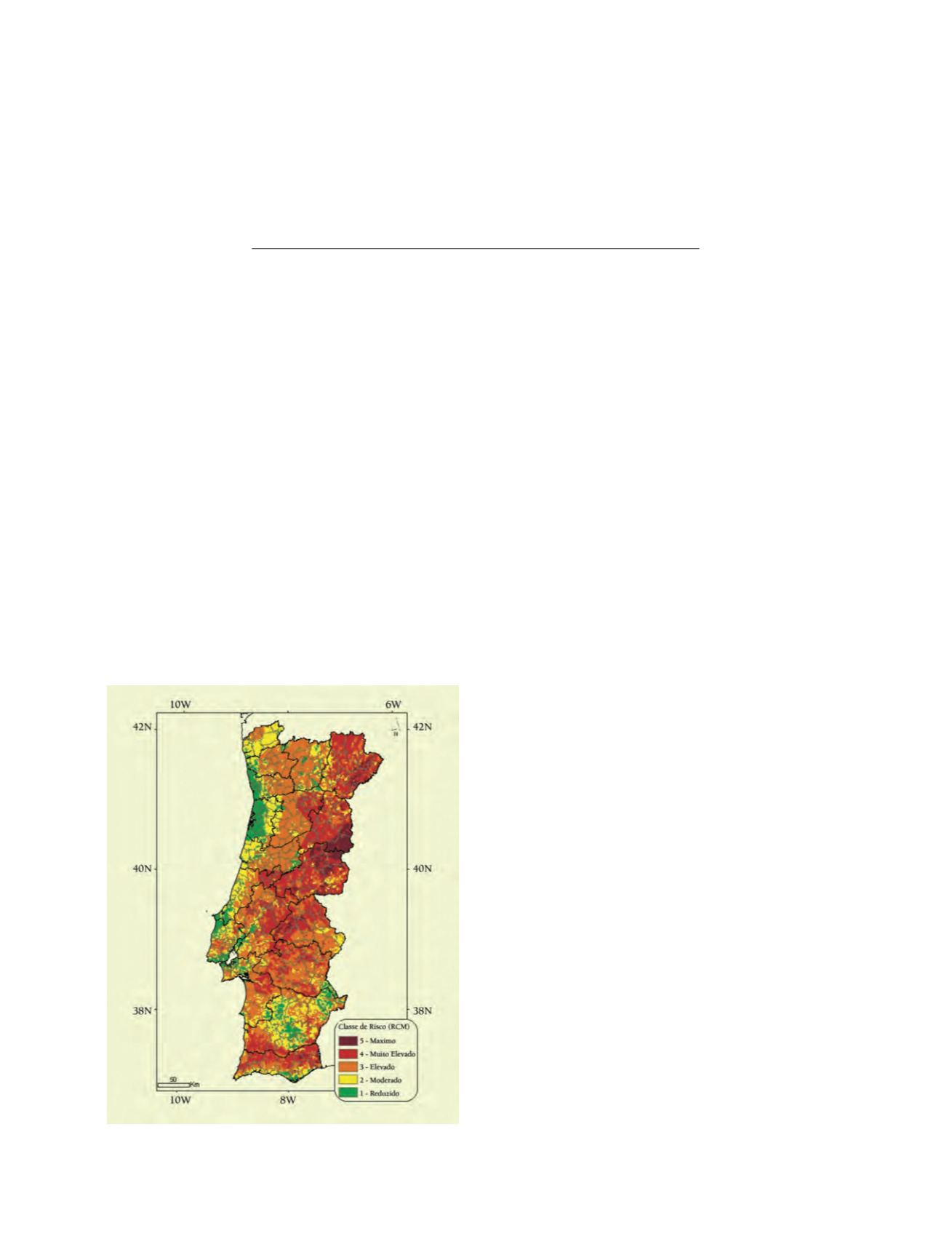
The information also contains charts with different classes of
fire risk defined by regions. The predicted fire risk classes are
based on the FWI integrated with the country vegetation type
map from the Portuguese Forestry Service. The different classes
of Fire Risk are shown in different colours, relative to the inten-
sity of risk from yellow to red.
The Portuguese Institute of Meteorology also computes a
daily combined Forest Fire Risk Index, the ICRIF (Índice
Combinado de Risco de Incêndio Florestal). It is a dynamic
index, combining meteorological, vegetation status and struc-
tural information and computing, not just the probability of
forest fire ignition, but also the capability of fire spread.
The Portuguese Institute of
Meteorology and forest fires
Luis Pessanha, Julia Silva and Teresa Abrantes, Instituto de Meteorologia, Portugal
Forest fire risk classes by regions
Source: IM Portugal