



 149 / 218

[
] 147
a National Disaster Management Authority (NDMA) in the
year 2006, as an apex body at the highest level under the
Chairmanship of the Prime Minister. All activities related to
disasters are being brought into this framework to make well-
orchestrated efforts across the concerned departments of the
Central government and the various state governments that
would be the actual responders. A dedicated institution called
the National Institute for Disaster Management has been estab-
lished for training and improving awareness at all levels.
One of the significant priorities of the NDMA, has been to
bring together the existing scientific capacities in research insti-
tutes to address disaster management issues. This effort is being
supported by the Department of Science & Technology, with an
ultimate aim to create systems for enhancing the relevance of
early warnings through customized decision support and rapid
information/alert delivery through novel communication
protocols. Once created, these integrated frameworks should
also have capabilities to dynamically upgrade themselves by
assimilating state-of-the-art technologies. Creating systemic
linkages among research institutions specializing in the various
components of the integrated system will ensure sustained
capacities.
The following enhancements are planned:
•
Observational aspects
– Improved observational systems
over the land and oceans, enhanced use of satellite data
and improved weather radar networks
•
Forecasting and warning
– Improved processing of obser-
vational data, multi-model ensemble forecast systems that
can give probabilistic tropical cyclone landfall scenario
generation at finer scales and warnings of extreme weather
•
Impact assessment
– Development of appropriate regional
scale models for storm surge inundation, Wind Damage
Assessment and catchments-scale coastal river hydrolog-
ical models for heavy rainfall induced inundation
combined with GIS capabilities to identify regions of
maximum risk
•
Vulnerability (Physical, Economic and Social)
– enhance-
ment and integration of topographic and thematic layers
under the National Database for Emergency Management
(NDEM) Project for multi-hazard vulnerability assess-
ment
•
Communication and Dissemination
– Integration of multi-
departmental communication infrastructure and
institutionalization of 24-7 operations of hazard mitigation
information and dissemination infrastructure at national
and state levels, and development of multiple communica-
tion options for alerts and in post disaster situations.
Integrating technologies and capacities
for disaster management
Effective disaster management strategies must be able to bring
together a variety of expertise that may be available with a
diverse set of research groups. For example, information about
the impending risks from a severe cyclonic storm must incor-
porate information about the area that will experience
maximum winds/rains, magnitude of surge near the coast and
likely regions of damage by high winds and heavy rains. This
information should be available to decision makers in a user-
friendly graphical interface on a geo-referenced platform. In a
post disaster situation we must be able to restore communica-
tions within the shortest possible time to facilitate aid and
medical redress. Building robust disaster management systems
will enable us to adapt to the threats of severe weather induced
by climate change.
Regional assessments, especially in developing and under
developed countries, have shown that many systems and poli-
cies are not well adjusted even to today’s climate and climate
variability. Increasing losses both in terms of human lives and
capital costs, from drought, storms and floods demonstrate the
current vulnerability. Integrating technologies and research,
leading up to better decision-making and evolution of strate-
gies for disaster management would not only contribute
towards adaptation to future climate change, but also improve
the existing systems. Appropriate research and policies that are
consistent with broader societal objectives will promote
sustainable development in communities.
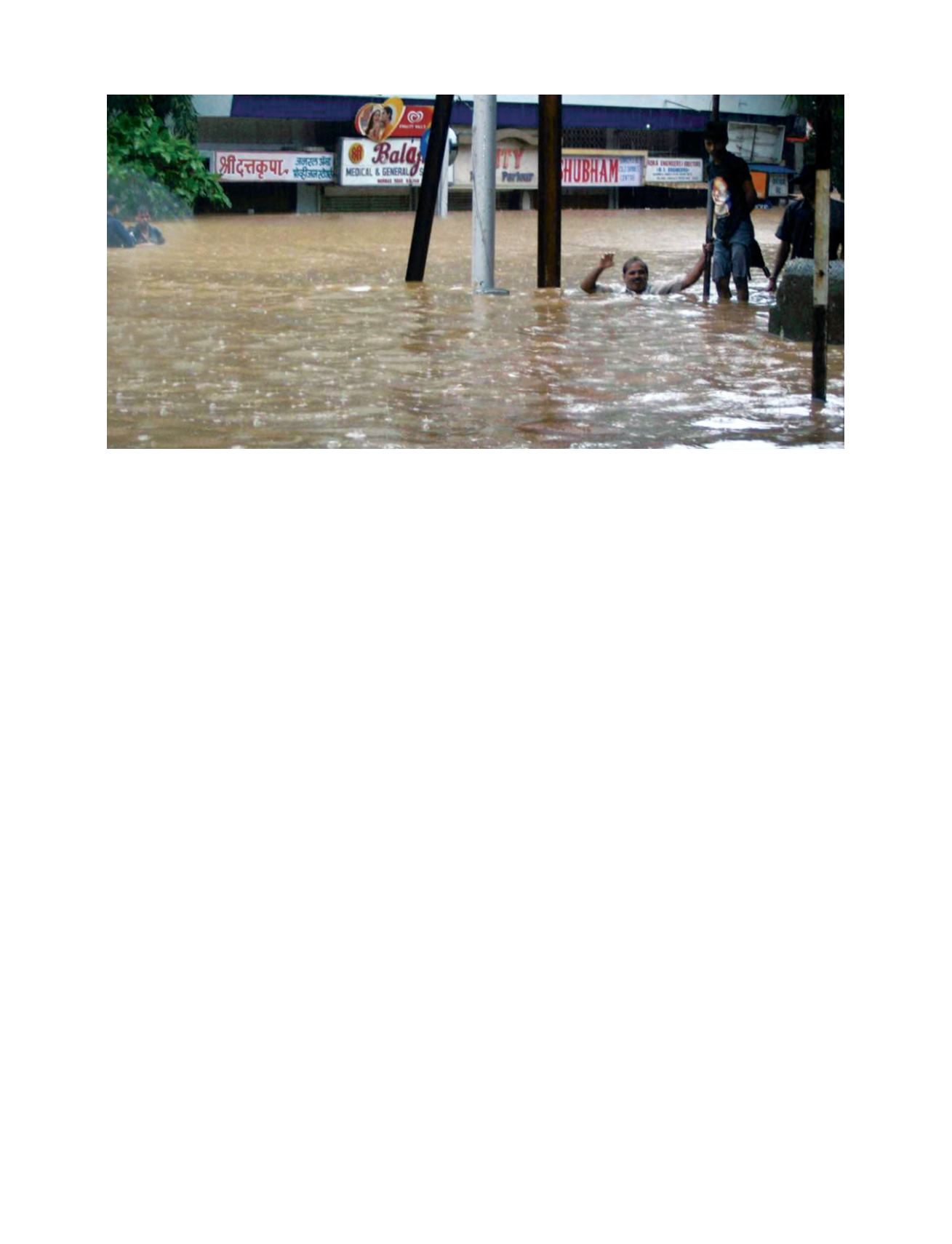
Mumbai, India after the heavy rains on 26 July 2005
Photo: Sushma Nair