



 150 / 218

[
] 148
S
OME NATURAL DISASTERS
are strongly linked to meteoro-
logical conditions, and among these forest fires play a very
important role as a major threat to vegetation-covered
areas in many parts of the world.
The impact of fires in a given region is usually evaluated by the
number of fires and the size of the burned area. Unfortunately,
there is no uniformity in these data throughout the world to
render the statistics relevant for comparison.
1
The relative impor-
tance of the problem in a given area depends both on its
dimension and frequency, and on the perceptions of local people.
Forest fires are a complex mixture of human and natural
factors. Man is quite often the originator of such fires, inter-
venes during their development, and is also impacted by them.
Overall, it is very difficult to assess precisely the relative roles
of man and nature in forest fires. We can only say that there are
aspects of forest fire in which human and social activity are
the most relevant; but there are also aspects in which nature
plays the dominant role.
Fire is part of nature and has shaped vegetation cover and
life throughout millennia. It cannot be eliminated from the
landscape without damage to biodiversity. Conversely, man has
used and continues to use fire for the management of rural and
wild spaces. Therefore it is necessary to distinguish between
controlled fires and wild fires. The latter include those events,
either natural or anthropogenic, in which fire cannot be
controlled before causing undesired damage.
The advent of technology has created the illusion that man can
dominate natural forces and overcome the laws of nature. One of
the consequences of this attitude is the illusory ideal of exclud-
ing fires from the forest altogether. We have to recognize that
even if all anthropogenic fires could be avoided, natural events
such as lightning strikes might originate fires in conditions that
are beyond the control of even the most advanced technologies.
The role of climate and meteorology
It is commonly accepted that physical factors such as topogra-
phy, vegetation cover, climate and meteorology contribute
greatly to the conditions needed for a fire to start and to spread.
Climate and topography determine to a great extent the type
of vegetation cover, its quantity and distribution.
2
Meteorological factors such as precipitation, air temperature
and humidity affect the growth of fine vegetation and deter-
mine its proliferation and dryness. The moisture content of fine
vegetation, particularly in dead plants, is strongly related to the
risk of ignition – above a certain moisture threshold it is very
difficult to ignite or maintain. Conversely, very dry fuels provide
an ideal environment for fires to start and spread. The presence
of slopes or wind can also contribute to an increase in the rate
of spread of a fire, to a point that may make its control virtually
impossible. In certain conditions including steep slopes and
canyons, the convection induced by the fire modifies the
burning conditions and thus increases its rate of spread.
3
Climate, man and forest fires
Domingos Xavier Viegas, Department of Mechanical Engineering,
University of Coimbra, Portugal
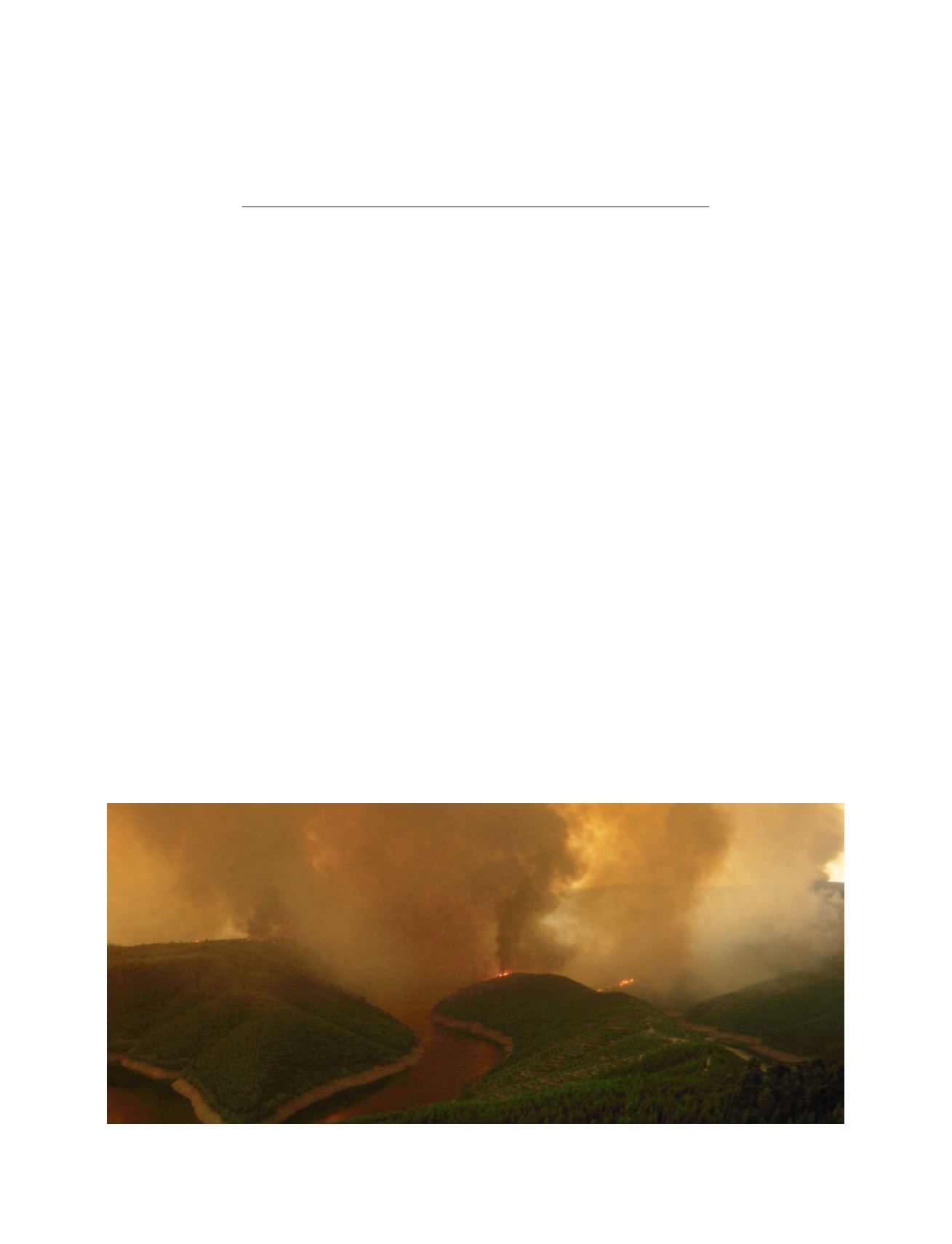
Forest fire at the borders of River Zezere in Pampilhosa da Serra, Central Portugal, 1 August 2003
Photo: Pedro Palheiro/ADAI