



 140 / 218

[
] 138
Higher temperatures coupled with increased rainfall variability
are expected to impact the type of agriculture currently practiced
in the region. For example, variability in rainfall and increased
temperatures are expected to reduce soil moisture and increase
heat stress to animals and plants, thereby reducing agricultural
productivity and increasing economic losses. Rainfall variability
is expected to lead to increased surface water runoff and reduced
infiltration and recharge of aquifers. These processes are expected
to increase the risk of severe flooding and aquifer depletion.
Several regional initiatives geared to addressing the impact of
climate change and variability on Caribbean societies have been
funded by regional and international agencies including the
World Bank, the Global Environmental Fund (GEF) and the
Canadian International Development Agency. These are
managed by regional institutions including the CARICOM
Secretariat and the Caribbean Community Climate Change
Centre (CCCCC). Regional institutions involved in climate
change activities include the University of the West Indies, the
University of Guyana, the University of Belize, and CIMH among
others. National agencies are generally integrated into regional
activities through the provision of data, expertise, and services
to support sectoral analyses at local pilot sites. Outcomes from
these studies not only benefit local agencies but also provide a
basis for further development and implementation regionally.
The first major regional initiative related to climate change
in the Caribbean was the Caribbean Planning for Adaptation
to Climate Change (CPACC) initiative, which received USD
6.5 million from GEF and operated from 1997 to 2001. The
CPACC initiative was implemented by the World Bank,
executed by the Organization of American States, and over-
seen by a Project Advisory Committee chaired by the
CARICOM Secretariat. The objectives of the CPACC initiative
were to build capacity in the Caribbean region for adaptation
to the impacts of climate change, particularly sea level rises.
These objectives were achieved through a series of vulnerabil-
ity assessments, adaptation planning exercises, and capacity
building initiatives. The CPACC initiative included:
• Design and implementation of a sea level/climate moni-
toring network
• Establishment of databases and information systems
• Inventory of coastal resources
• Formulation and application of initial adaptation policies.
Key achievements of the CPACC project were:
• Establishment of 18 sea level monitoring stations in 12
countries in the region
• An increased appreciation of climate change issues by
regional policy makers and planners, and the articulation
of regional positions on the issue
• Establishment of coral reef monitoring protocols
• Improved access to and availability of regional data on
climate change
• The articulation of climate change adaption policies and
implementation plans in eleven of the twelve participating
countries.
The CIMH was a beneficiary of the CPACC initiative as it
provided CIMH with an opportunity to enter into regional
climate change research through the provision of climatic data
for the region that extended in some cases over 100 years, and
through the sea level monitoring programme, in which CIMH
was heavily involved.
The Adaptation to Climate Change in the Caribbean (ACCC)
initiative extended the climate change activities started under
the CPACC initiative. The ACCC initiative lasted from 2001
to 2004 and received CAD3.5 million in funding from the
Canadian International Development Agency (CIDA).
Important achievements of the ACCC initiative were:
• Political endorsement and the establishment of the basis
for financial self-sustainability for the CCCCC
• Development of a set of guidelines to facilitate incorpo-
ration of climate change effects into the Environmental
Impact Assessment process
• Development of capacity building programmes
20
22
24
26
28
30
32
Year
Temperature(Deg C)
1971
1972
1973
1974
1975
1976
1977
1978
1979
1980
1981
1982
1983
1984
1985
1986
1987
1988
1989
1990
1991
1992
1993
1994
1995
1996
1997
1998
1999
2000
Tmin
Tmax
Linear Tmin
Linear Tmax
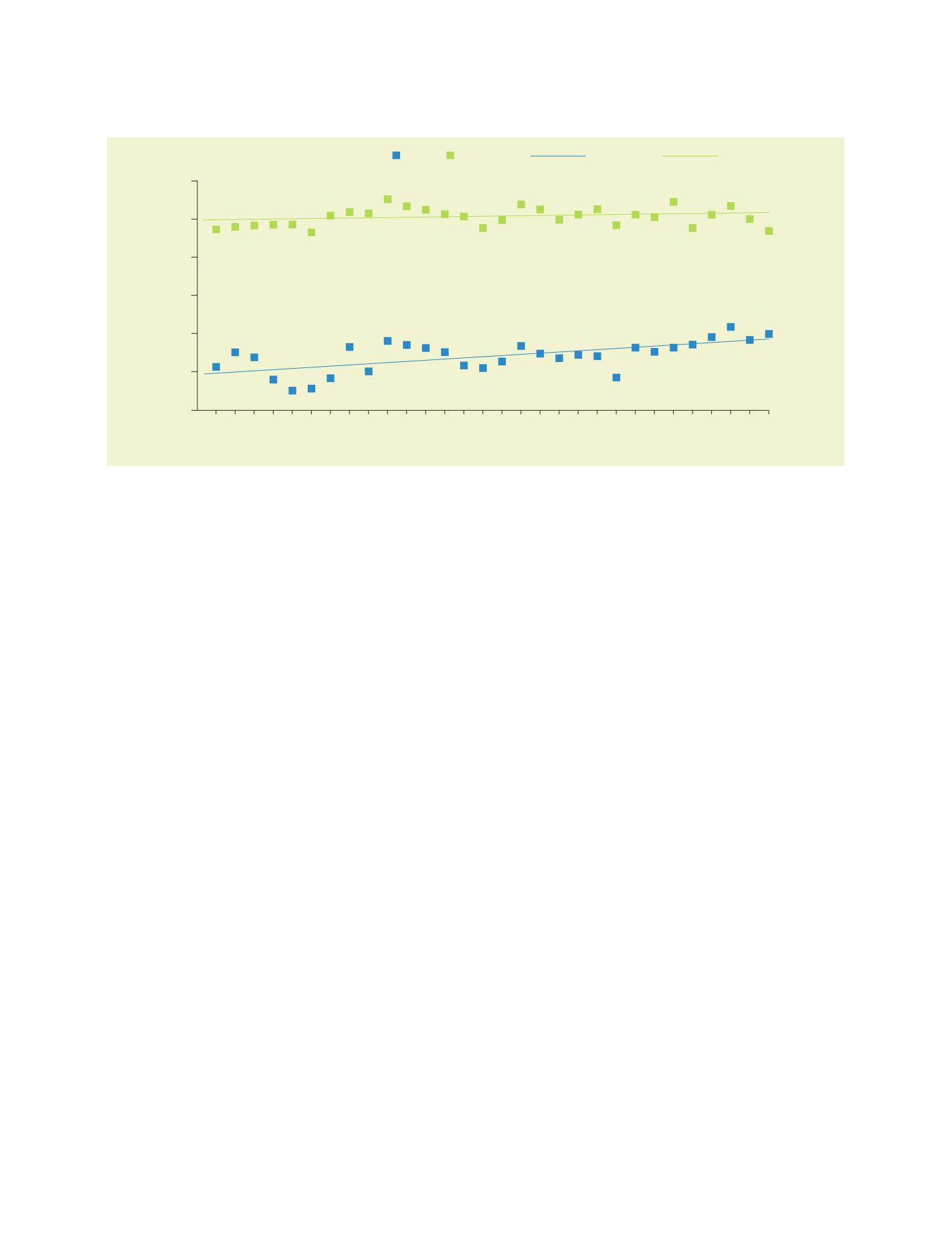
Temperature trends on Barbados during the period 1971-2000: Trends in the maximum and minimum temperatures recorded
(squares represent the measured data; solid line represents the inferred linear trend)
Source: Caribbean Institute for Meteorology and Hydrology (CIMH)