



 117 / 218

using energy-efficient appliances such as earth tunnel venting
systems, nocturnal cooling systems, or the stack effect, which
draws ambient air and cools it by convection
Intelligent lighting systems blend motion sensors, ambient
light sensors and timers to ensure that lights are switched off
when not needed. Compact fluorescent lamps and light emit-
ting diodes are used, cutting power consumption by up to 80
per cent while protecting lighting efficiency.
Washrooms are ventilated using noiseless, energy-efficient
DC and AC fans. DC fans are powered by photovoltaic panels
and run from dawn to dusk, while AC fans can be switched on
and off as needed.
External walls are built using soil-stabilised blocks, laterite
blocks and surface engineering with stone chip plastered
surfaces. This ensures that surfaces are non-erodable, need no
external paint applications, and are thermally efficient.
Green roofs or ‘sky gardens’ also contribute to the thermal
comfort of the dwellings. These provide a planting space for
every home while serving as thermal insulation for adjoining
and lower-built spaces. Each sky garden uses lightweight mulch
and coir pith instead of heavier soil, and is irrigated via a drip
method. The degree of self-sufficiency enabled by this promo-
tion of urban agriculture also helps to decrease the ‘food miles’
and encourage more organic urban agriculture.
Rubberwood which is a non-forest timber is used for door
shutters, and as flooring. Palm wood has been for external
walkway decking. We have also used compressed coir door
panels for door shutters, while bamboo composites provide
roofing for parts of the club and interior woodwork in places.
These are local resources which cost less than imported
timber and use less energy to produce, thus reducing carbon
emissions.
A centralised, district refrigeration system using an
ammonia-based chilling unit means that there are no compres-
sors in the individual refrigeration units installed in each home.
This in turn enables better management of cooling needs and
more space for storage within each fridge.
A self-sufficient and secure water supply system is also
provided, using rainwater collected from the roof and stored in
a shallow aquifier, through a system of drains, percolation pits,
trenches and wells. Trenches are shallow at ten metres, so
ground water is not depleted. Water treatment costs are
reduced via direct tapping of rooftop rainwater.
Each home also has ‘conscience meters’, monitoring electric
watts and water consumption. As the number of electrical devices
increases, so does power consumption. An electric watt meter
fitted in each home indicates the wattage used at a particular time
and thus allows users to monitor their power consumption and
introduce efficiencies. Meters on the kitchen and bathroom taps
help to monitor the volume of water used in litres.
[
] 117
How BCIL goes about its business
‘Technology’ at BCIL is not some new-fangled, modern-day electronic
wizardry. A 200-year-old traditional system of lift irrigation is as much
‘technology’ as is a microchip-based motion or temperature sensor that
brings lighting efficiency.
The key to decision-making in the organization has been a combination of
six factors:
• Cost (always relative to what you are ‘buying’)
• Aesthetics (should gain acceptance among customers)
• Function (must serve the basic purpose and not be there for
its own sake)
• Ease of execution (skills and material resources must be available within
a reasonable distance and time),
• Time (else, the organization fails as a delivery company)
• Environment (has to be resource-sensitive and/or bring social value,
or must bring domino impact of replicability and scale).
Design must recognize the ‘Four E’s’ of Ecological compatibility; Economic
efficiency; Endogeneity and Equity.
Architecture must adhere to a six-strand approach entailing integrated
management of all aspects that relate to:
• Earth (avoid bricks that employ precious topsoil and use 400 deg C
energy; use soil stabilized blocks)
• Energy (both embodied energy and active energy use on consumption,
while engineering active and passive elements on energy saving)
• Water (infrastructure approaches and plans that help communities grow
their own water; waste water management that reduces fresh water use)
• Waste (to ensure that communities of companies in an office block or of
homes in a residential enclave assume responsibility for managing the
spectrum from degradable to toxic wastes)
• Air (with passive cooling and active cooling systems that are energy-
efficient and ozone non-depleting)
• Biomass (to improve the microclimate of a land zone in a way that
reduces demands on cooling).
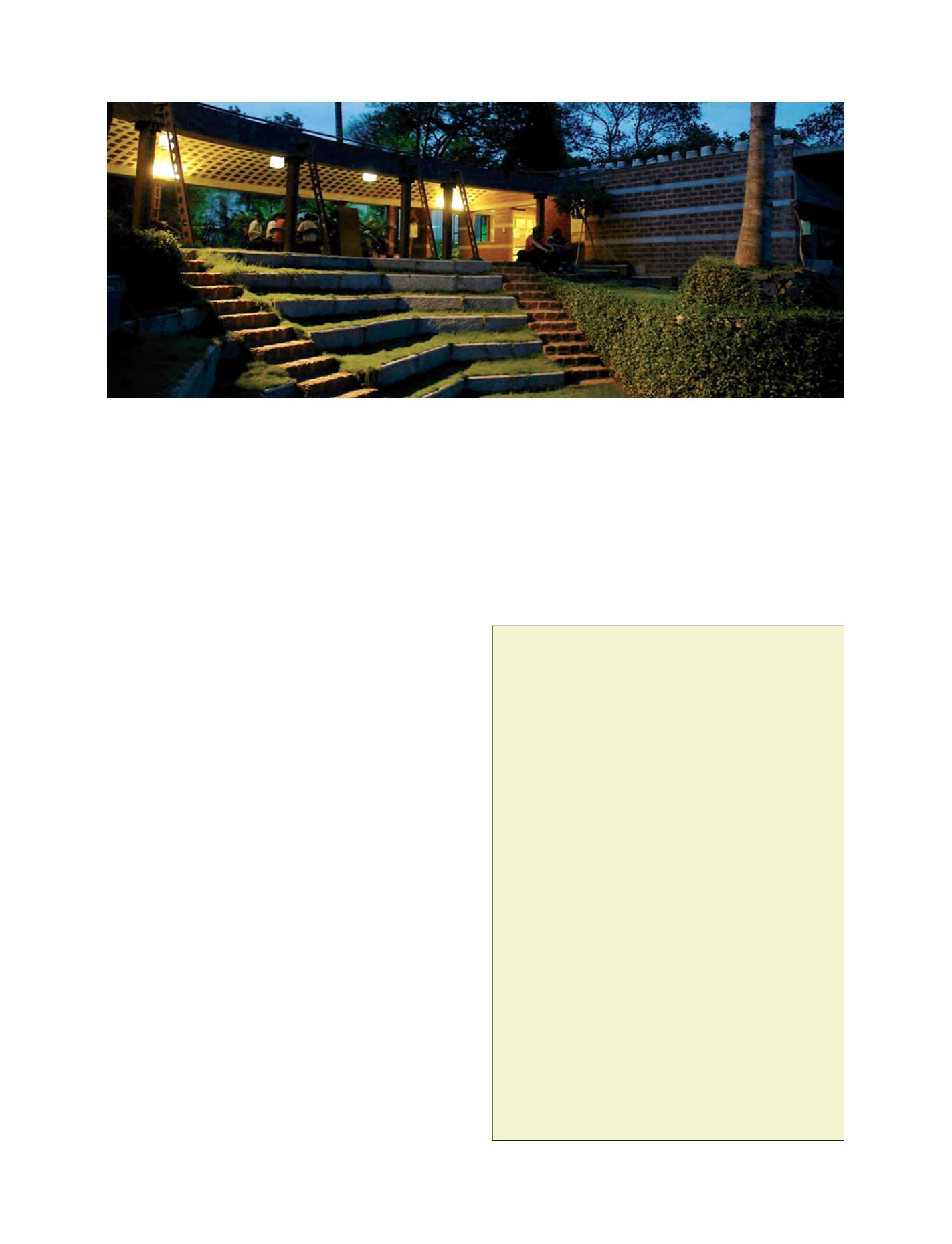
Blending aesthetics and sustainability: Club Zed, India’s first carbon-neutral residential campus that hosts 95 homes in the Silicon City of Bangalore
Photo: Harris Backer