


 40 / 210

[
] 38
A
dvancing
S
ocial
I
ntegration
and
I
ntergenerational
S
olidarity
played a major role in providing childcare services, particu-
larly in households where multiple generations cohabitate.
However, a United Nations Educational, Scientific and
Cultural Organization survey
9
in 2010 indicated that the
majority of childcare services for the 0-3 age band are only
available for select urban populations and are provided for by
for-profit commercial enterprises and in limited capacities.
There is evidence to suggest that transferring services tradi-
tionally rendered by the family to external parties is becoming
increasingly accepted. In Lebanon, for example, the decline
in fertility with the gains in schooling and employment for
women have given rise to formal and long-term care facilities,
particularly noting that 11.8 per cent of older people were
living alone in 2004.
10
Consequently, it can be observed that
social relations are changing within the Arab family, where
the patriarchal authority is increasingly challenged by the
growing and more educated youth cohort, and by Arab women
who are carving for themselves new roles given the increasing
opportunities for engagement and work within urban settings.
These changes reveal a paradigm shift on the social roles of
members of the Arab family, intrafamily relations and societal
changes within Arab communities towards empowerment of
the individual at the expense of the collective.
Such a move away from dependence on the extended family
in the provision of care will lead to an increased need for care
provided by the state, social welfare organizations or the private
sector. The complexity of this challenge is of particular concern
for slum populations and displaced people. These marginalized
groups face the dual challenge of lacking the traditional wide-
ranging extended family support and facing the new realities of
expensive housing and cost-of-living issues, as well as emerging
biases against slums and associated security risks.
One key realization that emerges from this paradigm shift
is the popular recognition of the deficit in social protection.
Arab populations continue to highlight the shortages in govern-
ment-sponsored social service delivery and social protection
platforms, particularly towards poorer segments of society.
These shortages mean that individuals continue to depend to a
degree on their families to fill the gap in care and social support.
This comes in the light of governments’ limited resources and
capacity to address the individuals’ needs and supplement care
provided by the family or the private sector for Arab families.
In a region which has witnessed a surge in conflict during the
past few years, resulting in significant population displacement
and an increased demand for care and social support, the need
for traditional family support as well as government and commu-
nity support is very high. Conflicts deprive affected populations
of many of their human rights, impact adversely on development
and the implementation of the Millennium Development Goals,
and create conditions that reverse the impact of development.
Impact of displacement on the family
It is estimated that there are over 7 million displaced persons in the
Arab world, from conflicts in Iraq, Somalia, Sudan, Yemen and, most
recently, Syria. Population displacement forces families to seek critical
and life-saving support from their extended families, as well as from
the state and from social welfare organizations. In Yemen, around
half a million people were displaced in 2011 as a result of previous
and ongoing conflicts in the country. Only a small fraction of that
population was housed in camps; the majority had to seek refuge
in slum areas of urban centres with close proximity to livelihood
opportunities. This adds an increased burden on host communities
and results in considerable tensions within the extended family and
increasing resentment over resources within the vulnerable slum
community. The Humanitarian Response Plan for Yemen appealed for
US$702 million in 2013, out of which US$39.5 million were required
for the immediate shelter needs of vulnerable displaced families.
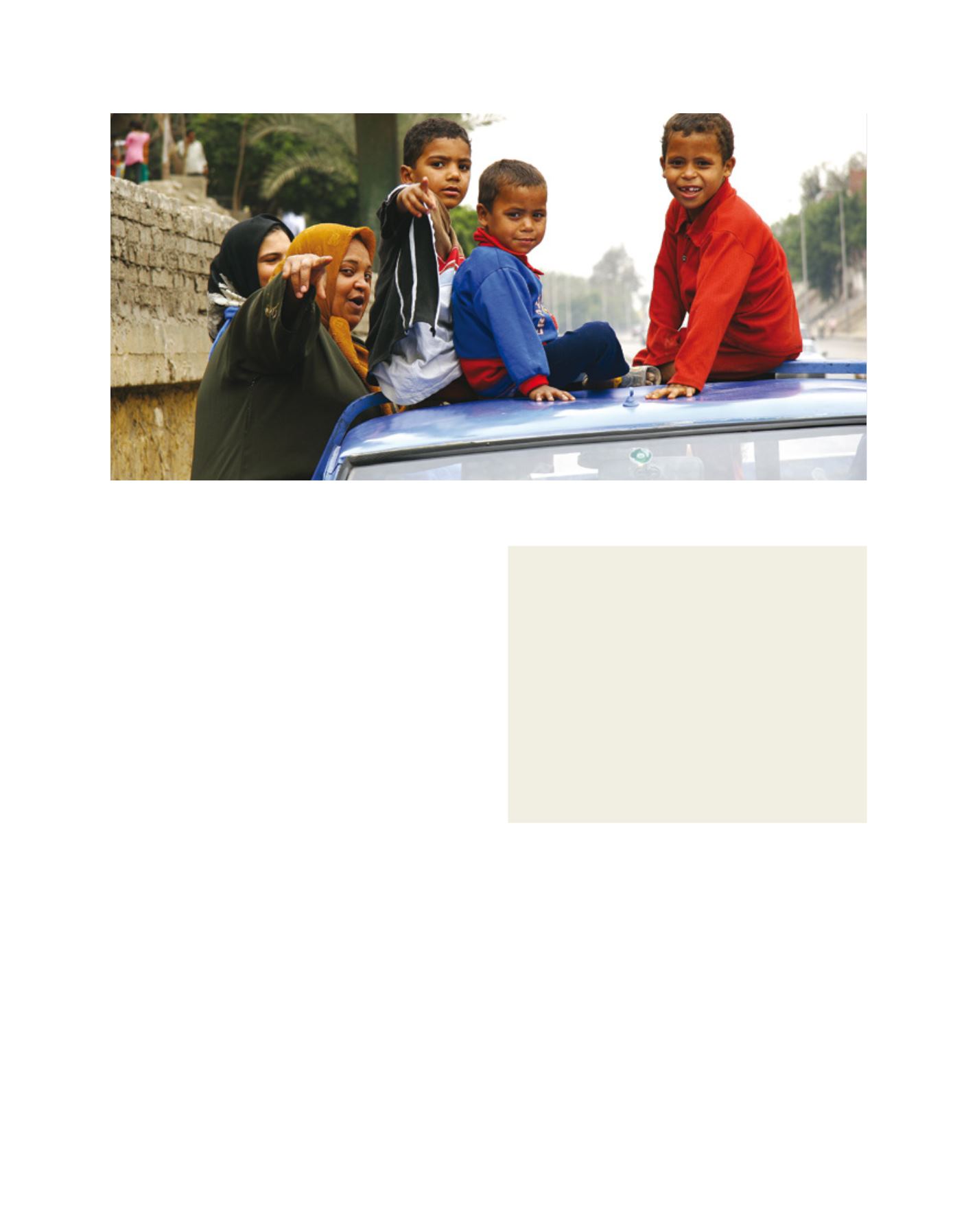
Many families in Egypt resort to living in substandard urban housing on the outskirts of cities. Commuting considerable distances to markets, livelihoods
and services becomes a necessity and in some cases a hazard for families and children
Image: Alena Yakusheva, Fotolia.com