


 39 / 210

[
] 37
A
dvancing
S
ocial
I
ntegration
and
I
ntergenerational
S
olidarity
Conflict is also a key reason behind the increase in the percent-
age of the population living in slum areas in some countries,
such as Iraq and Yemen where slums house over 50 per cent of
urban populations. Thus, slums include internally displaced
populations as well as other disadvantaged social groups. The
Iraq Housing Market Study
4
estimates that the housing needs
in six Iraqi cities could reach 1.27 million housing units over
the period of 2006-2016, notwithstanding the unique shelter
needs of the displaced populations within urban centres.
In particular, urbanization is expected to increase signifi-
cantly in Arab least developed countries (LDCs), where both
population growth and urbanization are comparatively higher.
The rates of urbanization will continue to be particularly high
in three Arab LDCs – Yemen, Sudan and Mauritania – which
raises a number of critical concerns around the well-being
of urban families in two of those countries suffering from
conflict and displacement.
With reference to the internal dynamics affecting the Arab
family, most Arab countries have experienced a number of
trends, including a decline in family size and the increas-
ing dominance of the nuclear family. Traditionally, the Arab
family is an extension of its parent clan, in which several
generations cohabitate and serve complementing functions
within the extended household. However, there have been
recent changes to this situation. For instance, the propor-
tion of nuclear families in Morocco increased from 51.5 per
cent in 1982 to 63.5 per cent in 2004, while the average size
of the Palestinian household decreased from 6.4 members
per household in 1997 to 5.9 in 2010.
5
These findings were
corroborated by another study which examined family forma-
tion in Egypt, Lebanon, Syria and Yemen, and concluded that
extended families are no longer the norm in these countries.
6
A review of the literature on the family in the Arab region
carried out by UN-ESCWA
7
shows that many Arab govern-
ments have adopted government family planning policies
which advocate for smaller and nuclear families. These policies
were coupled with several initiatives designed to modern-
ize Arab societies and improve the public’s access to social
services, including care. Several Arab countries have indeed
made progress on social development indicators, such as life
expectancy, girls’ education and reducing maternal mortality.
However, it must be noted that in LDCs, this progress has
not been as unequivocal: the United Nations Population Fund
reports that 77 per cent of maternal deaths in the Arab region
occur in Sudan, Somalia and Yemen.
8
Therefore, government policy on family planning in the
region cannot be isolated from social development policies
and programmes, where improvements in access to educa-
tion, health and welfare have supported a paradigm shift
from dependency on the family for care and support to a
shared dependency with the state. The success of many Arab
countries in improving social well-being indicators is praise-
worthy, however it must be noted that these improvements
vary by country, geographic location, and social group within
a geographic location.
Equitable access to government-sponsored care services is
not the norm in Arab countries, where institutionalized care
provision remains limited. A key example is in the area of
childcare, where traditionally the extended Arab family has
Annual growth rate (per cent) of the urban population in select Arab countries
Source: Calculations from the World Population Prospects 2012 revision and the World Urbanization Prospects 2011 revision, United Nations Department of Economic and Social Affairs
Egypt
Jordan
Morocco
Saudi Arabia
Mauritania
Sudan*
Yemen
Year
UG PG UG PG UG PG UG PG UG PG UG PG UG PG
1950
4.29 2.51 10.49 7.27 3.64 3.12 6.45 2.59 10.25 2.46 7.33 2.64 6.18 0.54
1980
2.43 2.28 5.98 3.98 4.27 2.36 7.95 5.98 7.78 2.83 6.04 3.41 6.22 3.99
2010
2.04 1.63 2.17 3.50 1.62 1.41 2.38 1.85 2.95 2.45 2.60 2.11 4.78 2.30
2040
1.59 0.81 0.85 0.98 0.43 0.40 0.85 0.62 2.43 1.63 2.47 1.60 3.15 1.01
*pre-2011 numbers include South Sudan territory, UG = Urban growth, PG = Population growth
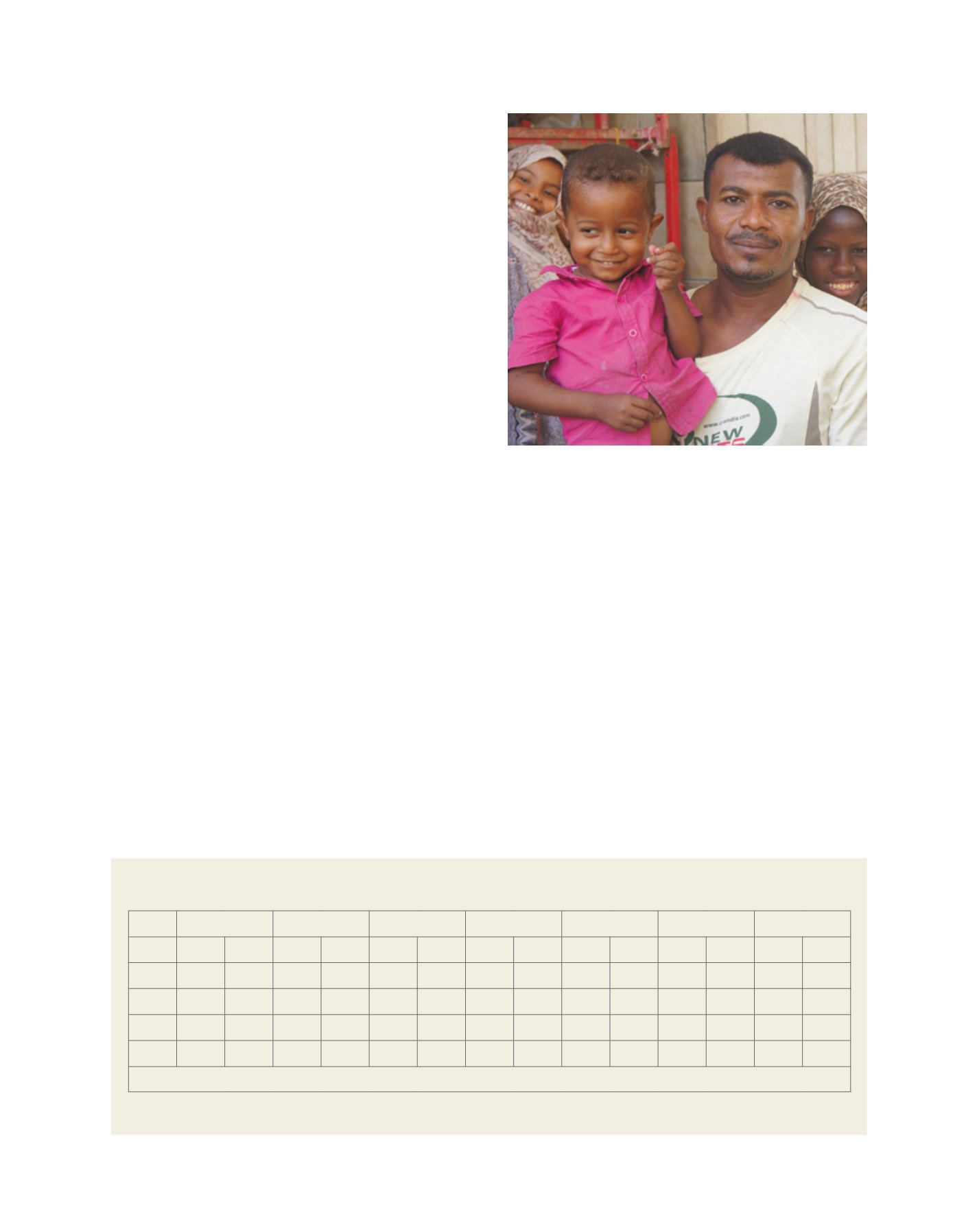
An internally displaced family housed in a public school in Aden, Yemen,
which fled armed conflict taking place in Abyan, 80 km east of Aden
Image: Khalid Sufian