


 34 / 210

[
] 32
A
dvancing
S
ocial
I
ntegration
and
I
ntergenerational
S
olidarity
zations, like the United Nations Educational, Scientific and
Cultural Organization (UNESCO) through its strategy for/
with young people, based on principles of social justice, seek
to enable not just a greater appreciation and positive recog-
nition of young people, but also to counterbalance unfair
negative representations.
Apart from any benefits to their families, community and
society, participation through civic action by young people
has been associated with a range of specific personal bene-
fits, many developed as part of their internal processing.
Young people who contribute through civic action develop
mastery (skills), generosity (including a sense of empathy),
independence (through new relationships) and belonging
(a sense of connectedness to others). It could be argued that
whereas the seeds of these four personal qualities are sown
for a young person within their early-life familial and school
contexts, it is during adolescence in particular that they
are developed and enhanced. Take, for example, a young
person who not only feels empathy but acts on it, by working
with others to stop the bullying of one of his or her peers
at school. One could argue that such positive action by the
young person comes partly from a range of values and skills
attained as part of his or her upbringing experiences and an
accompanying innate sense of social justice.
Young people benefit from the opportunity to exchange
learning with others from different cultures and countries,
most typically accessed through individualized leadership
and group citizenship projects. Through experiential learn-
ing young people not only gain insight from interaction with
peers living in other countries, but also have an opportunity
to revisit their own value system.
For young people, the experience of participating in an
international citizenship programme by simply spend-
ing time with other young people and sharing views of
family and school life, hobbies and interests, ambitions and
concerns can create mutual understanding and enhance
self-esteem. The experience can act as a reminder of the
importance of giving and receiving support within family
relationships, and can have a positive ‘quasi renaissance’
effect on a young person. More simply, when young people
travel abroad and participate in a social leadership commu-
nity exchange project, they can road-test what is important
for them in their lives through interaction with their peers.
Importantly, the evidence is that many young people who
volunteer inevitably find that in doing so they get back much
more than they give.
The 20th anniversary year of the International Year of the
Family is a good time to remind ourselves of the positive
aspects of family life for young people, but not to deny or
minimize its risks and challenges. In the main, many young
people benefit immensely from the support of their familial
ties, but additionally contribute hugely to their family and
community. We raise our children not just for their benefit
or that of our families, but for the betterment of civic society
in general. Despite hardships or adversity, young people
have value in their own right during their childhood and
adolescence, and are more than a future asset in adult life.
The Ireland Zambia Youth Leadership Exchange Programme
In 2011/12 young people from the west of Ireland and western
Zambia participated in a youth civic engagement exchange
programme. Fundraising for the project took place in Ireland and
the programme occurred in Kaoma, Zambia.
3
The project was under
the guidance of the Alan Kerins Projects, which works with local
orphanages run by the Zambia-based Presentation Sisters Order. They
partnered with Foróige, Ireland’s leading youth work organization,
which developed an international youth leadership programme in
collaboration with (and accredited by) the UNESCO Child and Family
Research Centre at the National University of Ireland, Galway.
The project evaluation found that, over a short but intense period
of activity, young people engaged in dialogue with one another,
exchanged aspects of each other’s culture, played, formed bonds of
friendship and provided a caring and supportive role. All this left a
marked insight into their own lives as well as into the resilience of
people in situations of adversity.
Strikingly, the project evaluation found a very real and deep sense
of empathy and care instilled in the young people towards the children
and young people in Kaoma. Deeply felt bonds of attachment and
friendship were forged in the period spent there, which created a
strongly expressed emotional impact on all youth and adults involved.
Another notable value attributable to the initiative is the new
awareness and appreciation generated among the youth. Only this
type of experiential hands-on learning and exchange can create
profound new insights, and in this regard the initiative was successful
in challenging and changing young people’s perspectives about their
own lives in relation to others who are less privileged. There was a
clear sense of a stronger awareness about the importance of aspects
of young people’s lives that they previously had taken for granted.
Youth developed a clearer capacity to view their lives in the broader
context of a reawakened knowledge of family support, the functionality
of school life and their engagement in local community.
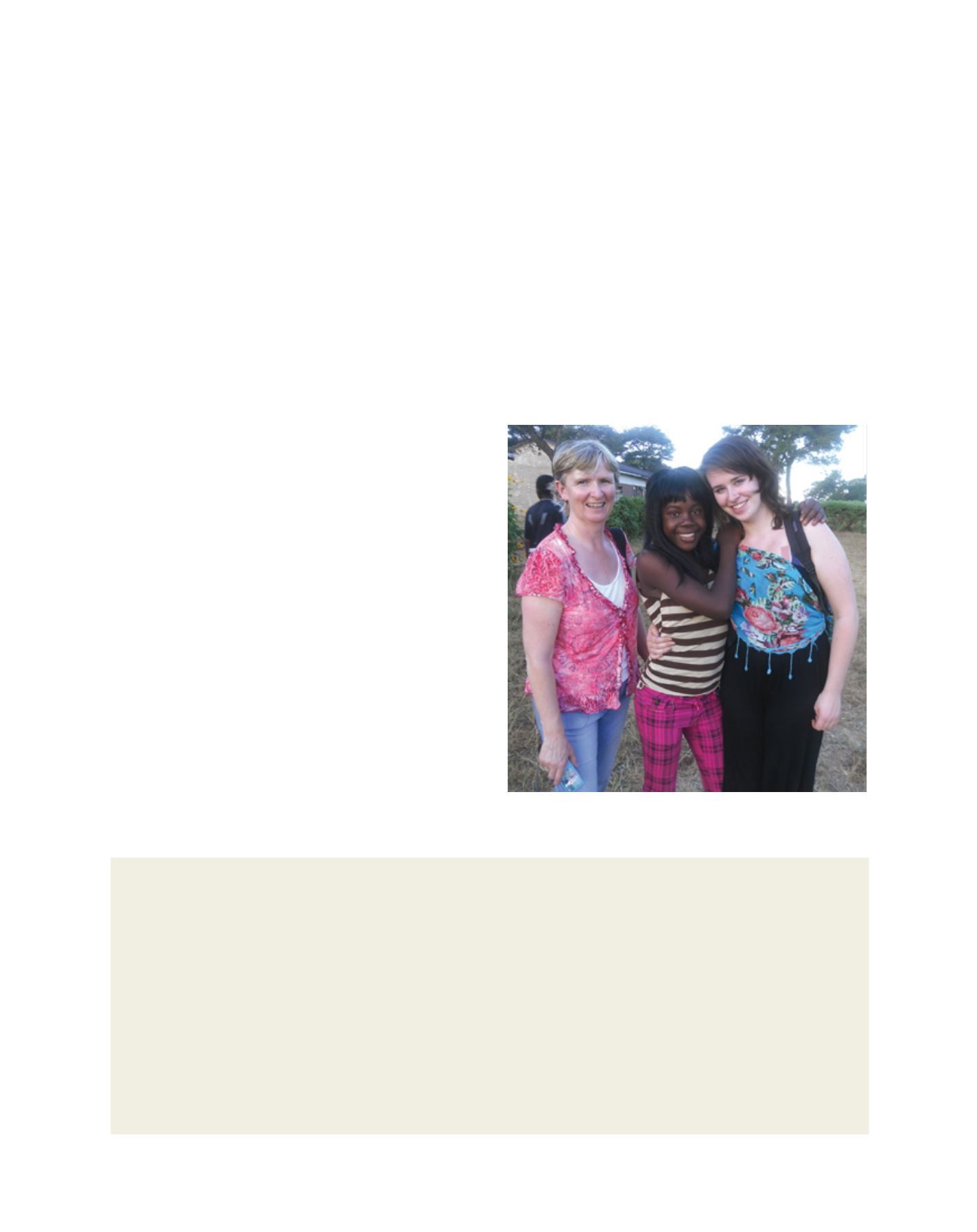
Participating in an international citizenship programme can create mutual
understanding and enhance self-esteem for young people
Image: Foróige, Ireland/Alan Kerins Projects