



 33 / 210

[
] 31
A
dvancing
S
ocial
I
ntegration
and
I
ntergenerational
S
olidarity
Apart from the importance of source, amount, type and
quality of support, help that is provided through informal
sources (unpaid) is often preferred to interventions through
formal (paid) services. This is not to say that there are not
essential situations where professionals need to intervene,
but rather to highlight the value of informal help. Informal,
positive and natural support, particularly from family, is
essential in that it is generally on call at any time, provided
outside of nine-to-five, Monday-to-Friday contexts and avail-
able throughout the year. It should also be remembered that
this is a natural function within positive familial relationships
– it is what families do anyway – and is therefore non-stig-
matizing. In practical terms, from the point of view of civic
society, informal support is very cost effective. Consider the
mere quantity of needs of the elderly, willingly and lovingly
provided by their adult children day-in, day-out in countries
around the world. If it were incumbent on each member state
to provide a similar service, the costs would be astronomical
and probably unsustainable to most if not all economies.
While the role of parents in the rearing of their chil-
dren and adolescents is rightfully noted as vital and the
importance of teachers as educators is well known, the part
played by other family members and community volunteers
also deserves some recognition. Brothers and sisters, grand-
parents, aunts, uncles and collegial cousins are important
sources of help to young people. Similarly, voluntary
youth workers, church groups, sporting organizations and
musical allies all have a role to play in the provision of
family support for children and youth.
The association between positive life experiences gathered
during young people’s formative years and their willingness
to contribute and participate in civic society has been well
established. However, the rhetoric of young people being
an investment for the future and over-simplification of their
right to be heard and participate, cited in article 12 of the
United Nations Convention on the Rights of the Child, needs
challenging and elaborating.
Firstly, in part based on the value systems they receive at
home, in school and from their community, many children
and youth contribute strongly in the present in consistent
ways. Think of young carers who are supporting family
members with a disability, or consider how often youth
volunteers contribute positively to society through commu-
nity actions ranging from local environmental clean-ups
to intergenerational initiatives to support older people.
Very often, civic engagement by young people is labelled
narrowly as political rather social (altruistic), moral
(demonstrable empathy) or economic (working to support
other family members).
Secondly, while there is now more awareness of the need
to value such participation by young people, this is usually
accompanied by advocacy and a co-request to listen and hear
their voices. Equally important, however, is the need not just
to listen and hear but also to act on what young people are
saying. For example, the World Assembly of Youth works
to ensure positive action with and for young people as well
as making sure they receive adequate recognition. Despite
what are often negative images of young people in the media,
portrayed as disruptive and destructive, the vast majority of
young people have insight, contribute very positively and,
to some extent, are unsung heroes in communities. Even
at a more basic level it is important to remember that most
young people do well and of those who have difficulty, many
demonstrate resilience, either growing out of their prob-
lems or overcoming their issues – typically with strong and
consistent support from family and friends. Global organi-
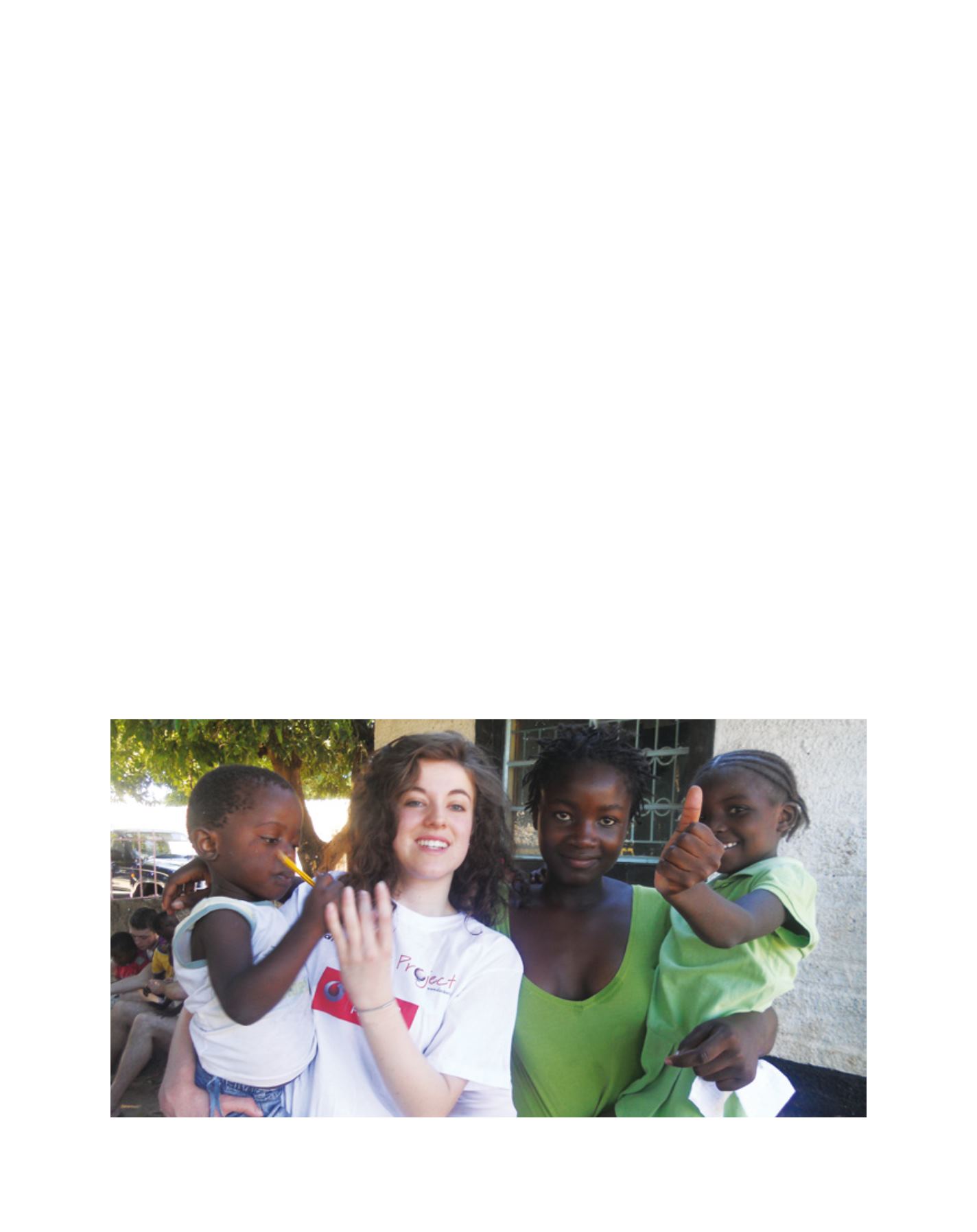
Many young people contribute strongly and consistently by supporting family members or volunteering to take part in community actions
Image: Foróige, Ireland/Alan Kerins Projects